
Contents
- 🎵 Origins & History
- ⚙️ How It Works
- 📊 Key Facts & Numbers
- 👥 Key People & Organizations
- 🌍 Cultural Impact & Influence
- ⚡ Current State & Latest Developments
- 🤔 Controversies & Debates
- 🔮 Future Outlook & Predictions
- 💡 Practical Applications
- 📚 Related Topics & Deeper Reading
- Frequently Asked Questions
- References
- Related Topics
Overview
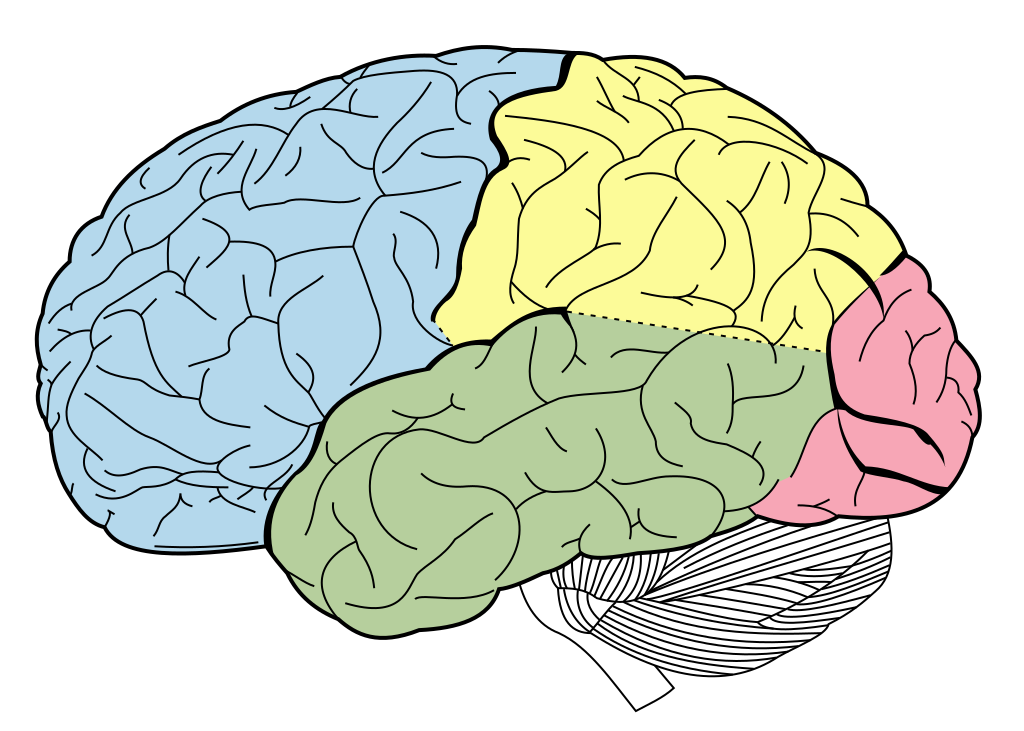
The temporal lobe is a vital component of the cerebral cortex, playing a crucial role in processing sensory input, visual memory, language comprehension, and emotion association. Located beneath the lateral fissure on both cerebral hemispheres, the temporal lobe is responsible for integrating sensory information from various sources, enabling us to understand and interpret the world around us. With its intricate structure and complex functions, the temporal lobe has been the subject of extensive research, shedding light on its significance in cognitive processes, neurological disorders, and overall brain function. As our understanding of the temporal lobe continues to evolve, its importance in maintaining healthy brain function and preventing neurological disorders becomes increasingly evident. The temporal lobe's role in processing auditory information, including speech and music, has been extensively studied, with notable researchers like David Peretz and Isabelle Peretz contributing to our understanding of its functions. Furthermore, the temporal lobe's involvement in emotion regulation and memory formation has been explored in studies on post-traumatic stress disorder and Alzheimer's disease.
🎵 Origins & History
The temporal lobe has a rich history, with early studies dating back to the 19th century. Researchers like Pierre Paul Broca and Carl Wernicke laid the foundation for our understanding of the temporal lobe's role in language processing. The term 'temporal' refers to the head's temples, where the lobe is located. Over the years, our understanding of the temporal lobe has expanded, with advancements in neuroimaging techniques like functional magnetic resonance imaging (fMRI) and electroencephalography (EEG). These technologies have enabled researchers to study the temporal lobe in greater detail, revealing its intricate structure and complex functions.
⚙️ How It Works
The temporal lobe plays a critical role in processing sensory input, including visual, auditory, and tactile information. It is involved in the retention of visual memory, language comprehension, and emotion association. The temporal lobe is divided into several sub-regions, each with distinct functions. For example, the hippocampus is responsible for forming new memories, while the amygdala processes emotions. The temporal lobe's functions are closely linked to those of other brain regions, including the prefrontal cortex and the parietal lobe. Researchers like Eric Kandel have made significant contributions to our understanding of the temporal lobe's functions, including its role in memory formation and learning.
📊 Key Facts & Numbers
Key facts about the temporal lobe include its location beneath the lateral fissure on both cerebral hemispheres, its involvement in processing sensory input, and its role in language comprehension and emotion association. The temporal lobe is also responsible for processing auditory information, including speech and music. Studies have shown that the temporal lobe is active when we listen to music, with areas like the planum temporale and the primary auditory cortex playing critical roles. The temporal lobe's functions are also closely linked to those of other brain regions, including the basal ganglia and the cerebellum. According to the National Institute of Neurological Disorders and Stroke, the temporal lobe is involved in a range of neurological disorders, including epilepsy and Alzheimer's disease.
👥 Key People & Organizations
Key people and organizations involved in temporal lobe research include neuroscientists like Vittorio Gallese and Chris Frith, who have made significant contributions to our understanding of the temporal lobe's functions. Organizations like the National Institutes of Health and the Wellcome Trust have provided funding for research on the temporal lobe, enabling scientists to explore its functions and significance. The American Academy of Neurology and the International Brain Research Organization have also played important roles in promoting research on the temporal lobe and its functions.
🌍 Cultural Impact & Influence
The temporal lobe has had a significant cultural impact, with its functions and significance influencing fields like psychology, neuroscience, and philosophy. The temporal lobe's role in processing sensory information and forming memories has been explored in literature and art, with works like Marcel Proust's 'In Search of Lost Time' and Salvador Dali's 'The Persistence of Memory' reflecting its influence. The temporal lobe's functions have also been referenced in popular culture, with TV shows like Westworld and Black Mirror exploring its significance in the context of artificial intelligence and memory manipulation.
⚡ Current State & Latest Developments
Current research on the temporal lobe is focused on understanding its functions and significance in greater detail. Studies are exploring the temporal lobe's role in neurological disorders like Parkinson's disease and Huntington's disease, as well as its involvement in cognitive processes like attention and perception. The development of new neuroimaging techniques like diffusion tensor imaging (DTI) and magnetic resonance spectroscopy (MRS) is enabling researchers to study the temporal lobe in greater detail, revealing its intricate structure and complex functions. According to a study published in the journal Nature Neuroscience, the temporal lobe plays a critical role in the formation of memories, with the hippocampus and the entorhinal cortex working together to process and store sensory information.
🤔 Controversies & Debates
Controversies and debates surrounding the temporal lobe include its role in neurological disorders like epilepsy and Alzheimer's disease. Some researchers argue that the temporal lobe is a critical component of the brain's default mode network, which is involved in self-referential thinking and mind-wandering. Others propose that the temporal lobe plays a key role in the formation of consciousness, with its functions enabling us to perceive and interpret the world around us. The temporal lobe's functions are also closely linked to those of other brain regions, including the prefrontal cortex and the parietal lobe.
🔮 Future Outlook & Predictions
The future outlook for temporal lobe research is promising, with advancements in neuroimaging techniques and computational modeling enabling researchers to study the temporal lobe in greater detail. The development of new treatments for neurological disorders like epilepsy and Alzheimer's disease is also expected to benefit from a greater understanding of the temporal lobe's functions. According to a report by the World Health Organization, the temporal lobe is a critical component of the brain's cognitive systems, and its functions are essential for maintaining healthy brain function. As our understanding of the temporal lobe continues to evolve, its significance in cognitive processes, neurological disorders, and overall brain function is likely to become increasingly evident.
💡 Practical Applications
Practical applications of temporal lobe research include the development of new treatments for neurological disorders like epilepsy and Alzheimer's disease. The temporal lobe's functions are also closely linked to those of other brain regions, including the basal ganglia and the cerebellum. Researchers are exploring the use of transcranial magnetic stimulation (TMS) and transcranial direct current stimulation (tDCS) to modulate temporal lobe activity, with potential applications in the treatment of neurological disorders. The temporal lobe's role in processing sensory information and forming memories has also been explored in the context of neuroplasticity and brain-computer interfaces.
Key Facts
- Year
- 2010
- Origin
- The temporal lobe is located in the cerebral cortex of the brain
- Category
- mental-health
- Type
- concept
Frequently Asked Questions
What is the temporal lobe?
The temporal lobe is a component of the cerebral cortex, involved in processing sensory input, language comprehension, and emotion association. It is located beneath the lateral fissure on both cerebral hemispheres of the brain. The temporal lobe plays a critical role in the formation of memories, with the hippocampus and the entorhinal cortex working together to process and store sensory information. According to the National Institute of Neurological Disorders and Stroke, the temporal lobe is involved in a range of neurological disorders, including epilepsy and Alzheimer's disease.
What are the functions of the temporal lobe?
The temporal lobe is involved in processing sensory input, including visual, auditory, and tactile information. It plays a critical role in language comprehension and emotion association, and is divided into several sub-regions, each with distinct functions. The temporal lobe's functions are closely linked to those of other brain regions, including the prefrontal cortex and the parietal lobe. Researchers like Eric Kandel have made significant contributions to our understanding of the temporal lobe's functions, including its role in memory formation and learning.
What is the significance of the temporal lobe in neurological disorders?
The temporal lobe is involved in a range of neurological disorders, including epilepsy and Alzheimer's disease. Its functions are closely linked to those of other brain regions, including the basal ganglia and the cerebellum. Researchers are exploring the use of transcranial magnetic stimulation (TMS) and transcranial direct current stimulation (tDCS) to modulate temporal lobe activity, with potential applications in the treatment of neurological disorders. According to a study published in the journal Nature Neuroscience, the temporal lobe plays a critical role in the formation of memories, with the hippocampus and the entorhinal cortex working together to process and store sensory information.
How does the temporal lobe process sensory information?
The temporal lobe processes sensory information through a network of interconnected regions, including the primary auditory cortex and the planum temporale. It is involved in the retention of visual memory, language comprehension, and emotion association. The temporal lobe's functions are closely linked to those of other brain regions, including the prefrontal cortex and the parietal lobe. Researchers like Giulio Tononi and Christof Koch have made significant contributions to our understanding of the temporal lobe's functions, including its role in consciousness and integrated information theory.
What are the potential applications of temporal lobe research?
The potential applications of temporal lobe research include the development of new treatments for neurological disorders like epilepsy and Alzheimer's disease. The temporal lobe's functions are also closely linked to those of other brain regions, including the basal ganglia and the cerebellum. Researchers are exploring the use of transcranial magnetic stimulation (TMS) and transcranial direct current stimulation (tDCS) to modulate temporal lobe activity, with potential applications in the treatment of neurological disorders. According to a report by the World Health Organization, the temporal lobe is a critical component of the brain's cognitive systems, and its functions are essential for maintaining healthy brain function.
How does the temporal lobe contribute to our understanding of consciousness?
The temporal lobe plays a critical role in our understanding of consciousness, with its functions enabling us to perceive and interpret the world around us. The temporal lobe's functions are closely linked to those of other brain regions, including the prefrontal cortex and the parietal lobe. Researchers like Giulio Tononi and Christof Koch have made significant contributions to our understanding of the temporal lobe's functions, including its role in consciousness and integrated information theory.
What is the relationship between the temporal lobe and other brain regions?
The temporal lobe's functions are closely linked to those of other brain regions, including the prefrontal cortex, the parietal lobe, the basal ganglia, and the cerebellum. The temporal lobe is involved in the retention of visual memory, language comprehension, and emotion association, and its functions are essential for maintaining healthy brain function. According to a study published in the journal Nature Neuroscience, the temporal lobe plays a critical role in the formation of memories, with the hippocampus and the entorhinal cortex working together to process and store sensory information.
How does the temporal lobe process auditory information?
The temporal lobe processes auditory information through a network of interconnected regions, including the primary auditory cortex and the planum temporale. The temporal lobe's functions are closely linked to those of other brain regions, including the prefrontal cortex and the parietal lobe. Researchers like David Peretz and Isabelle Peretz have made significant contributions to our understanding of the temporal lobe's functions, including its role in music perception and speech processing.