
Contents
- 🔍 Introduction to Diffusion Tensor Imaging
- 💡 Principles of Diffusion-Weighted Magnetic Resonance Imaging
- 🧠 Mapping White Matter Tractography in the Brain
- 📊 Analyzing Molecular Diffusion in Biological Tissues
- 🔬 Applications of Diffusion Tensor Imaging in Neuroscience
- 👥 Key Players in the Development of DTI
- 📈 Future Directions and Advancements in DTI
- 💻 Computational Models and Software for DTI
- 🤝 Relationships Between DTI and Other Neuroimaging Techniques
- 📊 Controversies and Limitations of DTI
- 📚 Conclusion and Future Prospects
- Frequently Asked Questions
- Related Topics
Overview
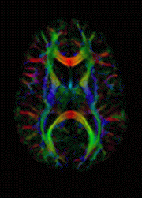
Diffusion tensor imaging (DTI) is a non-invasive neuroimaging technique that allows researchers to map the brain's hidden networks, providing valuable insights into the organization and function of white matter tracts. Diffusion-weighted magnetic resonance imaging is the foundation of DTI, using specific MRI sequences and software to generate images that reflect the diffusion of water molecules in biological tissues. This technique has been used extensively to study white matter tractography in the brain, enabling researchers to visualize and analyze the complex network of nerve fibers that underlie cognitive and motor functions. For example, DTI has been used to study neuroplasticity and neurodevelopment in the brain. The development of DTI has been influenced by the work of pioneers in the field, including Peter Basser and David Le Bihan.
💡 Principles of Diffusion-Weighted Magnetic Resonance Imaging
The principles of diffusion-weighted magnetic resonance imaging are based on the idea that molecular diffusion in tissues is not random, but rather reflects interactions with various obstacles, such as macromolecules, fibers, and membranes. By analyzing the diffusion patterns of water molecules, researchers can gain insights into the microscopic details of tissue architecture, either in a normal or diseased state. Magnetic resonance imaging (MRI) is a crucial tool in this process, providing high-resolution images of the brain and other organs. The development of diffusion tensor imaging (DTI) has built upon this foundation, enabling researchers to map white matter tracts and study the brain's connectivity. DTI has been used to study various neurological and psychiatric disorders, including Alzheimer's disease and schizophrenia.
🧠 Mapping White Matter Tractography in the Brain
Mapping white matter tractography in the brain is a key application of DTI, allowing researchers to visualize and analyze the complex network of nerve fibers that underlie cognitive and motor functions. By using DTI to study white matter tracts, researchers can gain insights into the organization and function of the brain's connectivity, which is essential for understanding various neurological and psychiatric disorders. For example, DTI has been used to study stroke and traumatic brain injury, providing valuable information for the development of novel therapeutic strategies. The use of DTI in neurology and psychiatry has the potential to revolutionize our understanding of brain function and behavior. DTI has also been used to study neurodegenerative diseases, such as Parkinson's disease and Huntington's disease.
📊 Analyzing Molecular Diffusion in Biological Tissues
Analyzing molecular diffusion in biological tissues is a critical aspect of DTI, as it allows researchers to gain insights into the microscopic details of tissue architecture. By using diffusion-weighted magnetic resonance imaging, researchers can study the diffusion patterns of water molecules in various tissues, including the brain, and gain a better understanding of the underlying biology. This information can be used to develop novel diagnostic and therapeutic strategies for various diseases, including cancer and neurodegenerative diseases. The use of DTI in oncology has the potential to improve our understanding of tumor biology and behavior. DTI has also been used to study inflammation and infection, providing valuable information for the development of novel therapeutic strategies.
🔬 Applications of Diffusion Tensor Imaging in Neuroscience
The applications of DTI in neuroscience are diverse and rapidly expanding, with potential uses in the diagnosis and treatment of various neurological and psychiatric disorders. For example, DTI has been used to study autism spectrum disorder and attention deficit hyperactivity disorder, providing valuable insights into the underlying biology of these conditions. The use of DTI in clinical neurology has the potential to improve our understanding of brain function and behavior, and to develop novel therapeutic strategies for various diseases. DTI has also been used to study neuroplasticity and neurodevelopment, providing valuable information for the development of novel therapeutic strategies. The development of DTI has been influenced by the work of pioneers in the field, including Marcus Raichle and Sebastian Seung.
👥 Key Players in the Development of DTI
The development of DTI has been influenced by the work of several key players in the field, including Peter Basser and David Le Bihan. These researchers have made significant contributions to the development of DTI, including the creation of novel MRI sequences and software for analyzing diffusion tensor data. The work of these pioneers has paved the way for the widespread adoption of DTI in neuroscience and other fields, and has enabled researchers to gain a better understanding of the brain's hidden networks. DTI has been used to study various neurological and psychiatric disorders, including Alzheimer's disease and schizophrenia. The use of DTI in neurology and psychiatry has the potential to revolutionize our understanding of brain function and behavior.
📈 Future Directions and Advancements in DTI
The future directions and advancements in DTI are likely to be shaped by ongoing research and technological developments in the field. For example, the development of novel MRI sequences and software for analyzing diffusion tensor data is likely to improve the resolution and accuracy of DTI, enabling researchers to gain a better understanding of the brain's hidden networks. The use of DTI in clinical neurology is also likely to expand, with potential applications in the diagnosis and treatment of various neurological and psychiatric disorders. DTI has been used to study neuroplasticity and neurodevelopment, providing valuable information for the development of novel therapeutic strategies. The development of DTI has been influenced by the work of pioneers in the field, including Marcus Raichle and Sebastian Seung.
💻 Computational Models and Software for DTI
The computational models and software used in DTI are critical for analyzing and interpreting diffusion tensor data. These models and software enable researchers to visualize and analyze the complex network of nerve fibers that underlie cognitive and motor functions, and to gain insights into the organization and function of the brain's connectivity. For example, fiber tracking algorithms are used to reconstruct white matter tracts from diffusion tensor data, providing valuable information for the development of novel therapeutic strategies. The use of DTI in neurology and psychiatry has the potential to revolutionize our understanding of brain function and behavior. DTI has been used to study various neurological and psychiatric disorders, including Alzheimer's disease and schizophrenia.
🤝 Relationships Between DTI and Other Neuroimaging Techniques
The relationships between DTI and other neuroimaging techniques, such as functional magnetic resonance imaging (fMRI) and meg, are complex and multifaceted. These techniques provide complementary information about brain function and behavior, and can be used in combination with DTI to gain a more comprehensive understanding of the brain's hidden networks. For example, DTI can be used to study the structural connectivity of the brain, while fMRI can be used to study functional connectivity. The use of DTI in clinical neurology has the potential to improve our understanding of brain function and behavior, and to develop novel therapeutic strategies for various diseases. DTI has been used to study neuroplasticity and neurodevelopment, providing valuable information for the development of novel therapeutic strategies.
📊 Controversies and Limitations of DTI
The controversies and limitations of DTI are significant, and include concerns about the accuracy and reliability of diffusion tensor data. For example, DTI is sensitive to various artifacts and biases, including motion artifacts and eddy currents. Additionally, the interpretation of diffusion tensor data can be complex and challenging, requiring specialized expertise and software. Despite these limitations, DTI remains a powerful tool for studying the brain's hidden networks, and has the potential to revolutionize our understanding of brain function and behavior. DTI has been used to study various neurological and psychiatric disorders, including Alzheimer's disease and schizophrenia. The development of DTI has been influenced by the work of pioneers in the field, including Peter Basser and David Le Bihan.
📚 Conclusion and Future Prospects
In conclusion, DTI is a powerful tool for studying the brain's hidden networks, providing valuable insights into the organization and function of white matter tracts. The applications of DTI in neuroscience are diverse and rapidly expanding, with potential uses in the diagnosis and treatment of various neurological and psychiatric disorders. However, the controversies and limitations of DTI must be carefully considered, and ongoing research and technological developments are needed to improve the accuracy and reliability of diffusion tensor data. The use of DTI in clinical neurology has the potential to improve our understanding of brain function and behavior, and to develop novel therapeutic strategies for various diseases. DTI has been used to study neuroplasticity and neurodevelopment, providing valuable information for the development of novel therapeutic strategies.
Key Facts
- Year
- 1994
- Origin
- National Institutes of Health (NIH), USA
- Category
- Neuroscience
- Type
- Medical Imaging Technique
Frequently Asked Questions
What is diffusion tensor imaging (DTI)?
DTI is a non-invasive neuroimaging technique that allows researchers to map the brain's hidden networks, providing valuable insights into the organization and function of white matter tracts. DTI is based on the principle of diffusion-weighted magnetic resonance imaging, which uses specific MRI sequences and software to generate images that reflect the diffusion of water molecules in biological tissues. The development of DTI has been influenced by the work of pioneers in the field, including Peter Basser and David Le Bihan. DTI has been used to study various neurological and psychiatric disorders, including Alzheimer's disease and schizophrenia.
What are the applications of DTI in neuroscience?
The applications of DTI in neuroscience are diverse and rapidly expanding, with potential uses in the diagnosis and treatment of various neurological and psychiatric disorders. For example, DTI has been used to study autism spectrum disorder and attention deficit hyperactivity disorder, providing valuable insights into the underlying biology of these conditions. DTI has also been used to study neuroplasticity and neurodevelopment, providing valuable information for the development of novel therapeutic strategies. The use of DTI in clinical neurology has the potential to improve our understanding of brain function and behavior, and to develop novel therapeutic strategies for various diseases.
What are the limitations of DTI?
The limitations of DTI are significant, and include concerns about the accuracy and reliability of diffusion tensor data. For example, DTI is sensitive to various artifacts and biases, including motion artifacts and eddy currents. Additionally, the interpretation of diffusion tensor data can be complex and challenging, requiring specialized expertise and software. Despite these limitations, DTI remains a powerful tool for studying the brain's hidden networks, and has the potential to revolutionize our understanding of brain function and behavior. DTI has been used to study various neurological and psychiatric disorders, including Alzheimer's disease and schizophrenia.
How does DTI relate to other neuroimaging techniques?
The relationships between DTI and other neuroimaging techniques, such as functional magnetic resonance imaging (fMRI) and meg, are complex and multifaceted. These techniques provide complementary information about brain function and behavior, and can be used in combination with DTI to gain a more comprehensive understanding of the brain's hidden networks. For example, DTI can be used to study the structural connectivity of the brain, while fMRI can be used to study functional connectivity. The use of DTI in clinical neurology has the potential to improve our understanding of brain function and behavior, and to develop novel therapeutic strategies for various diseases.
What is the future of DTI in neuroscience?
The future of DTI in neuroscience is likely to be shaped by ongoing research and technological developments in the field. For example, the development of novel MRI sequences and software for analyzing diffusion tensor data is likely to improve the resolution and accuracy of DTI, enabling researchers to gain a better understanding of the brain's hidden networks. The use of DTI in clinical neurology is also likely to expand, with potential applications in the diagnosis and treatment of various neurological and psychiatric disorders. DTI has been used to study neuroplasticity and neurodevelopment, providing valuable information for the development of novel therapeutic strategies. The development of DTI has been influenced by the work of pioneers in the field, including Marcus Raichle and Sebastian Seung.