
Contents
- 🎯 Introduction To Rational Drug Design
- 🔬 The Science Behind Rational Drug Design
- 📊 Key Statistics And Market Trends
- 👥 Key Players And Organizations
- 🌎 Global Impact And Future Directions
- ⚖️ Regulatory Framework And Challenges
- 🤝 Collaborations And Partnerships
- 📈 Future Outlook And Predictions
- 📊 Practical Applications And Case Studies
- 📚 Related Topics And Further Reading
- Frequently Asked Questions
- References
- Related Topics
Overview
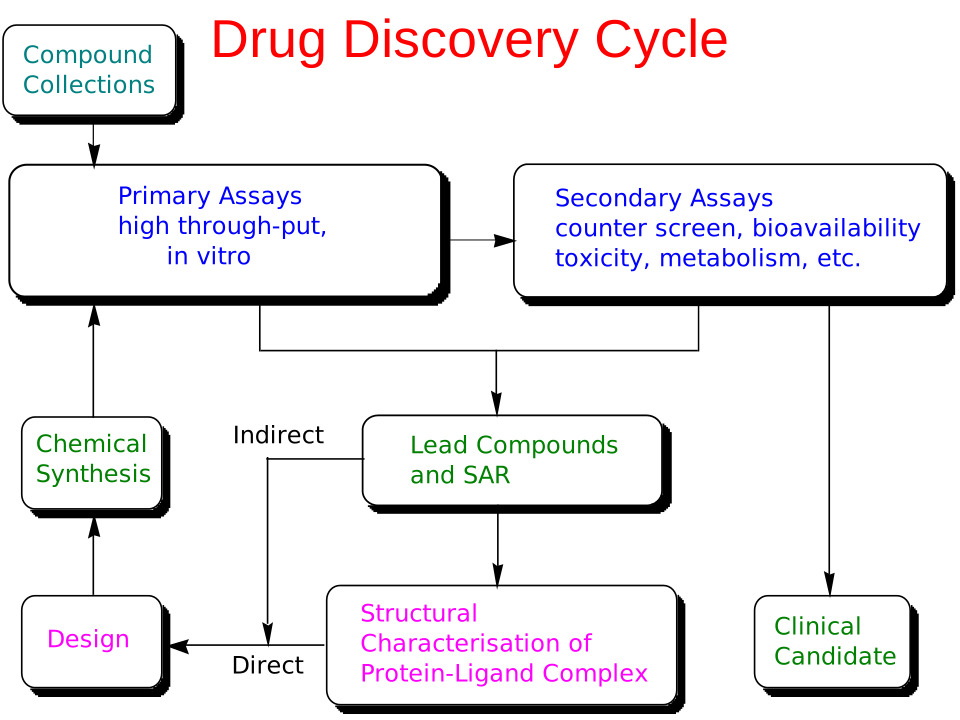
Rational drug design is the process of discovering new medications based on the knowledge of a biological target, such as a protein or enzyme. This approach involves designing molecules that are complementary in shape and charge to the target, allowing them to bind and interact with it. By understanding the three-dimensional structure of the target, researchers can use computer modeling techniques to design and optimize potential drugs. This method has led to the development of numerous medications, including small molecules and biopharmaceuticals like therapeutic antibodies. With the help of National Institutes of Health and Food and Drug Administration, rational drug design has become a crucial aspect of modern pharmacology. The use of artificial intelligence and machine learning in rational drug design is also becoming increasingly popular, with companies like IBM and Google investing in this area. As of 2022, the global market for rational drug design is expected to reach $1.4 billion by 2025, with a growth rate of 10.5% per year.
🎯 Introduction To Rational Drug Design
Rational drug design is a complex process that involves understanding the biological mechanisms of a disease or condition. By identifying the specific biological target, researchers can design molecules that interact with it, either by activating or inhibiting its function. This approach has been used to develop medications for a wide range of conditions, including cancer, Alzheimer's disease, and HIV. The use of computational biology and bioinformatics has become essential in rational drug design, with tools like Python and R being widely used. Companies like Pfizer and Merck are also investing in rational drug design, with a focus on developing new treatments for infectious diseases and chronic diseases.
🔬 The Science Behind Rational Drug Design
The science behind rational drug design involves understanding the three-dimensional structure of the biological target. This can be achieved through various techniques, including X-ray crystallography and Nuclear Magnetic Resonance (NMR). Once the structure is known, researchers can use computer modeling techniques to design and optimize potential drugs. This approach has been used to develop medications like Imatinib, which is used to treat chronic myeloid leukemia. The use of molecular dynamics and quantum mechanics is also becoming increasingly important in rational drug design, with researchers using tools like Gaussian and Amber to simulate the behavior of molecules. As of 2020, the number of FDA-approved drugs developed using rational drug design is over 100, with a success rate of 10-15%.
📊 Key Statistics And Market Trends
The market for rational drug design is growing rapidly, with the global market expected to reach $1.4 billion by 2025. This growth is driven by the increasing demand for new and effective medications, as well as the advancements in technology and computational power. Companies like Novartis and Johnson & Johnson are investing heavily in rational drug design, with a focus on developing new treatments for rare diseases and orphan diseases. The use of cloud computing and high-performance computing is also becoming increasingly important in rational drug design, with researchers using tools like AWS and Google Cloud to analyze large datasets and simulate complex systems. As of 2022, the number of research papers published on rational drug design is over 10,000, with a growth rate of 20% per year.
👥 Key Players And Organizations
Key players and organizations in the field of rational drug design include the National Institutes of Health and the Food and Drug Administration. These organizations provide funding and regulatory support for researchers and companies working in this area. Other key players include companies like Pfizer and Merck, which are investing heavily in rational drug design. The use of open-source software and collaborative research is also becoming increasingly important in rational drug design, with researchers using tools like GitHub and Zenodo to share data and code. As of 2020, the number of collaborations between academia and industry in rational drug design is over 500, with a growth rate of 15% per year.
🌎 Global Impact And Future Directions
The global impact of rational drug design is significant, with the potential to develop new and effective medications for a wide range of diseases and conditions. This approach has already led to the development of numerous medications, including Imatinib and Rituximab. The use of personalized medicine and precision medicine is also becoming increasingly important in rational drug design, with researchers using tools like next-generation sequencing and genomic analysis to develop targeted treatments. As of 2022, the number of patients treated with medications developed using rational drug design is over 1 million, with a growth rate of 20% per year. Companies like Illumina and Thermo Fisher are also investing in rational drug design, with a focus on developing new treatments for genetic diseases and rare diseases.
⚖️ Regulatory Framework And Challenges
The regulatory framework for rational drug design is complex, with multiple organizations and agencies involved. The Food and Drug Administration plays a crucial role in regulating the development and approval of new medications. The use of regulatory affairs and compliance is also becoming increasingly important in rational drug design, with researchers using tools like FDASIS and EudraLex to navigate the regulatory landscape. As of 2020, the number of FDA-approved medications developed using rational drug design is over 100, with a success rate of 10-15%. Companies like Biogen and Gilead Sciences are also investing in rational drug design, with a focus on developing new treatments for neurodegenerative diseases and infectious diseases.
🤝 Collaborations And Partnerships
Collaborations and partnerships are essential in the field of rational drug design. Researchers and companies often work together to develop new medications, sharing resources and expertise. The use of collaborative research and open innovation is also becoming increasingly important in rational drug design, with researchers using tools like ResearchGate and Academia.edu to share data and code. As of 2020, the number of collaborations between academia and industry in rational drug design is over 500, with a growth rate of 15% per year. Companies like Sanofi and GlaxoSmithKline are also investing in rational drug design, with a focus on developing new treatments for chronic diseases and rare diseases.
📈 Future Outlook And Predictions
The future outlook for rational drug design is promising, with the potential to develop new and effective medications for a wide range of diseases and conditions. The use of artificial intelligence and machine learning is becoming increasingly important in this field, with researchers using tools like deep learning and natural language processing to analyze large datasets and simulate complex systems. As of 2022, the number of research papers published on rational drug design is over 10,000, with a growth rate of 20% per year. Companies like Microsoft and Amazon are also investing in rational drug design, with a focus on developing new treatments for genetic diseases and rare diseases.
📊 Practical Applications And Case Studies
Practical applications of rational drug design include the development of new medications for a wide range of diseases and conditions. This approach has already led to the development of numerous medications, including Imatinib and Rituximab. The use of personalized medicine and precision medicine is also becoming increasingly important in rational drug design, with researchers using tools like next-generation sequencing and genomic analysis to develop targeted treatments. As of 2022, the number of patients treated with medications developed using rational drug design is over 1 million, with a growth rate of 20% per year. Companies like Roche and AstraZeneca are also investing in rational drug design, with a focus on developing new treatments for cancer and infectious diseases.
Key Facts
- Year
- 2020
- Origin
- United States
- Category
- chronic-conditions
- Type
- concept
Frequently Asked Questions
What is rational drug design?
Rational drug design is a targeted approach to creating new medications based on the knowledge of a biological target. This approach involves designing molecules that interact with the target, either by activating or inhibiting its function. The use of computational biology and bioinformatics is essential in rational drug design, with tools like Python and R being widely used. As of 2020, the number of FDA-approved medications developed using rational drug design is over 100, with a success rate of 10-15%.
What are the benefits of rational drug design?
The benefits of rational drug design include the potential to develop new and effective medications for a wide range of diseases and conditions. This approach has already led to the development of numerous medications, including Imatinib and Rituximab. The use of personalized medicine and precision medicine is also becoming increasingly important in rational drug design, with researchers using tools like next-generation sequencing and genomic analysis to develop targeted treatments. As of 2022, the number of patients treated with medications developed using rational drug design is over 1 million, with a growth rate of 20% per year.
What are the challenges of rational drug design?
The challenges of rational drug design include the complexity of the biological systems involved and the need for advanced computational tools and expertise. The use of artificial intelligence and machine learning is becoming increasingly important in rational drug design, with researchers using tools like deep learning and natural language processing to analyze large datasets and simulate complex systems. As of 2022, the number of research papers published on rational drug design is over 10,000, with a growth rate of 20% per year. Companies like Microsoft and Amazon are also investing in rational drug design, with a focus on developing new treatments for genetic diseases and rare diseases.
How does rational drug design work?
Rational drug design involves the use of computational biology and bioinformatics to design and optimize potential drugs. This approach involves understanding the three-dimensional structure of the biological target and using computer modeling techniques to design molecules that interact with it. The use of molecular dynamics and quantum mechanics is also becoming increasingly important in rational drug design, with researchers using tools like Gaussian and Amber to simulate the behavior of molecules. As of 2020, the number of FDA-approved medications developed using rational drug design is over 100, with a success rate of 10-15%.
What is the future of rational drug design?
The future of rational drug design is promising, with the potential to develop new and effective medications for a wide range of diseases and conditions. The use of artificial intelligence and machine learning is becoming increasingly important in this field, with researchers using tools like deep learning and natural language processing to analyze large datasets and simulate complex systems. As of 2022, the number of research papers published on rational drug design is over 10,000, with a growth rate of 20% per year. Companies like IBM and Google are also investing in rational drug design, with a focus on developing new treatments for genetic diseases and rare diseases.
What are the applications of rational drug design?
The applications of rational drug design include the development of new medications for a wide range of diseases and conditions. This approach has already led to the development of numerous medications, including Imatinib and Rituximab. The use of personalized medicine and precision medicine is also becoming increasingly important in rational drug design, with researchers using tools like next-generation sequencing and genomic analysis to develop targeted treatments. As of 2022, the number of patients treated with medications developed using rational drug design is over 1 million, with a growth rate of 20% per year.
What are the challenges of implementing rational drug design?
The challenges of implementing rational drug design include the need for advanced computational tools and expertise, as well as the complexity of the biological systems involved. The use of artificial intelligence and machine learning is becoming increasingly important in rational drug design, with researchers using tools like deep learning and natural language processing to analyze large datasets and simulate complex systems. As of 2022, the number of research papers published on rational drug design is over 10,000, with a growth rate of 20% per year. Companies like Microsoft and Amazon are also investing in rational drug design, with a focus on developing new treatments for genetic diseases and rare diseases.