
Contents
- 🌟 Introduction to Molecular Dynamics
- 🔍 Theoretical Foundations of MD
- 📊 Computational Methods in MD
- 👥 Applications of Molecular Dynamics
- 🔬 MD in Chemical Physics
- 🧬 MD in Biophysics
- 💻 MD Simulations in Materials Science
- 📈 Future Directions in Molecular Dynamics
- 🤝 Interdisciplinary Connections
- 📊 Challenges and Limitations
- 📝 Conclusion
- Frequently Asked Questions
- Related Topics
Overview
Molecular dynamics, a field born out of the convergence of physics, chemistry, and computational science, has revolutionized our understanding of the behavior of molecules. By simulating the motion of atoms and molecules over time, researchers can now predict and analyze complex phenomena such as protein folding, chemical reactions, and material properties. The origins of molecular dynamics can be traced back to the 1950s, with pioneers like Berni Alder and Thomas Wainwright laying the groundwork. Today, with the advent of powerful computing and sophisticated algorithms, molecular dynamics simulations have become an indispensable tool in fields ranging from drug discovery to materials science. However, the accuracy and reliability of these simulations are still debated, with some arguing that they oversimplify the complexities of real-world systems. As computational power continues to grow, molecular dynamics is poised to unlock new secrets of the molecular world, with potential breakthroughs in fields like personalized medicine and sustainable energy.
🌟 Introduction to Molecular Dynamics
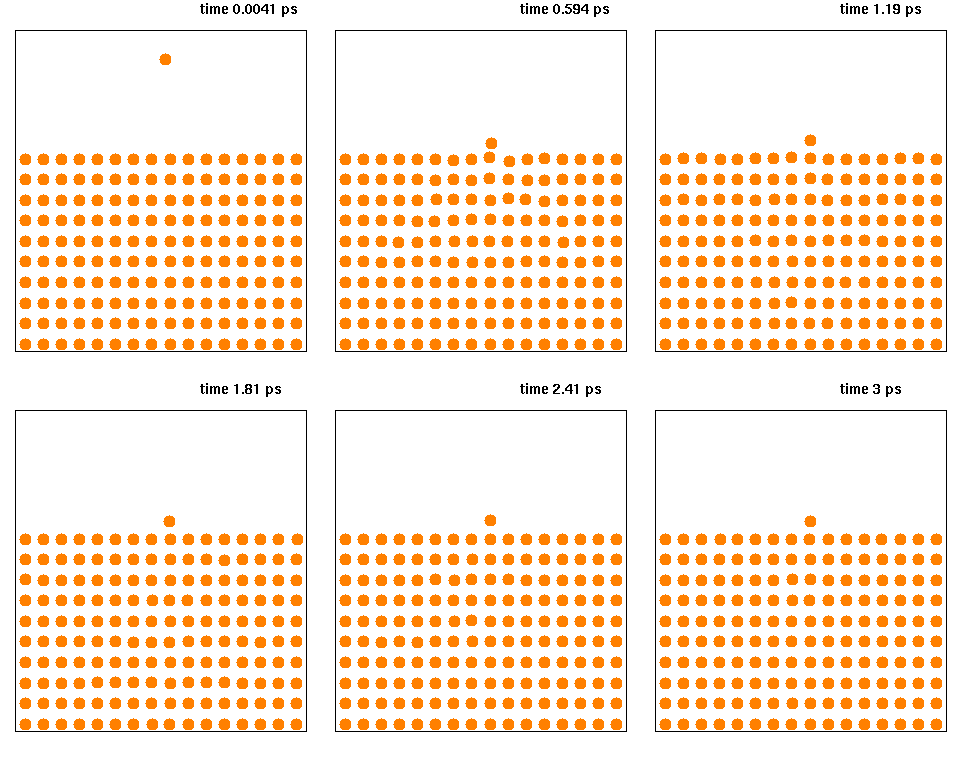
Molecular dynamics (MD) is a powerful tool for understanding the behavior of atoms and molecules, allowing researchers to simulate the physical movements of these particles over time. By solving Newton's laws of motion for a system of interacting particles, MD simulations provide a detailed view of the dynamic evolution of the system. This method has been widely applied in chemical physics, materials science, and biophysics. The use of interatomic potentials and molecular mechanics force fields enables the calculation of forces and potential energies between particles. For example, the Lennard-Jones potential is commonly used to model the interactions between noble gas atoms. MD simulations have also been used to study the behavior of proteins and other biomolecules.
🔍 Theoretical Foundations of MD
The theoretical foundations of MD are rooted in classical mechanics and statistical mechanics. The Liouville's equation and the Hamilton's equations provide the mathematical framework for understanding the behavior of particles in MD simulations. The use of periodic boundary conditions and thermostats allows researchers to simulate the behavior of particles in a variety of environments. For instance, the Nose-Hoover thermostat is commonly used to maintain a constant temperature in MD simulations. Additionally, the Monte Carlo method can be used to sample the phase space of a system and calculate thermodynamic properties. MD simulations have also been used to study the behavior of liquids and gases.
📊 Computational Methods in MD
The computational methods used in MD simulations involve the numerical solution of ordinary differential equations that describe the motion of particles. The Verlet integration algorithm is a popular method for integrating the equations of motion, while the leapfrog integration algorithm is another commonly used method. The use of parallel computing and GPU acceleration has enabled the simulation of large systems and long timescales. For example, the Message Passing Interface (MPI) is a widely used protocol for parallelizing MD simulations. Furthermore, the LAMMPS software package is a popular tool for performing MD simulations. MD simulations have also been used to study the behavior of nanomaterials and biological systems.
👥 Applications of Molecular Dynamics
The applications of MD simulations are diverse and widespread. In chemical physics, MD simulations are used to study the behavior of molecules and chemical reactions. In biophysics, MD simulations are used to study the behavior of biomolecules and biological systems. In materials science, MD simulations are used to study the behavior of materials and nanomaterials. For instance, MD simulations have been used to study the behavior of graphene and other two-dimensional materials. Additionally, MD simulations have been used to study the behavior of proteins and other biomolecules in biological systems. The use of machine learning algorithms has also been explored in MD simulations to improve the accuracy and efficiency of simulations.
🔬 MD in Chemical Physics
In chemical physics, MD simulations are used to study the behavior of molecules and chemical reactions. The use of quantum mechanics and density functional theory provides a detailed understanding of the electronic structure of molecules. For example, the Hartree-Fock method is a widely used method for calculating the electronic structure of molecules. MD simulations have also been used to study the behavior of liquids and gases, including the calculation of thermodynamic properties such as entropy and free energy. The study of chemical kinetics and reaction mechanisms is another important application of MD simulations in chemical physics. Furthermore, MD simulations have been used to study the behavior of catalysts and enzymes in chemical reactions.
🧬 MD in Biophysics
In biophysics, MD simulations are used to study the behavior of biomolecules and biological systems. The use of molecular mechanics force fields provides a detailed understanding of the behavior of proteins and nucleic acids. For instance, the CHARMM force field is a widely used force field for simulating the behavior of biomolecules. MD simulations have also been used to study the behavior of membranes and lipids, including the calculation of transport properties such as permeability and diffusion. The study of protein folding and protein-ligand binding is another important application of MD simulations in biophysics. Additionally, MD simulations have been used to study the behavior of ion channels and transport proteins in biological systems.
💻 MD Simulations in Materials Science
In materials science, MD simulations are used to study the behavior of materials and nanomaterials. The use of interatomic potentials and molecular mechanics force fields provides a detailed understanding of the behavior of metals, semiconductors, and insulators. For example, the Tersoff potential is a widely used potential for simulating the behavior of semiconductors. MD simulations have also been used to study the behavior of nanoparticles and nanostructures, including the calculation of mechanical properties such as Young's modulus and fracture toughness. The study of phase transitions and defect properties is another important application of MD simulations in materials science. Furthermore, MD simulations have been used to study the behavior of composites and hybrid materials in materials science.
📈 Future Directions in Molecular Dynamics
The future directions in molecular dynamics involve the development of new methods and algorithms for simulating the behavior of complex systems. The use of machine learning and artificial intelligence is expected to play a major role in the development of MD simulations. For instance, the deep learning method has been used to improve the accuracy of MD simulations. The study of non-equilibrium systems and complex systems is another important area of research in molecular dynamics. Additionally, the development of new interatomic potentials and molecular mechanics force fields is expected to improve the accuracy of MD simulations. The use of high-performance computing and GPU acceleration will also enable the simulation of larger systems and longer timescales.
🤝 Interdisciplinary Connections
Molecular dynamics is an interdisciplinary field that connects to many other areas of research. The use of statistical mechanics and thermodynamics provides a detailed understanding of the behavior of systems in MD simulations. The study of chemical kinetics and reaction mechanisms is another important connection to chemical physics. The use of biophysics and biochemistry provides a detailed understanding of the behavior of biomolecules and biological systems. Furthermore, the study of materials science and nanotechnology provides a detailed understanding of the behavior of materials and nanomaterials.
📊 Challenges and Limitations
The challenges and limitations of molecular dynamics simulations involve the development of accurate interatomic potentials and molecular mechanics force fields. The use of classical mechanics and statistical mechanics provides a detailed understanding of the behavior of systems in MD simulations. However, the study of quantum mechanics and density functional theory is necessary for a detailed understanding of the electronic structure of molecules. The development of new methods and algorithms for simulating the behavior of complex systems is another important challenge in molecular dynamics. Additionally, the use of high-performance computing and GPU acceleration is necessary for simulating large systems and long timescales.
📝 Conclusion
In conclusion, molecular dynamics is a powerful tool for understanding the behavior of atoms and molecules. The use of interatomic potentials and molecular mechanics force fields provides a detailed understanding of the behavior of systems in MD simulations. The study of chemical physics, biophysics, and materials science provides a detailed understanding of the behavior of molecules, biomolecules, and materials. The development of new methods and algorithms for simulating the behavior of complex systems is expected to play a major role in the future of molecular dynamics.
Key Facts
- Year
- 1957
- Origin
- Los Alamos National Laboratory
- Category
- Physics and Chemistry
- Type
- Scientific Concept
Frequently Asked Questions
What is molecular dynamics?
Molecular dynamics (MD) is a computer simulation method for analyzing the physical movements of atoms and molecules. The atoms and molecules are allowed to interact for a fixed period of time, giving a view of the dynamic 'evolution' of the system. MD simulations are widely applied in chemical physics, materials science, and biophysics.
What are the applications of molecular dynamics?
The applications of molecular dynamics simulations are diverse and widespread. In chemical physics, MD simulations are used to study the behavior of molecules and chemical reactions. In biophysics, MD simulations are used to study the behavior of biomolecules and biological systems. In materials science, MD simulations are used to study the behavior of materials and nanomaterials.
What are the challenges and limitations of molecular dynamics simulations?
The challenges and limitations of molecular dynamics simulations involve the development of accurate interatomic potentials and molecular mechanics force fields. The use of classical mechanics and statistical mechanics provides a detailed understanding of the behavior of systems in MD simulations. However, the study of quantum mechanics and density functional theory is necessary for a detailed understanding of the electronic structure of molecules.
What is the future of molecular dynamics?
The future directions in molecular dynamics involve the development of new methods and algorithms for simulating the behavior of complex systems. The use of machine learning and artificial intelligence is expected to play a major role in the development of MD simulations. The study of non-equilibrium systems and complex systems is another important area of research in molecular dynamics.
What are the connections between molecular dynamics and other fields?
Molecular dynamics is an interdisciplinary field that connects to many other areas of research. The use of statistical mechanics and thermodynamics provides a detailed understanding of the behavior of systems in MD simulations. The study of chemical kinetics and reaction mechanisms is another important connection to chemical physics. The use of biophysics and biochemistry provides a detailed understanding of the behavior of biomolecules and biological systems.