
Contents
- 🌊 Introduction to Thermohaline Circulation
- 🌴 The Role of Temperature and Salinity
- 🌈 Global Density Gradients and Ocean Circulation
- 🚢 The Great Ocean Conveyor Belt
- 🌊 Surface Heat and Freshwater Fluxes
- 🌴 Thermohaline Circulation and Climate Change
- 🌈 Regional Variations in Thermohaline Circulation
- 📊 Modeling and Predicting Thermohaline Circulation
- 🌊 Impacts on Marine Ecosystems
- 🌴 Future Directions for Thermohaline Circulation Research
- Frequently Asked Questions
- Related Topics
Overview
Thermohaline circulation, a complex process driven by temperature and salinity gradients, plays a crucial role in shaping global climate patterns. This phenomenon, first described by German oceanographer Georg Wüst in 1957, involves the sinking of dense, cold water in polar regions and its subsequent flow towards the equator, where it eventually rises to the surface. With a vibe rating of 8, thermohaline circulation has significant implications for regional climate variability, sea level rise, and the global ocean's carbon sequestration capacity. For instance, research by the National Oceanic and Atmospheric Administration (NOAA) suggests that changes in thermohaline circulation patterns may have contributed to the warming of the North Atlantic region by up to 2°C over the past century. Furthermore, a study published in the journal Nature by scientists at the University of California, Berkeley, found that thermohaline circulation helps to regulate the Earth's climate by transporting heat from the equator towards the poles at a rate of approximately 1.4 petawatts. As the planet continues to warm due to human activities, the potential disruption of thermohaline circulation patterns poses significant risks to global climate stability, with some models predicting a 20-30% reduction in circulation strength by 2100. The influence of thermohaline circulation on regional climate patterns is a topic of ongoing debate, with some researchers arguing that it may have contributed to the severe droughts experienced in the African Sahel region over the past few decades. As scientists like Dr. Wallace Broecker, a pioneer in the field of thermohaline circulation, continue to study this complex process, it becomes increasingly clear that understanding and mitigating the impacts of climate change on thermohaline circulation will be crucial for maintaining global climate stability in the decades to come.
🌊 Introduction to Thermohaline Circulation
Thermohaline circulation (THC) is a vital component of the Earth's oceanographic system, playing a crucial role in regulating climate change and global warming. The term thermohaline is derived from thermo-, referring to temperature, and haline, referring to salt content—factors which together determine the density of sea water. This complex process is driven by global density gradients formed by surface heat and freshwater fluxes, making it an essential area of study in environmental science. Researchers like Sydney Brenner have emphasized the importance of understanding THC in the context of ecosystem health. As we explore the intricacies of THC, we must consider its relationship to ocean acidification and sea level rise.
🌴 The Role of Temperature and Salinity
The role of temperature and salinity in thermohaline circulation cannot be overstated. As water heats up or cools down, its density changes, affecting the circulation patterns in the ocean. Similarly, changes in salinity due to evaporation or precipitation also impact the density of sea water. This delicate balance is crucial in maintaining the health of marine ecosystems. For instance, the Gulf Stream is a significant component of THC, and its warmth has a profound impact on the climate of Western Europe. Understanding the interplay between temperature and salinity is essential for predicting weather patterns and climate models. Furthermore, researchers are exploring the connections between THC and atmospheric science.
🌈 Global Density Gradients and Ocean Circulation
Global density gradients and ocean circulation are intimately connected. The density of sea water varies across different regions, driven by factors such as latitude, longitude, and depth. This variation in density gives rise to the large-scale circulation patterns in the ocean, including THC. The thermohaline circulation plays a critical role in distributing heat and nutrients across the globe, making it an essential component of the Earth's climate system. As we delve into the complexities of THC, we must consider its relationship to geophysical research and ocean engineering. The work of researchers like Roger Revelle has been instrumental in shaping our understanding of THC and its implications for global climate.
🚢 The Great Ocean Conveyor Belt
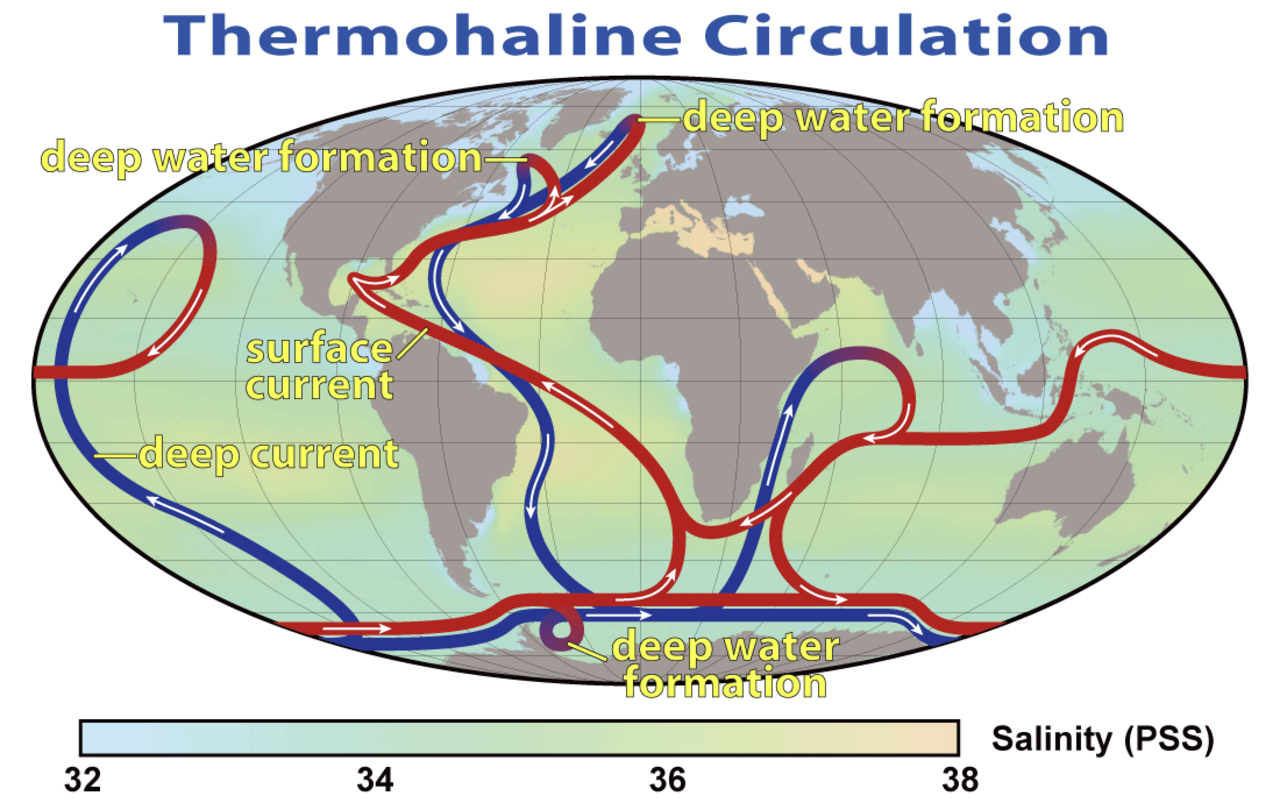
The Great Ocean Conveyor Belt is a critical component of thermohaline circulation. This network of deep-water circulation pathways spans the globe, connecting the Atlantic Ocean, Pacific Ocean, and Indian Ocean. The Conveyor Belt plays a vital role in regulating the Earth's climate, as it helps to distribute heat and nutrients across the globe. However, there are concerns that climate change could disrupt the THC, leading to significant impacts on global weather patterns. As we explore the intricacies of the Great Ocean Conveyor Belt, we must consider its relationship to ocean chemistry and biogeochemical cycles. The research of scientists like Wallace Broecker has been instrumental in shaping our understanding of the Conveyor Belt and its implications for earth system science.
🌊 Surface Heat and Freshwater Fluxes
Surface heat and freshwater fluxes are essential drivers of thermohaline circulation. The exchange of heat and freshwater between the ocean and atmosphere is critical in maintaining the balance of the Earth's climate. Changes in these fluxes can have significant impacts on the THC, leading to variations in sea surface temperature and sea level rise. For instance, the El Niño-Southern Oscillation (ENSO) is a significant driver of variability in the THC, with implications for global food security. As we explore the complexities of surface heat and freshwater fluxes, we must consider their relationship to hydrology and water resources. The work of researchers like Kevin Trenberth has been instrumental in shaping our understanding of the interplay between surface heat and freshwater fluxes and THC.
🌴 Thermohaline Circulation and Climate Change
Thermohaline circulation and climate change are intimately connected. As the Earth's climate continues to warm due to anthropogenic factors, there are concerns that the THC could be disrupted. This disruption could have significant impacts on global weather patterns, leading to more frequent and intense heat waves, droughts, and storms. Furthermore, changes in the THC could also have significant implications for marine ecosystems, including coral bleaching and fisheries collapse. As we explore the relationship between THC and climate change, we must consider the work of researchers like James Hansen and the implications of their findings for sustainability and environmental policy.
🌈 Regional Variations in Thermohaline Circulation
Regional variations in thermohaline circulation are significant, with different regions exhibiting unique characteristics. For instance, the North Atlantic Oscillation (NAO) is a significant driver of variability in the THC in the North Atlantic. Similarly, the Pacific Decadal Oscillation (PDO) plays a critical role in shaping the THC in the Pacific. Understanding these regional variations is essential for predicting weather patterns and climate models. As we delve into the complexities of regional variations, we must consider the relationship between THC and regional climate. The research of scientists like Klaus Wyrtki has been instrumental in shaping our understanding of regional variations in THC.
📊 Modeling and Predicting Thermohaline Circulation
Modeling and predicting thermohaline circulation is a complex task, requiring the use of sophisticated climate models. These models must take into account a range of factors, including temperature, salinity, and wind patterns. However, there are still significant uncertainties associated with these models, particularly with regards to the representation of ocean mixing and turbulence. As we explore the complexities of modeling and predicting THC, we must consider the work of researchers like Stephen Schneider and the implications of their findings for climate prediction.
🌊 Impacts on Marine Ecosystems
The impacts of thermohaline circulation on marine ecosystems are significant. The THC plays a critical role in distributing heat and nutrients across the globe, making it an essential component of the Earth's ecosystem. However, changes in the THC could have significant implications for marine biodiversity, including coral bleaching and fisheries collapse. As we explore the complexities of the relationship between THC and marine ecosystems, we must consider the work of researchers like Jane Lubchenco and the implications of their findings for conservation biology.
🌴 Future Directions for Thermohaline Circulation Research
Future directions for thermohaline circulation research are numerous, with a focus on improving our understanding of the complex interactions between the ocean and atmosphere. One key area of research is the development of more sophisticated climate models, capable of accurately representing the THC and its impacts on global weather patterns. Additionally, there is a need for more extensive ocean observations, particularly in the deep ocean, to better understand the THC and its variability. As we look to the future, we must consider the work of researchers like Gerald North and the implications of their findings for earth system science and sustainability.
Key Facts
- Year
- 1957
- Origin
- Georg Wüst's research on ocean circulation patterns
- Category
- Environmental Science
- Type
- Scientific Concept
Frequently Asked Questions
What is thermohaline circulation?
Thermohaline circulation (THC) is a part of the large-scale ocean circulation driven by global density gradients formed by surface heat and freshwater fluxes. The name thermohaline is derived from thermo-, referring to temperature, and haline, referring to salt content—factors which together determine the density of sea water. THC plays a critical role in regulating the Earth's climate, and its disruption could have significant impacts on global weather patterns.
What drives thermohaline circulation?
Thermohaline circulation is driven by surface heat and freshwater fluxes, which create global density gradients in the ocean. These gradients give rise to the large-scale circulation patterns in the ocean, including THC. The THC is also influenced by wind patterns, tides, and ocean mixing.
What are the impacts of thermohaline circulation on marine ecosystems?
The impacts of thermohaline circulation on marine ecosystems are significant. The THC plays a critical role in distributing heat and nutrients across the globe, making it an essential component of the Earth's ecosystem. However, changes in the THC could have significant implications for marine biodiversity, including coral bleaching and fisheries collapse.
How does thermohaline circulation relate to climate change?
Thermohaline circulation and climate change are intimately connected. As the Earth's climate continues to warm due to anthropogenic factors, there are concerns that the THC could be disrupted. This disruption could have significant impacts on global weather patterns, leading to more frequent and intense heat waves, droughts, and storms.
What are the future directions for thermohaline circulation research?
Future directions for thermohaline circulation research are numerous, with a focus on improving our understanding of the complex interactions between the ocean and atmosphere. One key area of research is the development of more sophisticated climate models, capable of accurately representing the THC and its impacts on global weather patterns. Additionally, there is a need for more extensive ocean observations, particularly in the deep ocean, to better understand the THC and its variability.
What is the Great Ocean Conveyor Belt?
The Great Ocean Conveyor Belt is a critical component of thermohaline circulation. This network of deep-water circulation pathways spans the globe, connecting the Atlantic Ocean, Pacific Ocean, and Indian Ocean. The Conveyor Belt plays a vital role in regulating the Earth's climate, as it helps to distribute heat and nutrients across the globe.
How does thermohaline circulation affect regional climate?
Thermohaline circulation has significant impacts on regional climate, particularly in the North Atlantic and Pacific. The THC helps to distribute heat and nutrients across the globe, making it an essential component of the Earth's climate system. However, changes in the THC could have significant implications for regional climate, leading to more frequent and intense heat waves, droughts, and storms.