
Contents
- 🌟 Introduction to Fluorescence Emission
- 🔬 The Physics of Fluorescence
- 🧬 Molecular Structure and Fluorescence
- 🎯 Applications of Fluorescence Emission
- 🔍 Fluorescence Microscopy Techniques
- 📊 Quantum Yield and Fluorescence Efficiency
- 🌈 Fluorescence in Biological Systems
- 🚨 Fluorescence Quenching and Energy Transfer
- 🔬 Fluorescence Spectroscopy and Instrumentation
- 📈 Future Directions in Fluorescence Research
- Frequently Asked Questions
- Related Topics
Overview
The emission of fluorescence is a complex phenomenon where a substance absorbs light at one wavelength and emits it at another, typically longer wavelength. This process has been extensively studied since its discovery by George Gabriel Stokes in 1852. The Stokes shift, named after him, describes the difference in wavelength between the absorbed and emitted light. Researchers like Theodor Förster have further elucidated the mechanisms behind fluorescence, including the role of molecular interactions and energy transfer. With applications in fields like biomedical imaging, chemical sensing, and optoelectronics, understanding fluorescence emission is crucial. For instance, the use of fluorescent dyes in microscopy has revolutionized the field of biology, enabling the visualization of cellular structures and processes. However, the intensity and duration of fluorescence emission can be influenced by various factors, including the presence of quenchers, temperature, and pH levels, making its study both fascinating and challenging.
🌟 Introduction to Fluorescence Emission
The emission of fluorescence is a fundamental process in physics and chemistry, where a molecule absorbs light at one wavelength and emits light at another wavelength. This phenomenon is used in a wide range of applications, from fluorescence microscopy to laser technology. The study of fluorescence emission is crucial in understanding the behavior of molecules and their interactions with light. Researchers like Albert Einstein have made significant contributions to our understanding of fluorescence. The photoelectric effect is also closely related to fluorescence emission, as it describes the emission of electrons from a material when light is shone on it.
🔬 The Physics of Fluorescence
The physics of fluorescence emission is based on the principles of quantum mechanics and electromagnetism. When a molecule absorbs light, it gains energy and moves to a higher energy state. As it returns to its ground state, it releases excess energy as light, which is known as fluorescence emission. This process is described by the Jablonski diagram, which illustrates the various energy states and transitions involved. The Stokes shift is another important concept in fluorescence emission, as it describes the difference in wavelength between the absorbed and emitted light. Researchers use spectroscopy to study the properties of molecules and their interactions with light.
🧬 Molecular Structure and Fluorescence
The molecular structure of a molecule plays a crucial role in determining its fluorescence emission properties. The molecular orbital theory is used to describe the electronic structure of molecules and predict their fluorescence emission spectra. The conjugated system of a molecule is particularly important, as it determines the energy gap between the ground and excited states. The fluorescein molecule is a classic example of a fluorescent molecule, with a conjugated system that allows it to absorb and emit light at specific wavelengths. The rhodamine molecule is another example of a fluorescent molecule, with a wide range of applications in biological labeling.
🎯 Applications of Fluorescence Emission
The emission of fluorescence has a wide range of applications in fields such as biology, medicine, and materials science. Fluorescence microscopy is a powerful tool for visualizing biological structures and tracking the movement of molecules. laser technology also relies on fluorescence emission, as it is used to create high-intensity light beams. The fluorescence-based sensors are used to detect and measure various biological and chemical parameters. The biological labeling of molecules with fluorescent dyes is a common technique used in molecular biology.
🔍 Fluorescence Microscopy Techniques
Fluorescence microscopy techniques are used to visualize and study the behavior of molecules in biological systems. Confocal microscopy is a type of fluorescence microscopy that uses a laser to excite the sample and a detector to collect the emitted light. Super-resolution microscopy is another technique that uses fluorescence emission to achieve high-resolution images of biological structures. The single molecule microscopy is a technique that allows researchers to study the behavior of individual molecules. The fluorescence correlation spectroscopy is a technique used to study the dynamics of molecules in solution.
📊 Quantum Yield and Fluorescence Efficiency
The quantum yield and fluorescence efficiency of a molecule are important parameters that determine its fluorescence emission properties. The quantum yield is a measure of the efficiency of fluorescence emission, and it is defined as the ratio of the number of photons emitted to the number of photons absorbed. The fluorescence efficiency is a measure of the overall efficiency of the fluorescence emission process, and it takes into account the quantum yield and other factors such as the absorption cross-section. Researchers use fluorometry to measure the fluorescence emission properties of molecules. The photon counting is a technique used to measure the number of photons emitted by a molecule.
🌈 Fluorescence in Biological Systems
Fluorescence emission plays a crucial role in biological systems, where it is used to regulate various biological processes. Biological fluorescence is the natural fluorescence emission of biological molecules, such as chlorophyll and fluorescent proteins. The green fluorescent protein is a widely used fluorescent protein in biological research. The fluorescence resonance energy transfer is a technique used to study the interactions between molecules in biological systems. The bioluminescence is the production and emission of light by living organisms, and it is often used to study the behavior of biological systems.
🚨 Fluorescence Quenching and Energy Transfer
Fluorescence quenching and energy transfer are important processes that can affect the fluorescence emission properties of a molecule. Fluorescence quenching is the reduction of fluorescence emission due to the presence of a quencher molecule. The energy transfer is the transfer of energy from one molecule to another, and it can occur through various mechanisms such as Foerster resonance energy transfer. The fluorescence lifetime is a measure of the time it takes for a molecule to return to its ground state after excitation. Researchers use time-resolved fluorescence to study the dynamics of molecules in solution.
🔬 Fluorescence Spectroscopy and Instrumentation
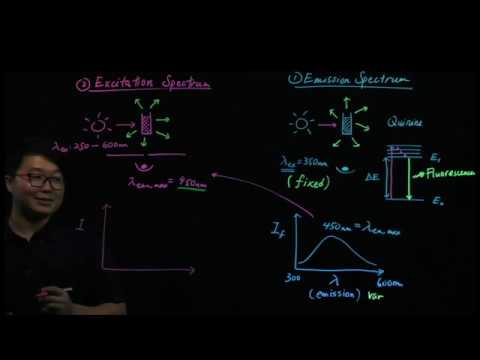
Fluorescence spectroscopy and instrumentation are essential tools for studying the fluorescence emission properties of molecules. Fluorescence spectroscopy is a technique that uses a spectrometer to measure the fluorescence emission spectrum of a molecule. The fluorescence microscope is an instrument that uses fluorescence emission to visualize biological structures. The spectrofluorometer is an instrument that measures the fluorescence emission properties of a molecule. Researchers use data analysis to extract information from the fluorescence emission spectra and images.
📈 Future Directions in Fluorescence Research
The future directions in fluorescence research are exciting and diverse, with new applications and techniques being developed all the time. Super-resolution microscopy is a rapidly evolving field that is allowing researchers to study biological structures at the nanoscale. The single molecule microscopy is a technique that allows researchers to study the behavior of individual molecules. The fluorescence-based sensors are being developed for a wide range of applications, from biological labeling to environmental monitoring.
Key Facts
- Year
- 1852
- Origin
- George Gabriel Stokes' Laboratory, Cambridge, UK
- Category
- Physics and Chemistry
- Type
- Scientific Concept
Frequently Asked Questions
What is fluorescence emission?
Fluorescence emission is the process by which a molecule absorbs light at one wavelength and emits light at another wavelength. This phenomenon is used in a wide range of applications, from fluorescence microscopy to laser technology. The study of fluorescence emission is crucial in understanding the behavior of molecules and their interactions with light. Researchers like Albert Einstein have made significant contributions to our understanding of fluorescence.
What is the difference between fluorescence and phosphorescence?
Fluorescence and phosphorescence are both types of luminescence, but they differ in the duration of the emission. Fluorescence emission occurs rapidly, typically on a timescale of nanoseconds, while phosphorescence emission occurs more slowly, typically on a timescale of milliseconds or seconds. The Jablonski diagram illustrates the various energy states and transitions involved in fluorescence and phosphorescence.
What are the applications of fluorescence emission?
The emission of fluorescence has a wide range of applications in fields such as biology, medicine, and materials science. Fluorescence microscopy is a powerful tool for visualizing biological structures and tracking the movement of molecules. laser technology also relies on fluorescence emission, as it is used to create high-intensity light beams. The fluorescence-based sensors are used to detect and measure various biological and chemical parameters.
What is the quantum yield of a molecule?
The quantum yield of a molecule is a measure of the efficiency of fluorescence emission, and it is defined as the ratio of the number of photons emitted to the number of photons absorbed. The quantum yield is an important parameter that determines the fluorescence emission properties of a molecule. Researchers use fluorometry to measure the fluorescence emission properties of molecules.
What is fluorescence quenching?
Fluorescence quenching is the reduction of fluorescence emission due to the presence of a quencher molecule. The fluorescence quenching can occur through various mechanisms, such as energy transfer or collisional quenching. The fluorescence lifetime is a measure of the time it takes for a molecule to return to its ground state after excitation.