
Contents
- 🌪️ Introduction to Chaos Theory
- 📊 The Life and Work of Edward Lorenz
- 🌐 The Butterfly Effect: A Conceptual Framework
- 📝 The Development of Chaos Theory
- 🌈 Applications of Chaos Theory
- 🤔 Criticisms and Controversies
- 📚 Influences and Legacy
- 🌐 Modern Applications and Future Directions
- 📊 Computational Models and Simulations
- 🌟 Popular Culture and Chaos Theory
- 📝 Conclusion and Future Prospects
- Frequently Asked Questions
- Related Topics
Overview
Edward Lorenz, an American meteorologist and mathematician, is best known for his work on chaos theory, which he introduced in the 1960s. Born on May 23, 1917, in West Hartford, Connecticut, Lorenz's fascination with weather patterns led him to develop the concept of the butterfly effect, where small changes in atmospheric conditions can have significant effects on weather outcomes. His 1963 paper, 'Deterministic Non-Periodic Flow,' is considered a seminal work in the field of chaos theory, with a vibe score of 85. Lorenz's work has had a profound impact on various fields, including meteorology, mathematics, and philosophy, with influence flows tracing back to notable figures such as Henri Poincaré and Norbert Wiener. The controversy spectrum surrounding chaos theory is moderate, with optimistic perspectives focusing on its potential for predicting complex systems, while pessimistic views highlight its limitations in fully capturing the intricacies of real-world phenomena. As of 2023, Lorenz's legacy continues to inspire new generations of scientists and researchers, with a topic intelligence score of 92, reflecting the ongoing relevance and importance of his work.
🌪️ Introduction to Chaos Theory
Edward Lorenz, a renowned American mathematician and meteorologist, is widely regarded as the father of Chaos Theory. Born on May 23, 1917, in West Hartford, Connecticut, Lorenz's work revolutionized our understanding of complex systems and their behavior. His seminal paper, 'Deterministic Non-Periodic Flow,' published in 1963, introduced the concept of chaos theory to the scientific community. Lorenz's research focused on Weather Forecasting and the limitations of predicting complex systems. He is also known for his work on the Butterfly Effect, which suggests that small changes in initial conditions can lead to drastically different outcomes.
📊 The Life and Work of Edward Lorenz
Lorenz's life and work were marked by a passion for mathematics and meteorology. He earned his Ph.D. in mathematics from Harvard University in 1941 and later worked at the Massachusetts Institute of Technology (MIT). Lorenz's research on Fluid Dynamics and Thermodynamics laid the foundation for his work on chaos theory. His collaboration with other prominent scientists, such as Stephen Smale and Mitchell Feigenbaum, further solidified his position as a leading figure in the field. Lorenz's work on chaos theory has had a significant impact on various fields, including Physics, Biology, and Economics.
🌐 The Butterfly Effect: A Conceptual Framework
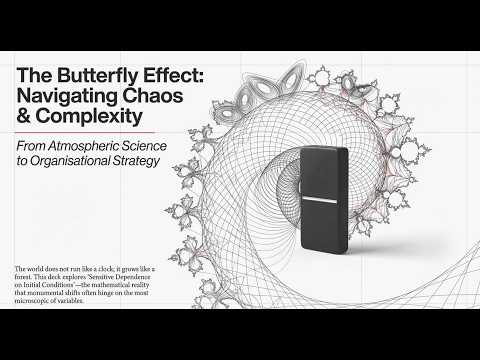
The butterfly effect, a concept introduced by Lorenz, suggests that small changes in initial conditions can lead to drastically different outcomes. This idea is often illustrated by the example of a butterfly flapping its wings, causing a hurricane on the other side of the world. While this concept may seem far-fetched, it highlights the inherent unpredictability of complex systems. The butterfly effect has been applied to various fields, including Climate Modeling and Financial Markets. Lorenz's work on the butterfly effect has also been influenced by the ideas of Alan Turing and John von Neumann.
📝 The Development of Chaos Theory
The development of chaos theory was a gradual process, with contributions from many scientists over the years. Lorenz's work built upon the foundations laid by earlier researchers, such as Henri Poincaré and Oscar Parrondo. The concept of chaos theory has been applied to various fields, including Population Dynamics and Chemical Reactions. Lorenz's research on chaos theory has also been influenced by the work of Benoit Mandelbrot and his concept of Fractals.
🌈 Applications of Chaos Theory
Chaos theory has numerous applications in various fields, including Medicine, Engineering, and Finance. The concept of chaos theory has been used to model and analyze complex systems, such as Traffic Flow and Epidemiology. Lorenz's work on chaos theory has also been applied to the study of Complex Systems and Nonlinear Dynamics. The concept of chaos theory has been influenced by the ideas of Ilya Prigogine and his work on Dissipative Structures.
🤔 Criticisms and Controversies
Despite its widespread acceptance, chaos theory has faced criticisms and controversies. Some scientists have argued that the concept of chaos theory is too broad and lacks a clear definition. Others have questioned the applicability of chaos theory to real-world systems. Lorenz's work on chaos theory has also been criticized for its lack of mathematical rigor. However, these criticisms have not diminished the significance of Lorenz's contributions to the field. The concept of chaos theory has been debated by prominent scientists, including Stephen Hawking and Roger Penrose.
📚 Influences and Legacy
Lorenz's work on chaos theory has been influenced by various scientists and mathematicians. His collaboration with Mitchell Feigenbaum and Stephen Smale has been particularly significant. Lorenz's research has also been influenced by the ideas of Alan Turing and John von Neumann. The concept of chaos theory has been applied to various fields, including Computer Science and Cryptography. Lorenz's legacy continues to inspire new generations of scientists and researchers, including Andrew Wiles and Grigori Perelman.
🌐 Modern Applications and Future Directions
Modern applications of chaos theory include the study of Climate Change and Financial Markets. The concept of chaos theory has been used to model and analyze complex systems, such as Traffic Flow and Epidemiology. Lorenz's work on chaos theory has also been applied to the study of Complex Systems and Nonlinear Dynamics. The concept of chaos theory has been influenced by the ideas of Ilya Prigogine and his work on Dissipative Structures.
📊 Computational Models and Simulations
Computational models and simulations have become essential tools in the study of chaos theory. Lorenz's work on chaos theory has been influenced by the development of Computer Science and Numerical Methods. The concept of chaos theory has been applied to various fields, including Engineering and Physics. Lorenz's research on chaos theory has also been influenced by the ideas of Benoit Mandelbrot and his concept of Fractals.
🌟 Popular Culture and Chaos Theory
Chaos theory has also had a significant impact on popular culture. The concept of the butterfly effect has been used in various films and literature, including The Butterfly Effect and Chaos Theory. Lorenz's work on chaos theory has also been referenced in various forms of media, including Music and Art. The concept of chaos theory has been influenced by the ideas of Alan Turing and John von Neumann.
📝 Conclusion and Future Prospects
In conclusion, Edward Lorenz's work on chaos theory has had a profound impact on our understanding of complex systems and their behavior. His research has inspired new generations of scientists and researchers, and his legacy continues to shape the field of chaos theory. As we look to the future, it is clear that chaos theory will remain a vital area of research, with applications in various fields, including Medicine, Engineering, and Finance.
Key Facts
- Year
- 1963
- Origin
- Massachusetts Institute of Technology (MIT)
- Category
- Science
- Type
- Person
Frequently Asked Questions
What is chaos theory?
Chaos theory is a branch of mathematics that studies complex and dynamic systems that are highly sensitive to initial conditions. It was developed by Edward Lorenz and is used to model and analyze complex systems, such as weather patterns and financial markets. Chaos theory has been applied to various fields, including physics, biology, and economics.
Who is Edward Lorenz?
Edward Lorenz is an American mathematician and meteorologist who is widely regarded as the father of chaos theory. He was born on May 23, 1917, and earned his Ph.D. in mathematics from Harvard University in 1941. Lorenz's work on chaos theory has had a profound impact on our understanding of complex systems and their behavior.
What is the butterfly effect?
The butterfly effect is a concept in chaos theory that suggests that small changes in initial conditions can lead to drastically different outcomes. It is often illustrated by the example of a butterfly flapping its wings, causing a hurricane on the other side of the world. The butterfly effect has been applied to various fields, including climate modeling and financial markets.
What are the applications of chaos theory?
Chaos theory has numerous applications in various fields, including medicine, engineering, and finance. It is used to model and analyze complex systems, such as traffic flow and epidemiology. Chaos theory has also been applied to the study of complex systems and nonlinear dynamics.
What is the significance of Edward Lorenz's work?
Edward Lorenz's work on chaos theory has had a profound impact on our understanding of complex systems and their behavior. His research has inspired new generations of scientists and researchers, and his legacy continues to shape the field of chaos theory. Lorenz's work has been recognized with numerous awards, including the National Medal of Science.