
Contents
- 🌎 Introduction to Global Climate Models
- 📊 How Climate Models Work
- 📈 Key Facts and Numbers
- 👥 Key People and Organizations
- 🌍 Cultural Impact and Influence
- ⚡ Current State and Latest Developments
- 🤔 Controversies and Debates
- 🔮 Future Outlook and Predictions
- 💡 Practical Applications
- 📚 Related Topics and Deeper Reading
- Frequently Asked Questions
- References
- Related Topics
Overview
Global climate models are sophisticated computer simulations that analyze the complex interactions within the Earth's climate system, including the atmosphere, oceans, land surfaces, and ice. These models are crucial for understanding and predicting climate change, its impacts, and the effects of various mitigation and adaptation strategies. The development of global climate models has been driven by the need to understand the Earth's climate system, which is influenced by human activities such as fossil fuel burning, deforestation, and industrial practices. The Intergovernmental Panel on Climate Change (IPCC) relies heavily on global climate models to provide scenarios of future climate change and its potential consequences. For instance, the IPCC's Fifth Assessment Report utilized climate models from institutions like the National Center for Atmospheric Research (NCAR) and the National Oceanic and Atmospheric Administration (NOAA) to project future temperature increases and sea-level rise. As of 2022, global climate models have become increasingly accurate, with models like the Community Earth System Model (CESM) and the Geophysical Fluid Dynamics Laboratory (GFDL) model providing high-resolution simulations of climate phenomena.
🌎 Introduction to Global Climate Models
Global climate models have a rich history, dating back to the 1960s when the first climate models were developed. These early models were simple and focused on the basic principles of climate science. Over time, models have become increasingly complex, incorporating more variables and processes. For example, the development of the General Circulation Model (GCM) in the 1970s marked a significant milestone in climate modeling. Today, global climate models are used by researchers and policymakers around the world to understand and predict climate change. Organizations like the National Oceanic and Atmospheric Administration (NOAA) and the National Aeronautics and Space Administration (NASA) play a crucial role in developing and applying these models.
📊 How Climate Models Work
Global climate models work by solving complex mathematical equations that describe the behavior of the climate system. These equations take into account factors such as temperature, humidity, atmospheric circulation, and ocean currents. The models are run on powerful computers, which can simulate the climate system over long periods of time. For instance, the Community Earth System Model (CESM) uses a combination of atmospheric, oceanic, and land models to simulate the Earth's climate system. The model is run on high-performance computing systems, such as those at the National Center for Atmospheric Research (NCAR)
📈 Key Facts and Numbers
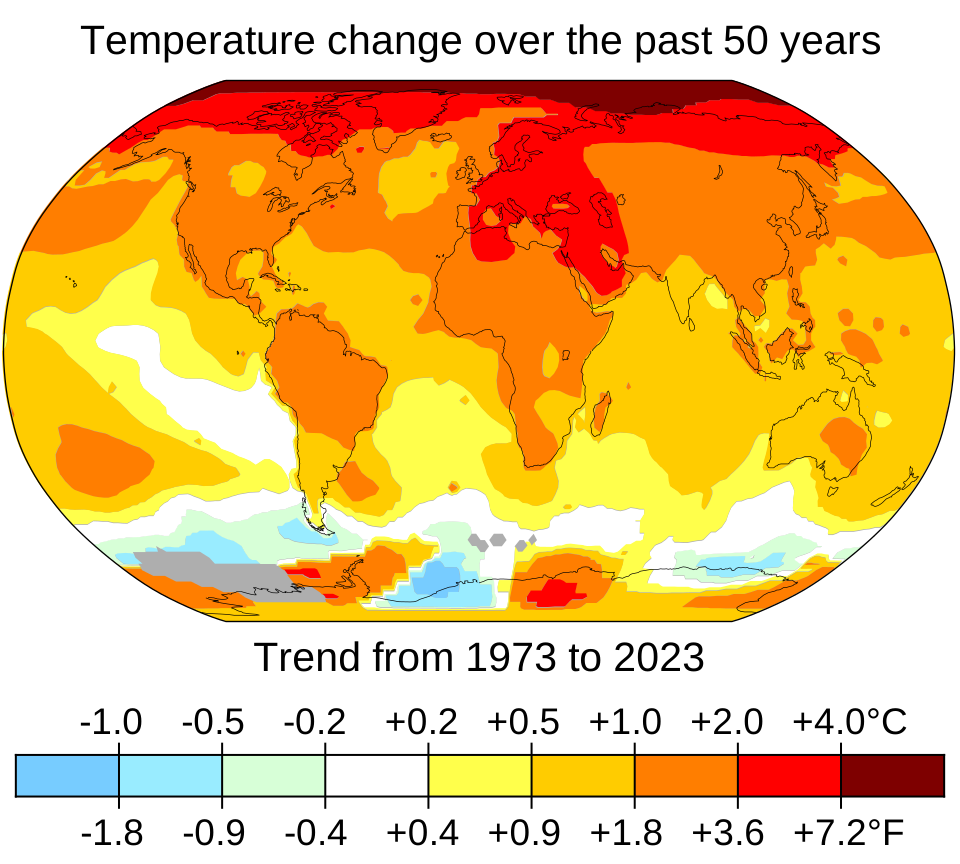
Some key facts and numbers about global climate models include: the average global temperature has risen by about 1°C since the late 19th century, with 2020 being the hottest year on record. The concentration of carbon dioxide in the atmosphere has increased by about 40% since the Industrial Revolution, primarily due to fossil fuel burning and land use changes. The IPCC projects that the global temperature will continue to rise, with a likely range of 1.5°C to 2°C above pre-industrial levels by 2050. According to the Intergovernmental Panel on Climate Change (IPCC), the current rate of global warming is likely to continue, with severe consequences for ecosystems, human health, and the economy.
👥 Key People and Organizations
Key people and organizations involved in the development and application of global climate models include climate scientists like James Hansen and Katherine Hayhoe, who have made significant contributions to our understanding of climate change. Organizations like the National Science Foundation (NSF) and the Environmental Protection Agency (EPA) provide critical funding and support for climate research and modeling. The University of Colorado and the Massachusetts Institute of Technology (MIT) are also major centers for climate research and education.
🌍 Cultural Impact and Influence
Global climate models have had a significant cultural impact, influencing the way we think about the environment and our role in shaping the planet's future. The models have been used in a variety of contexts, from predicting weather patterns to informing policy decisions. For example, the City of New York has used climate models to develop its climate resilience plan, which aims to protect the city from the impacts of climate change. The models have also been used in climate justice movements, highlighting the disproportionate impacts of climate change on vulnerable populations.
⚡ Current State and Latest Developments
The current state of global climate models is one of rapid advancement, with new models and techniques being developed all the time. For instance, the Next Generation Climate Model is being developed by the Department of Energy to provide more accurate and detailed simulations of the climate system. The latest developments in climate modeling include the use of artificial intelligence (AI) and machine learning (ML) to improve model performance and predictability. As of 2022, global climate models are being used to study the impacts of climate change on agriculture and water resources.
🤔 Controversies and Debates
Despite their importance, global climate models are not without controversy. Some critics argue that the models are too complex and difficult to understand, while others claim that they are not accurate enough. For example, the climate change denial movement has questioned the validity of climate models, citing uncertainties and limitations. However, the vast majority of climate scientists agree that the models are a powerful tool for understanding and predicting climate change. The American Geophysical Union (AGU) and the American Meteorological Society (AMS) have both endorsed the use of climate models in climate research and policy decision-making.
🔮 Future Outlook and Predictions
Looking to the future, global climate models will continue to play a critical role in shaping our understanding of the climate system and informing policy decisions. As the models become more advanced and accurate, they will be used to study a wide range of topics, from the impacts of climate change on human health to the effects of renewable energy on the climate system. For instance, the National Institutes of Health (NIH) is using climate models to study the impacts of climate change on vector-borne diseases. The United Nations (UN) is also using climate models to develop its Sustainable Development Goals (SDGs).
💡 Practical Applications
Global climate models have many practical applications, from predicting weather patterns to informing policy decisions. For example, the National Weather Service (NWS) uses climate models to predict weather patterns and issue warnings for severe weather events. The models are also used in climate resilience planning, helping communities to prepare for and adapt to the impacts of climate change. The Federal Emergency Management Agency (FEMA) is using climate models to develop its disaster risk reduction plans.
Key Facts
- Year
- 2022
- Origin
- Global
- Category
- public-health
- Type
- concept
Frequently Asked Questions
What is a global climate model?
A global climate model is a complex computer simulation that analyzes the interactions within the Earth's climate system, including the atmosphere, oceans, land surfaces, and ice. The models are used to understand and predict climate change, its impacts, and the effects of various mitigation and adaptation strategies. For example, the Community Earth System Model (CESM) is a global climate model that simulates the Earth's climate system and is used to study the impacts of climate change on agriculture and water resources.
How do global climate models work?
Global climate models work by solving complex mathematical equations that describe the behavior of the climate system. The models take into account factors such as temperature, humidity, atmospheric circulation, and ocean currents. The models are run on powerful computers, which can simulate the climate system over long periods of time. For instance, the Geophysical Fluid Dynamics Laboratory (GFDL) model uses a combination of atmospheric, oceanic, and land models to simulate the Earth's climate system.
What are the key applications of global climate models?
Global climate models have many practical applications, from predicting weather patterns to informing policy decisions. The models are used in climate resilience planning, helping communities to prepare for and adapt to the impacts of climate change. For example, the City of New York has used climate models to develop its climate resilience plan, which aims to protect the city from the impacts of climate change.
What are the limitations of global climate models?
Global climate models have several limitations, including the complexity of the climate system, the uncertainty of model parameters, and the limited resolution of the models. However, the models are continually being improved, with new techniques and data being incorporated to increase their accuracy and predictability. For instance, the Next Generation Climate Model is being developed by the Department of Energy to provide more accurate and detailed simulations of the climate system.
How are global climate models used in policy decision-making?
Global climate models are used in policy decision-making to inform decisions about climate change mitigation and adaptation. The models provide scenarios of future climate change and its potential consequences, which can be used to develop strategies for reducing greenhouse gas emissions and preparing for the impacts of climate change. For example, the United Nations (UN) is using climate models to develop its Sustainable Development Goals (SDGs).
What is the current state of global climate models?
The current state of global climate models is one of rapid advancement, with new models and techniques being developed all the time. The latest developments in climate modeling include the use of artificial intelligence (AI) and machine learning (ML) to improve model performance and predictability. As of 2022, global climate models are being used to study the impacts of climate change on human health and ecosystems.
How are global climate models used in climate justice movements?
Global climate models are used in climate justice movements to highlight the disproportionate impacts of climate change on vulnerable populations. The models provide scenarios of future climate change and its potential consequences, which can be used to develop strategies for reducing greenhouse gas emissions and preparing for the impacts of climate change. For example, the NAACP is using climate models to study the impacts of climate change on environmental justice and human rights.