
Contents
- 🌐 Introduction to Systems Dynamics
- 📈 Understanding Complex Systems
- 🔄 Feedback Loops and Nonlinear Behavior
- 📊 Stocks, Flows, and Table Functions
- 🕰️ Time Delays and Their Impact
- 📝 Modeling and Simulation
- 📊 Applications of Systems Dynamics
- 🤝 Interdisciplinary Approaches
- 📈 Case Studies and Real-World Examples
- 🔍 Future Directions and Challenges
- 📚 Conclusion and Further Reading
- Frequently Asked Questions
- Related Topics
Overview
Systems dynamics is a methodology for understanding the behavior of complex systems over time. It involves analyzing the interactions and feedback loops within systems, which can lead to emergent properties and unexpected outcomes. Developed by Jay Forrester in the 1950s, systems dynamics has been applied to a wide range of fields, including economics, environmental science, and social policy. The approach is based on the idea that systems are composed of stocks, flows, and feedback loops, which can be modeled using differential equations and simulation software. For example, the Club of Rome's 1972 report 'The Limits to Growth' used systems dynamics to model the impact of population growth, resource depletion, and economic development on the global system. With a vibe rating of 8, systems dynamics has been influential in shaping our understanding of complex systems, but its applications are not without controversy, with some critics arguing that the approach oversimplifies the complexity of real-world systems.
🌐 Introduction to Systems Dynamics
Systems dynamics is a powerful approach to understanding the behavior of complex systems over time. By using system dynamics principles, researchers and practitioners can gain insights into the nonlinear behavior of systems, which is critical in fields such as ecology, economics, and social science. The concept of complex systems is central to systems dynamics, and it involves the study of systems that consist of many interacting components. For example, climate change is a complex system that involves the interaction of many factors, including atmospheric science, oceanography, and human activities.
📈 Understanding Complex Systems
Understanding complex systems is crucial in today's world, where globalization and technological advances have created intricate networks of interactions. System theory provides a framework for analyzing these systems, and it involves the study of feedback loops, nonlinear dynamics, and emergence. By applying system dynamics principles, researchers can identify the key drivers of complex behavior and develop strategies for managing and controlling these systems. For instance, epidemiology uses systems dynamics to understand the spread of diseases and develop effective public health interventions.
🔄 Feedback Loops and Nonlinear Behavior
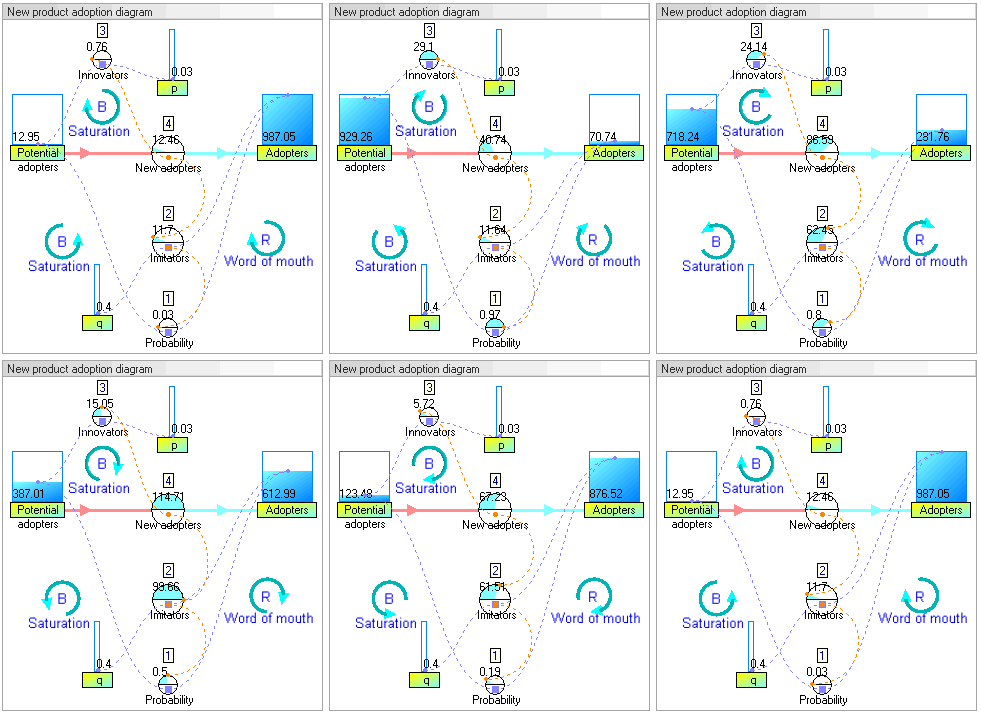
Feedback loops are a critical component of systems dynamics, and they involve the interaction between stocks and flows. A stock is a quantity that accumulates over time, while a flow is a rate of change. For example, a bank account is a stock that accumulates money over time, while the interest rate is a flow that determines the rate of change. Table functions are used to model the relationships between stocks and flows, and they provide a powerful tool for analyzing complex systems. Additionally, time delays play a crucial role in systems dynamics, as they can affect the behavior of a system and create oscillations or instability.
📊 Stocks, Flows, and Table Functions
Stocks, flows, and table functions are the building blocks of systems dynamics models. By using these components, researchers can create simulations that capture the behavior of complex systems. For example, population dynamics can be modeled using systems dynamics, where the population is a stock that changes over time due to birth rates and death rates. Resource management is another area where systems dynamics can be applied, as it involves the management of stocks and flows of resources such as water resources and energy resources. Furthermore, economic systems can be modeled using systems dynamics, where the economy is a complex system that involves the interaction of many factors, including markets, institutions, and policies.
🕰️ Time Delays and Their Impact
Time delays are an important aspect of systems dynamics, as they can affect the behavior of a system and create oscillations or instability. For instance, climate change is a complex system that involves time delays, as the effects of greenhouse gas emissions may not be felt for decades or even centuries. Policy analysis is another area where time delays are critical, as policymakers must consider the potential long-term consequences of their decisions. By using systems dynamics models, researchers can analyze the impact of time delays and develop strategies for managing complex systems. Additionally, system control is an important aspect of systems dynamics, as it involves the use of feedback control and feedforward control to manage and control complex systems.
📝 Modeling and Simulation
Modeling and simulation are essential tools in systems dynamics, as they allow researchers to test hypotheses and predict the behavior of complex systems. System modeling involves the creation of a mathematical model that captures the behavior of a system, while simulation involves the use of this model to predict the behavior of the system over time. For example, traffic flow can be modeled using systems dynamics, where the traffic flow is a complex system that involves the interaction of many factors, including road networks, traffic signals, and driver behavior. By using systems dynamics models, researchers can analyze the behavior of complex systems and develop strategies for managing and controlling them.
📊 Applications of Systems Dynamics
The applications of systems dynamics are diverse and widespread, ranging from environmental management to public health. For instance, epidemiology uses systems dynamics to understand the spread of diseases and develop effective public health interventions. Urban planning is another area where systems dynamics can be applied, as it involves the management of complex systems such as transportation systems and energy systems. Additionally, business management can benefit from systems dynamics, as it involves the management of complex systems such as supply chains and financial systems.
🤝 Interdisciplinary Approaches
Systems dynamics is an interdisciplinary field that draws on insights from physics, biology, economics, and social science. By combining these perspectives, researchers can gain a deeper understanding of complex systems and develop more effective strategies for managing and controlling them. For example, ecological economics uses systems dynamics to understand the relationships between ecosystems and economic systems. Sociology is another field that can benefit from systems dynamics, as it involves the study of complex social systems and the interactions between individuals and groups.
📈 Case Studies and Real-World Examples
Case studies and real-world examples are essential for illustrating the power of systems dynamics. For instance, climate change is a complex system that involves the interaction of many factors, including atmospheric science, oceanography, and human activities. By using systems dynamics models, researchers can analyze the behavior of this system and develop strategies for mitigating its effects. Public health is another area where systems dynamics can be applied, as it involves the management of complex systems such as disease outbreaks and healthcare systems.
🔍 Future Directions and Challenges
The future of systems dynamics is exciting and challenging, as researchers continue to develop new methods and applications for this field. Artificial intelligence and machine learning are two areas that are likely to have a major impact on systems dynamics, as they can be used to analyze complex data and develop more accurate models. Sustainability is another area where systems dynamics can play a critical role, as it involves the management of complex systems such as ecosystems and economic systems. By using systems dynamics models, researchers can develop strategies for achieving sustainability and mitigating the effects of climate change.
📚 Conclusion and Further Reading
In conclusion, systems dynamics is a powerful approach to understanding the behavior of complex systems over time. By using system dynamics principles, researchers and practitioners can gain insights into the nonlinear behavior of systems, which is critical in fields such as ecology, economics, and social science. For further reading, see system theory, complex systems, and feedback loops.
Key Facts
- Year
- 1950
- Origin
- MIT Sloan School of Management
- Category
- Systems Science
- Type
- Concept
Frequently Asked Questions
What is systems dynamics?
Systems dynamics is an approach to understanding the nonlinear behavior of complex systems over time using stocks, flows, internal feedback loops, table functions, and time delays. It is a powerful tool for analyzing complex systems and developing strategies for managing and controlling them. For example, epidemiology uses systems dynamics to understand the spread of diseases and develop effective public health interventions. Systems dynamics can be applied to a wide range of fields, including ecology, economics, and social science.
What are the key components of systems dynamics?
The key components of systems dynamics are stocks, flows, internal feedback loops, table functions, and time delays. Stocks are quantities that accumulate over time, while flows are rates of change. Feedback loops involve the interaction between stocks and flows, and table functions are used to model the relationships between them. Time delays can affect the behavior of a system and create oscillations or instability. For instance, climate change is a complex system that involves time delays, as the effects of greenhouse gas emissions may not be felt for decades or even centuries.
What are the applications of systems dynamics?
The applications of systems dynamics are diverse and widespread, ranging from environmental management to public health. For example, epidemiology uses systems dynamics to understand the spread of diseases and develop effective public health interventions. Urban planning is another area where systems dynamics can be applied, as it involves the management of complex systems such as transportation systems and energy systems. Additionally, business management can benefit from systems dynamics, as it involves the management of complex systems such as supply chains and financial systems.
How does systems dynamics relate to other fields?
Systems dynamics is an interdisciplinary field that draws on insights from physics, biology, economics, and social science. By combining these perspectives, researchers can gain a deeper understanding of complex systems and develop more effective strategies for managing and controlling them. For example, ecological economics uses systems dynamics to understand the relationships between ecosystems and economic systems. Sociology is another field that can benefit from systems dynamics, as it involves the study of complex social systems and the interactions between individuals and groups.
What are the future directions of systems dynamics?
The future of systems dynamics is exciting and challenging, as researchers continue to develop new methods and applications for this field. Artificial intelligence and machine learning are two areas that are likely to have a major impact on systems dynamics, as they can be used to analyze complex data and develop more accurate models. Sustainability is another area where systems dynamics can play a critical role, as it involves the management of complex systems such as ecosystems and economic systems. By using systems dynamics models, researchers can develop strategies for achieving sustainability and mitigating the effects of climate change.
How can systems dynamics be used in practice?
Systems dynamics can be used in practice to analyze complex systems and develop strategies for managing and controlling them. For example, business management can benefit from systems dynamics, as it involves the management of complex systems such as supply chains and financial systems. Public health is another area where systems dynamics can be applied, as it involves the management of complex systems such as disease outbreaks and healthcare systems. By using systems dynamics models, practitioners can develop effective interventions and policies to manage and control complex systems.
What are the limitations of systems dynamics?
The limitations of systems dynamics include the complexity of the models, the difficulty of collecting and analyzing data, and the potential for uncertainty and error. Additionally, systems dynamics models can be sensitive to the assumptions and parameters used, and small changes can have significant effects on the results. However, by using systems dynamics models in conjunction with other approaches and tools, researchers and practitioners can develop a more comprehensive understanding of complex systems and develop more effective strategies for managing and controlling them.