
Contents
- 🌐 Introduction to System Dynamics
- 📈 Understanding Nonlinear Behaviour
- 🔄 Internal Feedback Loops
- 📊 Stock and Flow Diagrams
- 🕰️ Time Delays and Table Functions
- 🌈 Applications of System Dynamics
- 📊 Case Studies and Examples
- 🤔 Criticisms and Limitations
- 🌐 Future Directions and Research
- 📚 Conclusion and Recommendations
- Frequently Asked Questions
- Related Topics
Overview
System dynamics (SD) is an approach to understanding the nonlinear behaviour of complex systems over time using stocks, flows, internal feedback loops, table functions and time delays. This method was developed in the 1950s by Jay Forrester and has since been applied to a wide range of fields, including economics, environmental science, and social science. The core idea of system dynamics is to model complex systems as a set of interconnected components that interact and influence each other over time. By analyzing these interactions, system dynamicists can identify patterns and trends that might not be immediately apparent. For example, the system dynamics modeling of population growth can help us understand how different factors, such as birth rates and death rates, affect the overall population size. Additionally, system dynamics can be used to study the behavior of complex systems in various fields, including biology and physics.
📈 Understanding Nonlinear Behaviour
One of the key features of system dynamics is its ability to capture nonlinear behaviour, which is characteristic of many complex systems. Nonlinear behaviour refers to the phenomenon where small changes in a system's inputs can lead to large and disproportionate changes in its outputs. This is in contrast to linear systems, where the output is directly proportional to the input. System dynamics can model nonlinear behaviour using nonlinear equations and feedback loops. For instance, the logistic map is a simple example of a nonlinear system that exhibits complex behavior. Furthermore, system dynamics can be used to study the behavior of complex systems in various fields, including chemistry and computer science. The complex systems theory provides a framework for understanding the behavior of complex systems, and system dynamics is a key tool in this field.
🔄 Internal Feedback Loops
Internal feedback loops are a crucial component of system dynamics. A feedback loop is a closed loop of causality, where the output of a system is fed back into the system as an input. Feedback loops can be either positive or negative, depending on whether they amplify or dampen the system's behaviour. System dynamicists use feedback loop diagrams to visualize and analyze these loops. For example, the population growth model includes a feedback loop that represents the effect of population size on birth and death rates. Additionally, system dynamics can be used to study the behavior of complex systems in various fields, including ecology and engineering. The system thinking approach provides a framework for understanding the behavior of complex systems, and system dynamics is a key tool in this field.
📊 Stock and Flow Diagrams
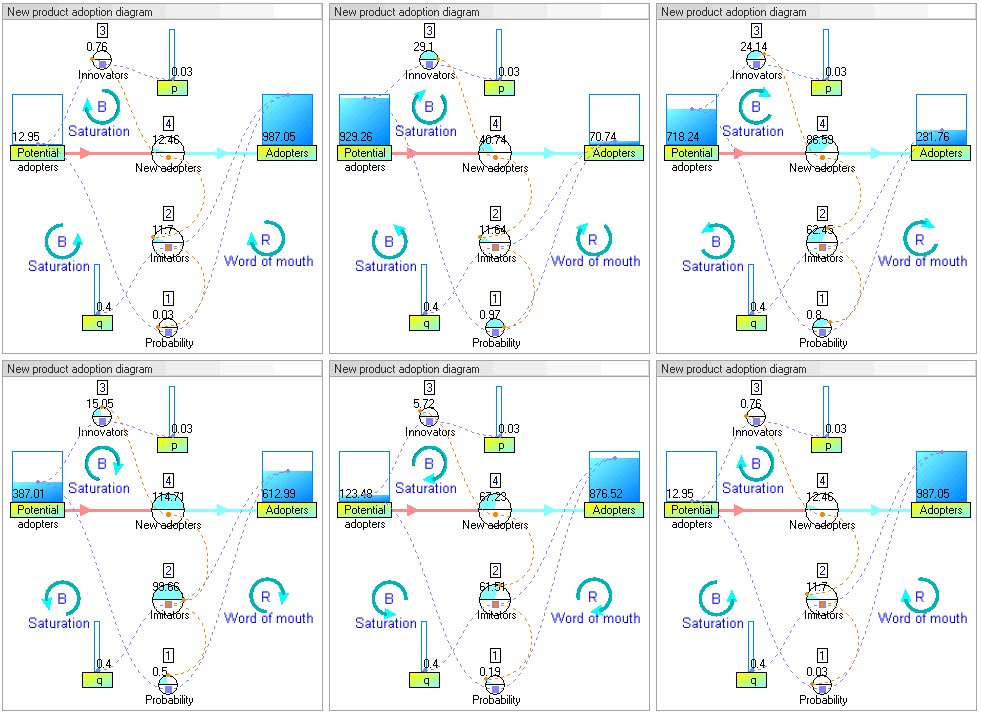
Stock and flow diagrams are a key tool in system dynamics. A stock is a quantity that accumulates over time, such as the amount of water in a reservoir. A flow is a rate at which a stock changes, such as the rate at which water flows into or out of the reservoir. System dynamicists use stock and flow diagrams to model the behaviour of complex systems. For instance, the water resource management system can be modeled using stock and flow diagrams to understand the dynamics of water supply and demand. Furthermore, system dynamics can be used to study the behavior of complex systems in various fields, including geology and meteorology. The system dynamics modeling approach provides a framework for understanding the behavior of complex systems, and stock and flow diagrams are a key tool in this field.
🕰️ Time Delays and Table Functions
Time delays and table functions are also important components of system dynamics. A time delay is a delay between the time a cause occurs and the time its effect is felt. Table functions are used to represent nonlinear relationships between variables. System dynamicists use time delay equations and table function models to capture these effects. For example, the epidemiology of infectious diseases can be modeled using time delays and table functions to understand the spread of disease. Additionally, system dynamics can be used to study the behavior of complex systems in various fields, including psychology and sociology. The complex systems modeling approach provides a framework for understanding the behavior of complex systems, and time delays and table functions are key tools in this field.
🌈 Applications of System Dynamics
System dynamics has a wide range of applications, from business and economics to environmental science and social science. It can be used to model and analyze complex systems, identify patterns and trends, and make predictions about future behaviour. For instance, system dynamics can be used to study the behavior of financial systems and understand the dynamics of economic growth. Additionally, system dynamics can be used to study the behavior of complex systems in various fields, including biology and physics. The system dynamics modeling approach provides a framework for understanding the behavior of complex systems, and has been applied to a wide range of fields.
📊 Case Studies and Examples
There are many case studies and examples of system dynamics in action. For example, the Club of Rome used system dynamics to model the global economy and environment, and predict the consequences of different policy scenarios. The limits to growth model is a classic example of system dynamics in action. Additionally, system dynamics can be used to study the behavior of complex systems in various fields, including ecology and engineering. The system thinking approach provides a framework for understanding the behavior of complex systems, and system dynamics is a key tool in this field. For instance, the water resource management system can be modeled using system dynamics to understand the dynamics of water supply and demand.
🤔 Criticisms and Limitations
Despite its many strengths, system dynamics is not without its criticisms and limitations. Some critics argue that system dynamics is too simplistic, and fails to capture the full complexity of real-world systems. Others argue that system dynamics is too focused on quantitative modeling, and neglects the importance of qualitative factors. For example, the system dynamics critique argues that system dynamics is limited by its reliance on linear programming and optimization techniques. Additionally, system dynamics can be used to study the behavior of complex systems in various fields, including psychology and sociology. The complex systems modeling approach provides a framework for understanding the behavior of complex systems, and system dynamics is a key tool in this field.
🌐 Future Directions and Research
As system dynamics continues to evolve and improve, it is likely to play an increasingly important role in a wide range of fields. One area of future research is the development of new methods and tools for modeling and analyzing complex systems. For example, the system dynamics software is being developed to provide a platform for system dynamicists to model and analyze complex systems. Additionally, system dynamics can be used to study the behavior of complex systems in various fields, including biology and physics. The system dynamics modeling approach provides a framework for understanding the behavior of complex systems, and has been applied to a wide range of fields. Another area of research is the application of system dynamics to new and emerging fields, such as artificial intelligence and data science.
📚 Conclusion and Recommendations
In conclusion, system dynamics is a powerful approach to understanding the nonlinear behaviour of complex systems over time. By using stocks, flows, internal feedback loops, table functions, and time delays, system dynamicists can model and analyze complex systems, identify patterns and trends, and make predictions about future behaviour. As the field continues to evolve and improve, it is likely to play an increasingly important role in a wide range of fields, from business and economics to environmental science and social science. The system thinking approach provides a framework for understanding the behavior of complex systems, and system dynamics is a key tool in this field. For instance, the water resource management system can be modeled using system dynamics to understand the dynamics of water supply and demand.
Key Facts
- Year
- 1950
- Origin
- MIT Sloan School of Management
- Category
- Systems Science
- Type
- Concept
Frequently Asked Questions
What is system dynamics?
System dynamics is an approach to understanding the nonlinear behaviour of complex systems over time using stocks, flows, internal feedback loops, table functions and time delays. It was developed in the 1950s by Jay Forrester and has since been applied to a wide range of fields, including economics, environmental science, and social science. System dynamics can be used to model and analyze complex systems, identify patterns and trends, and make predictions about future behaviour.
What are the key components of system dynamics?
The key components of system dynamics are stocks, flows, internal feedback loops, table functions, and time delays. Stocks are quantities that accumulate over time, such as the amount of water in a reservoir. Flows are rates at which stocks change, such as the rate at which water flows into or out of the reservoir. Internal feedback loops are closed loops of causality, where the output of a system is fed back into the system as an input. Table functions are used to represent nonlinear relationships between variables, and time delays are delays between the time a cause occurs and the time its effect is felt.
What are some applications of system dynamics?
System dynamics has a wide range of applications, from business and economics to environmental science and social science. It can be used to model and analyze complex systems, identify patterns and trends, and make predictions about future behaviour. For example, system dynamics can be used to study the behavior of financial systems and understand the dynamics of economic growth. Additionally, system dynamics can be used to study the behavior of complex systems in various fields, including biology and physics.
What are some criticisms of system dynamics?
Despite its many strengths, system dynamics is not without its criticisms and limitations. Some critics argue that system dynamics is too simplistic, and fails to capture the full complexity of real-world systems. Others argue that system dynamics is too focused on quantitative modeling, and neglects the importance of qualitative factors. For example, the system dynamics critique argues that system dynamics is limited by its reliance on linear programming and optimization techniques.
What is the future of system dynamics?
As system dynamics continues to evolve and improve, it is likely to play an increasingly important role in a wide range of fields. One area of future research is the development of new methods and tools for modeling and analyzing complex systems. For example, the system dynamics software is being developed to provide a platform for system dynamicists to model and analyze complex systems. Additionally, system dynamics can be used to study the behavior of complex systems in various fields, including biology and physics.