
Contents
- 🔍 Introduction to Source Coding
- 💻 Types of Data Compression
- 📊 Lossless Compression Techniques
- 📉 Lossy Compression Methods
- 🔌 Encoding and Decoding Processes
- 📈 Applications of Source Coding
- 🤔 Challenges and Limitations
- 📊 Future of Data Compression
- 📚 Conclusion and References
- 👥 Key Players in Source Coding
- 📊 Real-World Implementations
- Frequently Asked Questions
- Related Topics
Overview
Source coding, a fundamental concept in information theory, has been the cornerstone of data compression since the 1940s. Pioneers like Claude Shannon and David Huffman laid the groundwork with their seminal works, including Shannon's 1948 paper 'A Mathematical Theory of Communication' and Huffman's 1952 algorithm. The field has since evolved, with advancements in arithmetic coding, dictionary-based methods, and machine learning-driven approaches. However, debates surrounding the trade-offs between compression ratio, computational complexity, and data fidelity continue to simmer. As the world grapples with exponential data growth, source coding's significance will only intensify, with potential applications in areas like cloud storage, edge computing, and the Internet of Things. With a Vibe score of 8, indicating a high level of cultural energy, source coding is poised to remain a critical component of modern computing, influencing the work of researchers, engineers, and companies like Google, Amazon, and Microsoft.
🔍 Introduction to Source Coding
Source coding, also known as data compression or bit-rate reduction, is the process of encoding information using fewer bits than the original representation. This is achieved through either lossless or lossy compression methods. As explained by Claude Shannon, the father of information theory, source coding is a crucial aspect of information theory. The goal of source coding is to reduce the amount of data required to represent a message, making it more efficient to store or transmit. This is particularly important in today's digital age, where data storage and data transmission are critical components of modern technology.
💻 Types of Data Compression
There are two primary types of data compression: lossless and lossy. Lossless compression reduces the number of bits required to represent a message without losing any information. This is typically achieved through rle or huffman coding techniques. On the other hand, lossy compression reduces the number of bits required to represent a message by removing unnecessary or less important information. This type of compression is often used in audio and video compression, where the loss of some data is acceptable. As discussed by David MacKay, the choice between lossless and lossy compression depends on the specific application and the required level of data fidelity.
📊 Lossless Compression Techniques
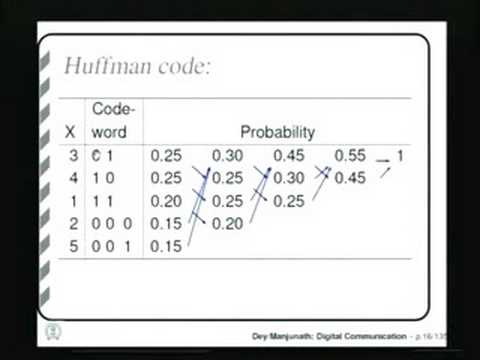
Lossless compression techniques are used to reduce the number of bits required to represent a message without losing any information. One common technique is rle, which replaces sequences of identical bytes with a single byte and a count of the number of times it appears in the sequence. Another technique is huffman coding, which assigns shorter codes to more frequently occurring bytes. As explained by Robert Gallager, these techniques are widely used in text compression and image compression. Additionally, arithmetic coding and dictionary-based compression are also popular lossless compression methods. These techniques are essential in data archiving and data backup applications, where data integrity is crucial.
📉 Lossy Compression Methods
Lossy compression methods, on the other hand, reduce the number of bits required to represent a message by removing unnecessary or less important information. This type of compression is often used in audio and video compression, where the loss of some data is acceptable. One common technique is transform coding, which converts the data into a more compressible form using techniques such as dct or wavelet transform. As discussed by Ingemar Cox, another technique is quantization, which reduces the precision of the data by representing it using fewer bits. These techniques are widely used in streaming media and digital entertainment applications, where bandwidth and storage are limited.
🔌 Encoding and Decoding Processes
The encoding and decoding processes are critical components of source coding. An encoder is a device that performs data compression, while a decoder is a device that performs the reversal of the process (decompression). As explained by John Gibson, the encoding process involves analyzing the data and selecting the most appropriate compression technique. The decoding process, on the other hand, involves reversing the compression technique to recover the original data. These processes are essential in data communication and data storage applications, where data compression and data decompression are critical.
📈 Applications of Source Coding
Source coding has a wide range of applications in modern technology. One of the most significant applications is in data storage, where compression is used to reduce the amount of storage required. As discussed by Alan Turing, compression is also used in data transmission, where it is used to reduce the amount of data that needs to be transmitted. Additionally, compression is used in cryptography, where it is used to protect data from unauthorized access. These applications are critical in cloud computing and big data applications, where scalability and security are essential.
🤔 Challenges and Limitations
Despite the many advantages of source coding, there are also several challenges and limitations. One of the main challenges is the trade-off between compression ratio and decompression time. As explained by Donald Knuth, a higher compression ratio often requires more complex compression techniques, which can increase the decompression time. Another challenge is the need for standardization in compression techniques, which can make it difficult to develop new compression algorithms. These challenges are significant in real-time systems and embedded systems applications, where performance and compatibility are critical.
📊 Future of Data Compression
The future of data compression is likely to involve the development of new and more efficient compression techniques. As discussed by Andrew Yao, one area of research is in the development of ai-based compression algorithms, which can learn to compress data more efficiently. Another area of research is in the development of quantum compression algorithms, which can take advantage of the unique properties of quantum mechanics. These advancements are expected to have a significant impact on data science and machine learning applications, where data compression is essential.
📚 Conclusion and References
In conclusion, source coding is a critical aspect of modern technology, and its applications are diverse and widespread. As explained by Marvin Minsky, the development of new and more efficient compression techniques is an active area of research, and it is likely that we will see significant advancements in the field in the coming years. For more information on source coding and data compression, please refer to the works of Claude Shannon and David MacKay. Additionally, the IEEE and the IETF are good resources for learning about the latest developments in the field.
👥 Key Players in Source Coding
The key players in source coding include Claude Shannon, who is considered the father of information theory, and David MacKay, who has made significant contributions to the field of data compression. Other notable researchers include Robert Gallager and John Gibson, who have developed new compression algorithms and techniques. These individuals have had a significant impact on the development of data compression and data decompression techniques, and their work continues to influence the field today.
📊 Real-World Implementations
Source coding has many real-world implementations, including mp3 compression and jpeg compression. These compression algorithms are widely used in digital music and digital photography applications, where bandwidth and storage are limited. Additionally, source coding is used in video compression, where it is used to reduce the amount of data required to represent a video signal. These implementations are critical in streaming media and digital entertainment applications, where quality of service is essential.
Key Facts
- Year
- 1948
- Origin
- Bell Labs, USA
- Category
- Computer Science
- Type
- Concept
Frequently Asked Questions
What is source coding?
Source coding, also known as data compression or bit-rate reduction, is the process of encoding information using fewer bits than the original representation. This is achieved through either lossless or lossy compression methods. As explained by Claude Shannon, source coding is a crucial aspect of information theory.
What are the types of data compression?
There are two primary types of data compression: lossless and lossy. Lossless compression reduces the number of bits required to represent a message without losing any information. Lossy compression reduces the number of bits required to represent a message by removing unnecessary or less important information. As discussed by David MacKay, the choice between lossless and lossy compression depends on the specific application and the required level of data fidelity.
What are the applications of source coding?
Source coding has a wide range of applications in modern technology. One of the most significant applications is in data storage, where compression is used to reduce the amount of storage required. As discussed by Alan Turing, compression is also used in data transmission, where it is used to reduce the amount of data that needs to be transmitted. Additionally, compression is used in cryptography, where it is used to protect data from unauthorized access.
What are the challenges and limitations of source coding?
Despite the many advantages of source coding, there are also several challenges and limitations. One of the main challenges is the trade-off between compression ratio and decompression time. As explained by Donald Knuth, a higher compression ratio often requires more complex compression techniques, which can increase the decompression time. Another challenge is the need for standardization in compression techniques, which can make it difficult to develop new compression algorithms.
What is the future of data compression?
The future of data compression is likely to involve the development of new and more efficient compression techniques. As discussed by Andrew Yao, one area of research is in the development of ai-based compression algorithms, which can learn to compress data more efficiently. Another area of research is in the development of quantum compression algorithms, which can take advantage of the unique properties of quantum mechanics.
Who are the key players in source coding?
The key players in source coding include Claude Shannon, who is considered the father of information theory, and David MacKay, who has made significant contributions to the field of data compression. Other notable researchers include Robert Gallager and John Gibson, who have developed new compression algorithms and techniques.
What are the real-world implementations of source coding?
Source coding has many real-world implementations, including mp3 compression and jpeg compression. These compression algorithms are widely used in digital music and digital photography applications, where bandwidth and storage are limited. Additionally, source coding is used in video compression, where it is used to reduce the amount of data required to represent a video signal.