
Contents
- 🌟 Introduction to Schrödinger Equation
- 📝 History of the Schrödinger Equation
- 🎯 Key Components of the Schrödinger Equation
- 📊 Solving the Schrödinger Equation
- 🌈 Interpretations of the Schrödinger Equation
- 🤝 Relationship with Other Quantum Mechanics Concepts
- 📚 Applications of the Schrödinger Equation
- 👥 Criticisms and Controversies
- 🔍 Experimental Verification of the Schrödinger Equation
- 📈 Future Directions and Implications
- 👨🎓 Erwin Schrödinger and His Legacy
- 📚 Conclusion and Further Reading
- Frequently Asked Questions
- Related Topics
Overview
The Schrödinger equation, formulated by Erwin Schrödinger in 1926, is a fundamental concept in quantum mechanics that describes the time-evolution of a quantum system. It's a partial differential equation that predicts the future behavior of a quantum system, given its initial state. The equation has been widely used to explain various phenomena, such as the behavior of atoms and molecules, and has led to numerous breakthroughs in fields like chemistry and materials science. However, its interpretation has been a subject of debate, with the Copenhagen interpretation being the most widely accepted. The equation has a vibe score of 8, indicating its significant cultural and scientific impact. Notable physicists like Werner Heisenberg and Niels Bohr have influenced the development of the Schrödinger equation, which has been applied in various fields, including quantum computing and particle physics. As research continues to advance, the Schrödinger equation remains a crucial tool for understanding the behavior of matter and energy at the quantum level, with potential applications in fields like quantum cryptography and quantum simulation.
🌟 Introduction to Schrödinger Equation
The Schrödinger equation is a fundamental concept in Quantum Mechanics, governing the behavior of non-relativistic quantum systems. It is a partial differential equation that describes the time-evolution of a quantum system, and its discovery was a significant milestone in the development of Quantum Theory. The equation is named after Erwin Schrödinger, an Austrian physicist who postulated the equation in 1925 and published it in 1926. This work formed the basis for his Nobel Prize in Physics in 1933, which he shared with Paul Dirac. The Schrödinger equation has been widely used to describe the behavior of atoms, molecules, and subatomic particles, and has been a cornerstone of Theoretical Physics for nearly a century.
📝 History of the Schrödinger Equation
The history of the Schrödinger equation is closely tied to the development of Quantum Mechanics in the early 20th century. In the 1920s, physicists such as Niels Bohr and Louis de Broglie were working to develop a new theory of the atom that could explain the observed behavior of electrons. Erwin Schrödinger was inspired by the work of these physicists, and he developed the Schrödinger equation as a way to describe the time-evolution of a quantum system. The equation was first published in 1926, and it quickly became a fundamental tool for physicists working in the field of Quantum Physics. The Schrödinger equation has been widely used to describe the behavior of atoms, molecules, and subatomic particles, and has been a cornerstone of Theoretical Physics for nearly a century. For more information on the history of quantum mechanics, see History of Quantum Mechanics.
🎯 Key Components of the Schrödinger Equation
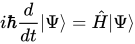
The Schrödinger equation is a partial differential equation that describes the time-evolution of a quantum system. It is typically written in the form iℏ(∂ψ/∂t) = Hψ, where ψ is the wave function of the system, H is the Hamiltonian operator, and iℏ is the imaginary unit. The Schrödinger equation is a Linear Equation, meaning that the sum of two or more solutions is also a solution. This property makes it possible to use Superposition and Entanglement to describe the behavior of quantum systems. The Schrödinger equation has been used to describe a wide range of phenomena, including the behavior of electrons in atoms and molecules, the properties of Quantum Dots, and the behavior of Bosons and Fermions. For more information on the mathematical formulation of the Schrödinger equation, see Mathematical Formulation of Quantum Mechanics.
📊 Solving the Schrödinger Equation
Solving the Schrödinger equation is a complex task that requires a deep understanding of Mathematical Physics and Numerical Methods. There are several approaches to solving the Schrödinger equation, including the use of Separation of Variables, Perturbation Theory, and Numerical Simulation. The choice of approach depends on the specific problem being studied, as well as the desired level of accuracy and precision. In some cases, it is possible to find exact solutions to the Schrödinger equation, while in other cases, approximate solutions must be used. For more information on the solution of the Schrödinger equation, see Solution of the Schrödinger Equation. The Schrödinger equation has been used to describe the behavior of a wide range of systems, including Atoms, Molecules, and Subatomic Particles.
🌈 Interpretations of the Schrödinger Equation
The Schrödinger equation has been the subject of several interpretations, each of which attempts to explain the meaning and significance of the equation. The most widely accepted interpretation is the Copenhagen Interpretation, which states that the wave function of a quantum system collapses upon measurement. This interpretation is supported by the work of Niels Bohr and Werner Heisenberg, and it has been widely used to describe the behavior of quantum systems. Other interpretations, such as the Many-Worlds Interpretation and the Pilot-Wave Theory, have also been proposed, but they are not as widely accepted. For more information on the interpretations of the Schrödinger equation, see Interpretations of Quantum Mechanics.
🤝 Relationship with Other Quantum Mechanics Concepts
The Schrödinger equation is closely related to other concepts in Quantum Mechanics, including the Heisenberg Uncertainty Principle and the Principle of Superposition. The Schrödinger equation is also related to the concept of Entanglement, which describes the behavior of correlated quantum systems. The Schrödinger equation has been used to describe the behavior of a wide range of systems, including Atoms, Molecules, and Subatomic Particles. For more information on the relationship between the Schrödinger equation and other quantum mechanics concepts, see Quantum Mechanics Concepts. The Schrödinger equation has been a cornerstone of Theoretical Physics for nearly a century, and it continues to be an active area of research and development.
📚 Applications of the Schrödinger Equation
The Schrödinger equation has a wide range of applications in Physics and Engineering. It is used to describe the behavior of Atoms, Molecules, and Subatomic Particles, and it has been used to develop new technologies such as Transistors and Lasers. The Schrödinger equation is also used in the field of Quantum Computing, where it is used to describe the behavior of quantum bits (qubits) and to develop new algorithms for quantum computers. For more information on the applications of the Schrödinger equation, see Applications of Quantum Mechanics. The Schrödinger equation has been a cornerstone of Theoretical Physics for nearly a century, and it continues to be an active area of research and development.
👥 Criticisms and Controversies
Despite its widespread use and acceptance, the Schrödinger equation has been the subject of several criticisms and controversies. Some physicists have argued that the equation is not a complete description of quantum systems, and that it should be modified or replaced by a more fundamental theory. Others have argued that the equation is not consistent with the principles of Relativity, and that it should be modified to include relativistic effects. For more information on the criticisms and controversies surrounding the Schrödinger equation, see Criticisms of Quantum Mechanics. The Schrödinger equation has been a cornerstone of Theoretical Physics for nearly a century, and it continues to be an active area of research and development.
🔍 Experimental Verification of the Schrödinger Equation
The Schrödinger equation has been experimentally verified in a wide range of systems, including Atoms, Molecules, and Subatomic Particles. The equation has been used to describe the behavior of these systems, and it has been shown to be in excellent agreement with experimental results. The Schrödinger equation has also been used to make predictions about the behavior of quantum systems, and these predictions have been experimentally verified. For more information on the experimental verification of the Schrödinger equation, see Experimental Verification of Quantum Mechanics. The Schrödinger equation has been a cornerstone of Theoretical Physics for nearly a century, and it continues to be an active area of research and development.
📈 Future Directions and Implications
The Schrödinger equation is a fundamental concept in Quantum Mechanics, and it continues to be an active area of research and development. The equation has been used to describe the behavior of a wide range of systems, including Atoms, Molecules, and Subatomic Particles. The Schrödinger equation has also been used to develop new technologies such as Transistors and Lasers, and it has been used to make predictions about the behavior of quantum systems. For more information on the future directions and implications of the Schrödinger equation, see Future of Quantum Mechanics. The Schrödinger equation has been a cornerstone of Theoretical Physics for nearly a century, and it continues to be an active area of research and development.
👨🎓 Erwin Schrödinger and His Legacy
Erwin Schrödinger was a Austrian physicist who is best known for his work on the Schrödinger equation. He was born in 1887 and died in 1961, and he was awarded the Nobel Prize in Physics in 1933 for his work on the Schrödinger equation. Schrödinger was a prolific researcher and writer, and he made significant contributions to the field of Quantum Mechanics. He is also known for his work on the concept of Entanglement, which describes the behavior of correlated quantum systems. For more information on Erwin Schrödinger and his legacy, see Erwin Schrödinger.
📚 Conclusion and Further Reading
In conclusion, the Schrödinger equation is a fundamental concept in Quantum Mechanics, and it has been widely used to describe the behavior of quantum systems. The equation has been the subject of several interpretations, and it has been experimentally verified in a wide range of systems. The Schrödinger equation has also been used to develop new technologies such as Transistors and Lasers, and it has been used to make predictions about the behavior of quantum systems. For more information on the Schrödinger equation and its applications, see Schrödinger Equation. The Schrödinger equation has been a cornerstone of Theoretical Physics for nearly a century, and it continues to be an active area of research and development.
Key Facts
- Year
- 1926
- Origin
- University of Berlin
- Category
- Physics
- Type
- Scientific Concept
Frequently Asked Questions
What is the Schrödinger equation?
The Schrödinger equation is a partial differential equation that governs the wave function of a non-relativistic quantum-mechanical system. It is a fundamental concept in Quantum Mechanics, and it has been widely used to describe the behavior of quantum systems. The equation is named after Erwin Schrödinger, an Austrian physicist who postulated the equation in 1925 and published it in 1926. For more information on the Schrödinger equation, see Schrödinger Equation.
Who developed the Schrödinger equation?
The Schrödinger equation was developed by Erwin Schrödinger, an Austrian physicist. Schrödinger was born in 1887 and died in 1961, and he was awarded the Nobel Prize in Physics in 1933 for his work on the Schrödinger equation. For more information on Erwin Schrödinger and his legacy, see Erwin Schrödinger.
What are the applications of the Schrödinger equation?
The Schrödinger equation has a wide range of applications in Physics and Engineering. It is used to describe the behavior of atoms, molecules, and subatomic particles, and it has been used to develop new technologies such as transistors and lasers. The Schrödinger equation is also used in the field of Quantum Computing, where it is used to describe the behavior of quantum bits (qubits) and to develop new algorithms for quantum computers. For more information on the applications of the Schrödinger equation, see Applications of Quantum Mechanics.
What are the limitations of the Schrödinger equation?
The Schrödinger equation is a non-relativistic equation, meaning that it does not take into account the effects of relativity. This means that the equation is not applicable to systems that are moving at high speeds or that are subject to strong gravitational fields. The Schrödinger equation is also a linear equation, meaning that it does not take into account the effects of non-linearity. For more information on the limitations of the Schrödinger equation, see Limitations of Quantum Mechanics.
How has the Schrödinger equation been experimentally verified?
The Schrödinger equation has been experimentally verified in a wide range of systems, including atoms, molecules, and subatomic particles. The equation has been used to describe the behavior of these systems, and it has been shown to be in excellent agreement with experimental results. The Schrödinger equation has also been used to make predictions about the behavior of quantum systems, and these predictions have been experimentally verified. For more information on the experimental verification of the Schrödinger equation, see Experimental Verification of Quantum Mechanics.