
Contents
- 🌎 Introduction to Fertility Rates
- 📊 Understanding Total Fertility Rate (TFR)
- 👩👩👧👦 Factors Influencing Fertility Rates
- 🌍 Global Fertility Trends
- 📈 Declining Fertility Rates in Developed Countries
- 🚨 Implications of Low Fertility Rates
- 🤝 Government Policies and Fertility Rates
- 🌈 Cultural and Social Factors
- 📊 Measuring Fertility Rates: Methods and Challenges
- 🔮 Future of Fertility Rates: Trends and Projections
- 🌐 Fertility Rates and Sustainable Development
- Frequently Asked Questions
- Related Topics
Overview
Fertility rates, a crucial metric in understanding population dynamics, have been declining globally, with the total fertility rate (TFR) dropping from 5.0 children per woman in 1960 to 2.4 in 2020, according to the World Bank. This shift is attributed to various factors, including increased access to education and family planning resources, urbanization, and changing social norms. The historian notes that fertility rates have fluctuated throughout history, with significant declines during times of economic hardship or social upheaval. The skeptic questions the impact of government policies on fertility rates, citing examples such as China's one-child policy, which was relaxed in 2016. The fan observes the cultural resonance of declining fertility rates, with many countries experiencing aging populations and increased pressure on social security systems. The engineer asks how advances in reproductive technology, such as in vitro fertilization (IVF), will influence fertility rates in the future. The futurist wonders what the long-term consequences of low fertility rates will be, with some countries, like Japan, already experiencing significant population decline. With a vibe score of 6.2, fertility rates are a topic of significant cultural energy, sparking debates about the role of government, education, and technology in shaping human reproduction.
🌎 Introduction to Fertility Rates
The study of fertility rates is a complex and multifaceted field, intersecting with demography, sociology, and economics. At its core, fertility rates are a measure of the average number of children born to a woman over her lifetime, taking into account the current age-specific fertility rates (ASFRs). The total fertility rate (TFR) is a widely used metric, providing insights into population growth, urbanization, and migration patterns. According to the World Health Organization, a TFR of 2.1 is considered replacement-level fertility, meaning that the population will remain stable over time. However, many countries are experiencing low fertility rates, with significant implications for pension systems and healthcare.
📊 Understanding Total Fertility Rate (TFR)
The total fertility rate (TFR) is a statistical measure that estimates the average number of children a woman would have in her lifetime, based on the current age-specific fertility rates (ASFRs). The TFR is calculated by summing the birth rates for each age group, and it provides a comprehensive picture of a population's reproductive patterns. For instance, a TFR of 1.5 indicates that, on average, a woman will have 1.5 children in her lifetime. This metric is crucial for understanding population growth and demographic transition. The United Nations and the World Bank use the TFR to monitor fertility trends and develop population policies.
👩👩👧👦 Factors Influencing Fertility Rates
Fertility rates are influenced by a complex array of factors, including education, income, urbanization, and cultural norms. In many developed countries, women are delaying childbirth due to increased access to contraception and changing social norms. Additionally, the rising cost of childcare and housing can deter people from having larger families. The European Union has implemented policies to support work-life balance and encourage higher fertility rates. However, these policies have had varying degrees of success, highlighting the need for a nuanced understanding of the factors influencing fertility rates.
🌍 Global Fertility Trends
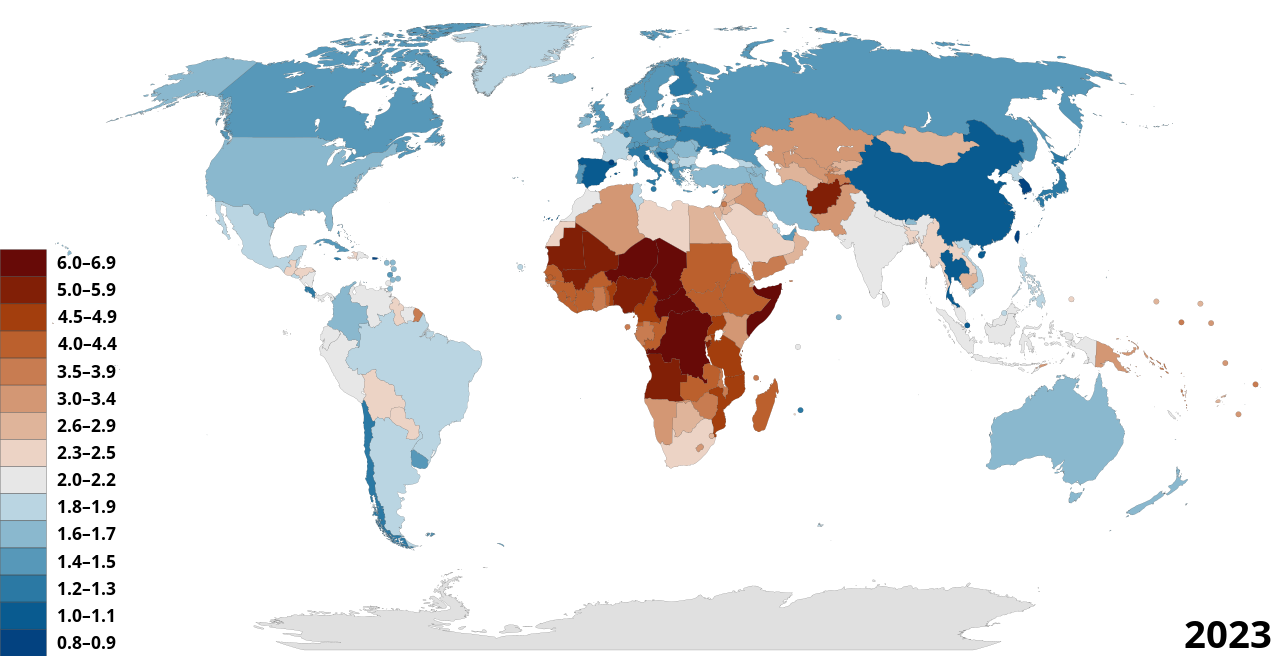
Global fertility trends are characterized by significant regional variations. While some countries, such as Nigeria and India, have high fertility rates, others, like Japan and Italy, are experiencing very low fertility rates. The African Union has launched initiatives to improve reproductive health and reduce maternal mortality. In contrast, many European countries are struggling to address the challenges posed by aging populations. The International Monetary Fund has warned that low fertility rates can have significant economic implications, including reduced tax revenue and increased pension liabilities.
📈 Declining Fertility Rates in Developed Countries
In many developed countries, fertility rates have been declining over the past few decades. This trend is often attributed to increased access to education and contraception, as well as changing social norms. For example, in South Korea, the TFR has fallen to 0.9, one of the lowest in the world. The South Korean government has introduced policies to encourage higher fertility rates, including cash incentives and parental leave. However, these efforts have had limited success, highlighting the need for a more comprehensive approach to addressing low fertility rates.
🚨 Implications of Low Fertility Rates
Low fertility rates can have significant implications for a country's economy and society. With fewer young people entering the workforce, there may be reduced tax revenue and increased pension liabilities. Additionally, low fertility rates can lead to aging populations, which can put pressure on healthcare and social security systems. The World Economic Forum has warned that low fertility rates can have significant economic implications, including reduced economic growth and increased income inequality.
🤝 Government Policies and Fertility Rates
Governments around the world have implemented policies to encourage higher fertility rates. These policies can include cash incentives, parental leave, and childcare support. For example, in Singapore, the government has introduced a range of policies to encourage families to have more children, including a baby bonus scheme. However, the effectiveness of these policies is often debated, and there is no one-size-fits-all solution to addressing low fertility rates. The Organisation for Economic Co-operation and Development has recommended a comprehensive approach to addressing low fertility rates, including policies to support work-life balance and family-friendly policies.
📊 Measuring Fertility Rates: Methods and Challenges
Measuring fertility rates can be challenging, particularly in countries with limited data collection capabilities. The World Health Organization has developed guidelines for estimating fertility rates, but these estimates can be subject to significant uncertainty. The United Nations Department of Economic and Social Affairs has warned that inaccurate estimates of fertility rates can have significant implications for population policies. Furthermore, the census and surveys used to collect data on fertility rates can be affected by bias and sampling error.
🔮 Future of Fertility Rates: Trends and Projections
The future of fertility rates is uncertain, and there are many factors that can influence trends. The United Nations has projected that the global population will continue to grow, but at a slower rate than in the past. However, some countries, such as China, are experiencing significant declines in fertility rates, which can have significant implications for their economies and societies. The World Bank has warned that low fertility rates can have significant economic implications, including reduced economic growth and increased income inequality.
🌐 Fertility Rates and Sustainable Development
Fertility rates are closely linked to sustainable development, as they can influence population growth and resource consumption. The United Nations Sustainable Development Goals include targets to improve reproductive health and reduce maternal mortality. The International Planned Parenthood Federation has highlighted the importance of addressing family planning and reproductive health in the context of sustainable development.
Key Facts
- Year
- 2020
- Origin
- Global
- Category
- Demographics
- Type
- Demographic Indicator
Frequently Asked Questions
What is the total fertility rate (TFR)?
The total fertility rate (TFR) is the average number of children a woman would have in her lifetime, based on the current age-specific fertility rates (ASFRs). It is a widely used metric to estimate population growth and reproductive patterns. The TFR is calculated by summing the birth rates for each age group, and it provides a comprehensive picture of a population's reproductive patterns. For instance, a TFR of 2.1 is considered replacement-level fertility, meaning that the population will remain stable over time.
What are the factors that influence fertility rates?
Fertility rates are influenced by a complex array of factors, including education, income, urbanization, and cultural norms. In many developed countries, women are delaying childbirth due to increased access to contraception and changing social norms. Additionally, the rising cost of childcare and housing can deter people from having larger families. The European Union has implemented policies to support work-life balance and encourage higher fertility rates.
What are the implications of low fertility rates?
Low fertility rates can have significant implications for a country's economy and society. With fewer young people entering the workforce, there may be reduced tax revenue and increased pension liabilities. Additionally, low fertility rates can lead to aging populations, which can put pressure on healthcare and social security systems. The World Economic Forum has warned that low fertility rates can have significant economic implications, including reduced economic growth and increased income inequality.
How do governments address low fertility rates?
Governments around the world have implemented policies to encourage higher fertility rates. These policies can include cash incentives, parental leave, and childcare support. For example, in Singapore, the government has introduced a range of policies to encourage families to have more children, including a baby bonus scheme. However, the effectiveness of these policies is often debated, and there is no one-size-fits-all solution to addressing low fertility rates.
What is the relationship between fertility rates and sustainable development?
Fertility rates are closely linked to sustainable development, as they can influence population growth and resource consumption. The United Nations Sustainable Development Goals include targets to improve reproductive health and reduce maternal mortality. The International Planned Parenthood Federation has highlighted the importance of addressing family planning and reproductive health in the context of sustainable development.