
Contents
- 📊 Introduction to Exponential Smoothing
- 📈 Understanding the Basics of Exponential Smoothing
- 📊 Types of Exponential Smoothing
- 📝 Simple Exponential Smoothing (SES)
- 📈 Holt's Method: A Special Case of Exponential Smoothing
- 📊 Holt-Winters Method: Handling Seasonality and Trends
- 📈 Applications of Exponential Smoothing in Data Science
- 📊 Comparison with Other Forecasting Techniques
- 📝 Real-World Examples of Exponential Smoothing
- 📊 Best Practices for Implementing Exponential Smoothing
- 📈 Future of Exponential Smoothing in Data Science
- 📊 Conclusion: The Power of Exponential Smoothing
- Frequently Asked Questions
- Related Topics
Overview
Exponential smoothing, also known as exponential moving average (EMA), is a widely used technique in Data Science for smoothing time series data. It uses the exponential window function to assign exponentially decreasing weights over time, making it a powerful tool for Time Series Analysis. This technique is often used for analysis of time-series data, and its applications can be seen in various fields such as Finance, Economics, and Operations Research. The use of exponential smoothing can be attributed to its simplicity and ease of application, making it a popular choice among data scientists and analysts. For instance, Amazon uses exponential smoothing to forecast demand and manage its inventory levels. Exponential smoothing is also closely related to Machine Learning and Statistics, as it provides a basis for understanding and analyzing complex data sets.
📈 Understanding the Basics of Exponential Smoothing
The basics of exponential smoothing involve using a weighted average of past observations to make predictions about future values. This is different from the simple moving average, where all past observations are weighted equally. Exponential smoothing uses a formula that gives more weight to recent observations and less weight to older observations, making it a more accurate method for forecasting. The technique is often used in conjunction with other methods, such as ARIMA and Prophet, to improve the accuracy of forecasts. Exponential smoothing is also related to Signal Processing, as it helps to filter out noise and extract meaningful patterns from data. Furthermore, exponential smoothing has been used in various applications, including Demand Forecasting and Supply Chain Management.
📊 Types of Exponential Smoothing
There are several types of exponential smoothing, including simple exponential smoothing (SES), Holt's method, and the Holt-Winters method. Each of these methods has its own strengths and weaknesses, and the choice of which one to use depends on the specific characteristics of the data. For example, SES is suitable for data with no trend or seasonality, while Holt's method is suitable for data with a trend but no seasonality. The Holt-Winters method, on the other hand, is suitable for data with both trend and seasonality. Exponential smoothing is also closely related to Forecasting and Predictive Analytics, as it provides a basis for making predictions about future events. Additionally, exponential smoothing has been used in various industries, including Healthcare and Finance, to improve decision-making and drive business outcomes.
📝 Simple Exponential Smoothing (SES)
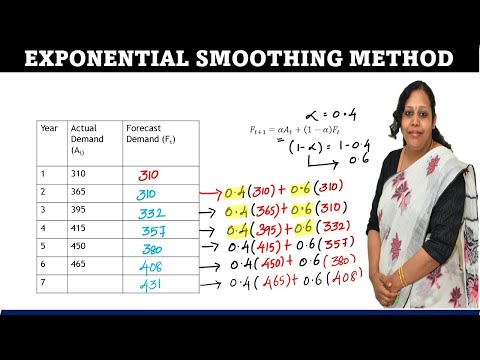
Simple exponential smoothing (SES) is the most basic form of exponential smoothing. It uses a single smoothing parameter to weight the past observations, and it is suitable for data with no trend or seasonality. SES is often used as a baseline model for more complex exponential smoothing methods, and it is a useful tool for understanding the basics of exponential smoothing. SES is also related to Regression Analysis, as it provides a basis for understanding the relationship between variables. For instance, SES can be used to analyze the relationship between Stock Prices and Economic Indicators. Furthermore, SES has been used in various applications, including Quality Control and Process Improvement.
📈 Holt's Method: A Special Case of Exponential Smoothing
Holt's method is a special case of exponential smoothing that is suitable for data with a trend but no seasonality. It uses two smoothing parameters, one for the level and one for the trend, to weight the past observations. Holt's method is more complex than SES, but it is still a relatively simple method that is easy to implement. Holt's method is often used in conjunction with other methods, such as Exponential Smoothing and ARIMA, to improve the accuracy of forecasts. Holt's method is also related to Time Series Decomposition, as it helps to extract meaningful patterns from data. Additionally, Holt's method has been used in various industries, including Retail and Manufacturing, to improve demand forecasting and supply chain management.
📊 Holt-Winters Method: Handling Seasonality and Trends
The Holt-Winters method is the most complex form of exponential smoothing. It uses three smoothing parameters, one for the level, one for the trend, and one for the seasonality, to weight the past observations. The Holt-Winters method is suitable for data with both trend and seasonality, and it is often used in conjunction with other methods, such as ARIMA and Prophet, to improve the accuracy of forecasts. The Holt-Winters method is also related to Seasonal Decomposition, as it helps to extract meaningful patterns from data. For instance, the Holt-Winters method can be used to analyze the relationship between Sales and Seasonality. Furthermore, the Holt-Winters method has been used in various applications, including Energy Forecasting and Traffic Forecasting.
📈 Applications of Exponential Smoothing in Data Science
Exponential smoothing has a wide range of applications in data science, including Demand Forecasting, Supply Chain Management, and Financial Forecasting. It is often used in conjunction with other methods, such as Machine Learning and Statistics, to improve the accuracy of forecasts. Exponential smoothing is also related to Business Intelligence, as it provides a basis for making informed decisions about business operations. For example, exponential smoothing can be used to analyze the relationship between Customer Demand and Production Planning. Additionally, exponential smoothing has been used in various industries, including Healthcare and Finance, to improve decision-making and drive business outcomes.
📊 Comparison with Other Forecasting Techniques
Exponential smoothing is often compared to other forecasting techniques, such as ARIMA and Prophet. While these methods are more complex and require more data, they can provide more accurate forecasts than exponential smoothing. However, exponential smoothing is still a useful tool for understanding the basics of forecasting and for making quick and accurate predictions. Exponential smoothing is also related to Forecasting Accuracy, as it provides a basis for evaluating the performance of forecasting models. For instance, exponential smoothing can be used to evaluate the performance of Forecasting Models in various industries. Furthermore, exponential smoothing has been used in various applications, including Sales Forecasting and Inventory Management.
📝 Real-World Examples of Exponential Smoothing
Exponential smoothing has been used in a wide range of real-world applications, including Demand Forecasting and Supply Chain Management. For example, Walmart uses exponential smoothing to forecast demand and manage its inventory levels. Exponential smoothing is also related to Operations Research, as it provides a basis for making informed decisions about business operations. For instance, exponential smoothing can be used to analyze the relationship between Production Planning and Inventory Control. Additionally, exponential smoothing has been used in various industries, including Healthcare and Finance, to improve decision-making and drive business outcomes.
📊 Best Practices for Implementing Exponential Smoothing
When implementing exponential smoothing, it is essential to follow best practices, such as choosing the right smoothing parameters and evaluating the performance of the model. Exponential smoothing is also related to Model Evaluation, as it provides a basis for evaluating the performance of forecasting models. For example, exponential smoothing can be used to evaluate the performance of Forecasting Models in various industries. Furthermore, exponential smoothing has been used in various applications, including Quality Control and Process Improvement.
📈 Future of Exponential Smoothing in Data Science
The future of exponential smoothing in data science is exciting, with new methods and techniques being developed all the time. For example, Google is using exponential smoothing to improve its forecasting capabilities. Exponential smoothing is also related to Artificial Intelligence, as it provides a basis for making informed decisions about business operations. For instance, exponential smoothing can be used to analyze the relationship between Customer Demand and Production Planning. Additionally, exponential smoothing has been used in various industries, including Healthcare and Finance, to improve decision-making and drive business outcomes.
📊 Conclusion: The Power of Exponential Smoothing
In conclusion, exponential smoothing is a powerful tool for smoothing time series data and making predictions about future values. Its simplicity and ease of application make it a popular choice among data scientists and analysts, and its applications can be seen in various fields such as Finance, Economics, and Operations Research. Exponential smoothing is also closely related to Machine Learning and Statistics, as it provides a basis for understanding and analyzing complex data sets. For example, exponential smoothing can be used to analyze the relationship between Stock Prices and Economic Indicators. Furthermore, exponential smoothing has been used in various applications, including Demand Forecasting and Supply Chain Management.
Key Facts
- Year
- 1950
- Origin
- Charles Holt and Peter Winters
- Category
- Data Science
- Type
- Algorithm
Frequently Asked Questions
What is exponential smoothing?
Exponential smoothing is a technique used to smooth time series data and make predictions about future values. It uses a weighted average of past observations to make predictions, with more weight given to recent observations. Exponential smoothing is often used in conjunction with other methods, such as ARIMA and Prophet, to improve the accuracy of forecasts. For instance, exponential smoothing can be used to analyze the relationship between Sales and Seasonality. Additionally, exponential smoothing has been used in various applications, including Energy Forecasting and Traffic Forecasting.
What are the types of exponential smoothing?
There are several types of exponential smoothing, including simple exponential smoothing (SES), Holt's method, and the Holt-Winters method. Each of these methods has its own strengths and weaknesses, and the choice of which one to use depends on the specific characteristics of the data. For example, SES is suitable for data with no trend or seasonality, while Holt's method is suitable for data with a trend but no seasonality. The Holt-Winters method, on the other hand, is suitable for data with both trend and seasonality. Exponential smoothing is also closely related to Forecasting and Predictive Analytics, as it provides a basis for making predictions about future events.
What are the applications of exponential smoothing?
Exponential smoothing has a wide range of applications in data science, including Demand Forecasting, Supply Chain Management, and Financial Forecasting. It is often used in conjunction with other methods, such as Machine Learning and Statistics, to improve the accuracy of forecasts. Exponential smoothing is also related to Business Intelligence, as it provides a basis for making informed decisions about business operations. For example, exponential smoothing can be used to analyze the relationship between Customer Demand and Production Planning. Additionally, exponential smoothing has been used in various industries, including Healthcare and Finance, to improve decision-making and drive business outcomes.
How does exponential smoothing compare to other forecasting techniques?
Exponential smoothing is often compared to other forecasting techniques, such as ARIMA and Prophet. While these methods are more complex and require more data, they can provide more accurate forecasts than exponential smoothing. However, exponential smoothing is still a useful tool for understanding the basics of forecasting and for making quick and accurate predictions. Exponential smoothing is also related to Forecasting Accuracy, as it provides a basis for evaluating the performance of forecasting models. For instance, exponential smoothing can be used to evaluate the performance of Forecasting Models in various industries.
What are the best practices for implementing exponential smoothing?
When implementing exponential smoothing, it is essential to follow best practices, such as choosing the right smoothing parameters and evaluating the performance of the model. Exponential smoothing is also related to Model Evaluation, as it provides a basis for evaluating the performance of forecasting models. For example, exponential smoothing can be used to evaluate the performance of Forecasting Models in various industries. Furthermore, exponential smoothing has been used in various applications, including Quality Control and Process Improvement.
What is the future of exponential smoothing in data science?
The future of exponential smoothing in data science is exciting, with new methods and techniques being developed all the time. For example, Google is using exponential smoothing to improve its forecasting capabilities. Exponential smoothing is also related to Artificial Intelligence, as it provides a basis for making informed decisions about business operations. For instance, exponential smoothing can be used to analyze the relationship between Customer Demand and Production Planning. Additionally, exponential smoothing has been used in various industries, including Healthcare and Finance, to improve decision-making and drive business outcomes.
How does exponential smoothing relate to other fields?
Exponential smoothing is closely related to Machine Learning and Statistics, as it provides a basis for understanding and analyzing complex data sets. Exponential smoothing is also related to Business Intelligence, as it provides a basis for making informed decisions about business operations. For example, exponential smoothing can be used to analyze the relationship between Stock Prices and Economic Indicators. Furthermore, exponential smoothing has been used in various applications, including Demand Forecasting and Supply Chain Management.