
Contents
- 🎵 Origins & History
- ⚙️ How It Works
- 📊 Key Facts & Numbers
- 👥 Key People & Organizations
- 🌍 Cultural Impact & Influence
- ⚡ Current State & Latest Developments
- 🤔 Controversies & Debates
- 🔮 Future Outlook & Predictions
- 💡 Practical Applications
- 📚 Related Topics & Deeper Reading
- Frequently Asked Questions
- References
- Related Topics
Overview
X ray computed tomography, commonly known as CT scanning, is a medical imaging technique that utilizes X-rays and computer processing to produce detailed cross-sectional images of the body. Developed in the 1970s, CT scans have become a crucial diagnostic tool in the medical field, allowing for the examination of internal structures without the need for surgery. With its ability to image a wide range of body parts, including those with metallic implants, CT scanning has proven to be a versatile and essential technique in modern medicine. According to the National Institutes of Health, over 80 million CT scans are performed annually in the United States alone, highlighting its significance in healthcare. The American College of Radiology also emphasizes the importance of CT scans in diagnosing various medical conditions, including cancer, vascular diseases, and neurological disorders. As technology continues to advance, CT scanning remains a vital component of medical imaging, with ongoing research focused on improving image quality, reducing radiation exposure, and expanding its applications in fields such as artificial intelligence-assisted diagnosis.
🎵 Origins & History
The concept of X ray computed tomography was first introduced in the 1960s by Godfrey Hounsfield, an English engineer who worked for Electrical and Musical Industries (EMI). Hounsfield's innovative idea involved using a rotating X-ray tube and a row of detectors to measure X-ray attenuations by different tissues inside the body. This pioneering work led to the development of the first CT scanner in the early 1970s, which was initially called a computed axial tomography (CAT) scan. The first clinical CT scan was performed in 1971 at Atkinson Morley Hospital in London, marking the beginning of a new era in medical imaging. The Food and Drug Administration (FDA) played a crucial role in regulating the development and approval of CT scanners, ensuring their safety and efficacy for clinical use.
⚙️ How It Works
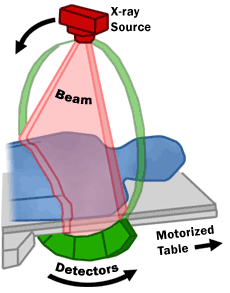
CT scanners operate by using a rotating X-ray tube and a row of detectors placed in a gantry to measure X-ray attenuations by different tissues inside the body. The multiple X-ray measurements taken from different angles are then processed on a computer using tomographic reconstruction algorithms to produce tomographic (cross-sectional) images (virtual 'slices') of a body. This process allows for the creation of detailed images of internal structures, enabling doctors to diagnose and treat a wide range of medical conditions. The International Commission on Radiological Protection (ICRP) provides guidelines for the safe use of CT scanners, emphasizing the importance of minimizing radiation exposure to patients and medical staff.
📊 Key Facts & Numbers
CT scans have become an essential diagnostic tool in modern medicine, with over 80 million scans performed annually in the United States alone. According to the Centers for Disease Control and Prevention (CDC), CT scans are used to diagnose a wide range of medical conditions, including cancer, vascular diseases, and neurological disorders. The World Health Organization (WHO) recognizes the significance of CT scanning in global healthcare, highlighting its potential to improve health outcomes in low- and middle-income countries. With the increasing use of CT scans, there is a growing concern about radiation exposure, prompting the development of new technologies and techniques to reduce radiation doses while maintaining image quality.
👥 Key People & Organizations
Key people and organizations have played a crucial role in the development and advancement of CT scanning technology. Godfrey Hounsfield and Allan McLeod Cormack were awarded the Nobel Prize in Physiology or Medicine in 1979 for their pioneering work on CT scanning. The American College of Radiology and the Radiological Society of North America are prominent organizations that promote the safe and effective use of CT scanning in medical practice. The National Cancer Institute and the National Institute of Neurological Disorders and Stroke are among the many research institutions that rely on CT scanning to advance our understanding of various diseases and develop new treatments.
🌍 Cultural Impact & Influence
CT scanning has had a significant cultural impact, transforming the way doctors diagnose and treat medical conditions. The development of CT scanning has also led to the creation of new medical specialties, such as radiology and nuclear medicine. The Society of Nuclear Medicine and Molecular Imaging is a professional organization that promotes the use of nuclear medicine and molecular imaging in clinical practice. CT scanning has also inspired the development of new technologies, such as positron emission tomography (PET), which combines CT scanning with PET to produce detailed images of the body. The Institute of Electrical and Electronics Engineers (IEEE) recognizes the significance of CT scanning in the development of medical imaging technologies.
⚡ Current State & Latest Developments
The current state of CT scanning is characterized by ongoing advancements in technology and technique. The development of new reconstruction algorithms and the use of artificial intelligence are improving image quality and reducing radiation exposure. The National Institutes of Health and the National Science Foundation are among the many organizations that fund research in CT scanning and medical imaging. The Food and Drug Administration (FDA) plays a crucial role in regulating the development and approval of new CT scanning technologies, ensuring their safety and efficacy for clinical use.
🤔 Controversies & Debates
Despite its many benefits, CT scanning is not without controversy. The use of CT scans has been criticized for its potential to increase radiation exposure, particularly in children and young adults. The American College of Radiology and the National Cancer Institute have issued guidelines for the safe use of CT scans, emphasizing the importance of minimizing radiation exposure and using alternative imaging modalities when possible. The World Health Organization (WHO) recognizes the need for responsible use of CT scanning, highlighting the importance of balancing the benefits of CT scanning with the potential risks.
🔮 Future Outlook & Predictions
The future of CT scanning is likely to be shaped by advances in technology and technique. The development of new reconstruction algorithms and the use of artificial intelligence are expected to improve image quality and reduce radiation exposure. The National Institutes of Health and the National Science Foundation are among the many organizations that fund research in CT scanning and medical imaging. As CT scanning continues to evolve, it is likely to play an increasingly important role in the diagnosis and treatment of medical conditions, particularly in the fields of oncology and neurology.
💡 Practical Applications
CT scanning has a wide range of practical applications in medicine, from diagnosing medical conditions to guiding surgical procedures. The American College of Radiology and the Radiological Society of North America provide guidelines for the use of CT scans in various medical specialties. The National Cancer Institute and the National Institute of Neurological Disorders and Stroke are among the many research institutions that rely on CT scanning to advance our understanding of various diseases and develop new treatments.
Key Facts
- Year
- 1971
- Origin
- London, UK
- Category
- public-health
- Type
- technology
Frequently Asked Questions
What is CT scanning?
CT scanning is a medical imaging technique that uses X-rays and computer processing to produce detailed cross-sectional images of the body. It is commonly used to diagnose a wide range of medical conditions, including cancer, vascular diseases, and neurological disorders. The American College of Radiology provides guidelines for the safe use of CT scans, emphasizing the importance of minimizing radiation exposure and using alternative imaging modalities when possible.
How does CT scanning work?
CT scanning works by using a rotating X-ray tube and a row of detectors to measure X-ray attenuations by different tissues inside the body. The multiple X-ray measurements taken from different angles are then processed on a computer using tomographic reconstruction algorithms to produce tomographic (cross-sectional) images (virtual 'slices') of a body. The National Institutes of Health funds research in CT scanning and medical imaging, aiming to improve image quality and reduce radiation exposure.
What are the benefits of CT scanning?
The benefits of CT scanning include its ability to produce detailed images of internal structures, enabling doctors to diagnose and treat a wide range of medical conditions. CT scanning is also non-invasive and relatively quick, making it a convenient diagnostic tool. The World Health Organization (WHO) recognizes the significance of CT scanning in global healthcare, highlighting its potential to improve health outcomes in low- and middle-income countries.
What are the risks of CT scanning?
The risks of CT scanning include radiation exposure, which can increase the risk of cancer and other health problems. The Food and Drug Administration (FDA) regulates the development and approval of new CT scanning technologies, ensuring their safety and efficacy for clinical use. The American College of Radiology provides guidelines for the safe use of CT scans, emphasizing the importance of minimizing radiation exposure and using alternative imaging modalities when possible.
How is CT scanning used in medicine?
CT scanning is used in a wide range of medical specialties, including oncology, neurology, and cardiology. It is used to diagnose and treat a variety of medical conditions, including cancer, vascular diseases, and neurological disorders. The National Cancer Institute and the National Institute of Neurological Disorders and Stroke are among the many research institutions that rely on CT scanning to advance our understanding of various diseases and develop new treatments.
What is the future of CT scanning?
The future of CT scanning is likely to be shaped by advances in technology and technique. The development of new reconstruction algorithms and the use of artificial intelligence are expected to improve image quality and reduce radiation exposure. The National Institutes of Health and the National Science Foundation are among the many organizations that fund research in CT scanning and medical imaging.
How does CT scanning compare to other medical imaging modalities?
CT scanning is closely related to other medical imaging modalities, such as MRI and PET. Each modality has its own strengths and weaknesses, and the choice of which to use depends on the specific medical condition being diagnosed or treated. The Society of Nuclear Medicine and Molecular Imaging is a professional organization that promotes the use of nuclear medicine and molecular imaging in clinical practice.
What are the limitations of CT scanning?
The limitations of CT scanning include its potential to increase radiation exposure, particularly in children and young adults. CT scanning is also relatively expensive and may not be available in all medical facilities. The World Health Organization (WHO) recognizes the need for responsible use of CT scanning, highlighting the importance of balancing the benefits of CT scanning with the potential risks.
How is CT scanning used in research?
CT scanning is used in a wide range of research applications, including the study of cancer, vascular diseases, and neurological disorders. The National Institutes of Health and the National Science Foundation are among the many organizations that fund research in CT scanning and medical imaging. The Institute of Electrical and Electronics Engineers (IEEE) recognizes the significance of CT scanning in the development of medical imaging technologies.
What are the potential applications of CT scanning in the future?
The potential applications of CT scanning in the future include its use in personalized medicine, where it can be used to tailor treatment to individual patients. CT scanning may also be used in combination with other medical imaging modalities, such as MRI and PET, to produce even more detailed images of the body. The National Cancer Institute and the National Institute of Neurological Disorders and Stroke are among the many research institutions that rely on CT scanning to advance our understanding of various diseases and develop new treatments.