
Contents
- 🎯 Origins & History
- ⚙️ How It Works
- 📊 Key Facts & Numbers
- 👥 Key People & Organizations
- 🌍 Cultural Impact & Influence
- ⚡ Current State & Latest Developments
- 🤔 Controversies & Debates
- 🔮 Future Outlook & Predictions
- 💡 Practical Applications
- 📚 Related Topics & Deeper Reading
- Frequently Asked Questions
- References
- Related Topics
Overview
Weight is a fundamental concept in science and engineering, referring to the gravitational force exerted on an object by its environment. With various definitions and measurements, weight plays a crucial role in understanding physics, engineering, and even human health. The unit of measurement for weight is that of force, and it is essential in calculating the energy expenditure of physical activities, such as those tracked by Fitbit or MyFitnessPal. According to the World Health Organization, maintaining a healthy weight is vital for preventing chronic diseases like diabetes and heart disease. As of 2022, the global obesity rate has risen to 39% of the adult population, emphasizing the need for accurate weight management. With the help of American Heart Association guidelines and Academy of Nutrition and Dietetics recommendations, individuals can make informed decisions about their weight and overall well-being.
🎯 Origins & History
The concept of weight has been studied for centuries, with ancient Greek philosophers like Aristotle and Euclid contributing to its understanding. The modern definition of weight, however, is attributed to Isaac Newton and his groundbreaking work on gravity. As explained in his book Philosophiæ Naturalis Principia Mathematica, the weight of an object is a vector quantity that depends on its mass and the gravitational force acting upon it. This fundamental principle has been built upon by numerous scientists, including Albert Einstein, who introduced the concept of relativity and its implications on weight and gravity.
⚙️ How It Works
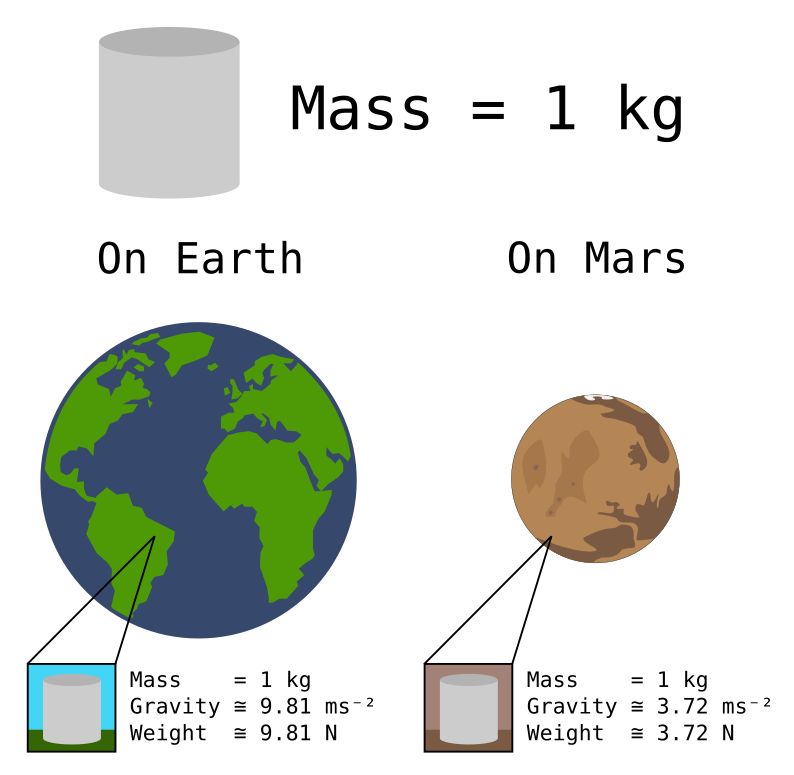
Weight is a measure of the gravitational force exerted on an object, and it can be calculated using the formula W = mg, where W is the weight, m is the mass, and g is the acceleration due to gravity. This formula is widely used in various fields, including physics, engineering, and even sports, as seen in the work of NASA and the International Olympic Committee. The unit of measurement for weight is typically expressed in units of force, such as Newtons (N) or pounds-force (lbf). For instance, the weight of an object on the surface of the Earth is approximately 9.8 N/kg, while on the surface of the Moon, it is about 1.6 N/kg.
📊 Key Facts & Numbers
Some key facts about weight include: the average adult human weight is around 62 kg (137 lbs), according to the World Health Organization; the largest living organism, the blue whale, can weigh up to 180 metric tons (200 tons); and the smallest known particle, the electron, has a weight of approximately 9.11 x 10^-31 kg. These numbers demonstrate the vast range of weights in our universe, from the incredibly small to the enormous. Furthermore, weight plays a crucial role in various industries, such as Boeing and Airbus, where precise weight calculations are essential for ensuring the safety and efficiency of aircraft.
👥 Key People & Organizations
Several key people and organizations have contributed to our understanding of weight, including Galileo Galilei, who conducted extensive research on gravity and motion, and the National Institute of Standards and Technology, which provides standardized units of measurement for weight. Additionally, organizations like the American Council on Exercise and the National Academy of Sciences have published guidelines and recommendations for maintaining a healthy weight, emphasizing the importance of regular exercise and balanced nutrition.
🌍 Cultural Impact & Influence
Weight has had a significant cultural impact, influencing various aspects of our lives, from art and literature to sports and entertainment. For example, the concept of weight is often used as a metaphor in literature, as seen in the works of William Shakespeare and Jane Austen. In sports, weight classes are used to categorize athletes, ensuring fair competition and safety, as seen in the Olympic Games and the National Football League. Moreover, weight has been a topic of interest in the media, with numerous articles and documentaries exploring its significance, such as those published by The New York Times and BBC.
⚡ Current State & Latest Developments
Currently, research on weight is ongoing, with scientists exploring new ways to measure and understand its effects on the human body. For instance, studies have shown that weight can affect an individual's mental health, with conditions like depression and anxiety often linked to weight-related issues, as reported by the National Institute of Mental Health. Furthermore, the development of new technologies, such as wearable technology and artificial intelligence, is revolutionizing the way we track and manage our weight, with companies like Apple and Google leading the charge.
🤔 Controversies & Debates
There are ongoing debates and controversies surrounding the concept of weight, particularly in the context of human health and body image. Some argue that the emphasis on weight loss can lead to unhealthy behaviors and body dissatisfaction, as discussed by the National Eating Disorders Association. Others argue that weight is an important indicator of overall health, and that efforts to promote healthy weight management are essential for preventing chronic diseases, as emphasized by the Centers for Disease Control and Prevention.
🔮 Future Outlook & Predictions
Looking to the future, it is likely that our understanding of weight will continue to evolve, with new discoveries and advancements in technology. For example, researchers are exploring the use of gene editing and stem cell therapy to develop new treatments for weight-related disorders, as reported by the National Institutes of Health. Additionally, the development of more accurate and personalized weight management tools, such as those using machine learning and Internet of Things technologies, is expected to revolutionize the way we approach weight management, with companies like Amazon and Microsoft investing heavily in these areas.
💡 Practical Applications
Practically, understanding weight is essential for various aspects of our lives, from maintaining a healthy lifestyle to designing and engineering structures and systems. For instance, weight is a critical factor in the design of bridges and buildings, as well as in the development of transportation systems, such as those used by Uber and Lyft. Furthermore, weight management is a crucial aspect of athletic training, with athletes like LeBron James and Serena Williams relying on precise weight calculations to optimize their performance.
Key Facts
- Year
- 1687
- Origin
- England
- Category
- nutrition
- Type
- concept
Frequently Asked Questions
What is the difference between weight and mass?
Weight is a measure of the gravitational force exerted on an object, while mass is a measure of the amount of matter in an object. For example, an object's weight on the surface of the Earth is different from its weight on the surface of the Moon, due to the difference in gravitational forces, as explained by NASA and the European Space Agency.
How is weight measured?
Why is weight important for human health?
Maintaining a healthy weight is essential for preventing chronic diseases, such as diabetes and heart disease, as emphasized by the World Health Organization and the American Heart Association. Excess weight can also increase the risk of certain types of cancer, as reported by the National Cancer Institute.
How can I manage my weight?
Weight management involves a combination of healthy eating habits, regular exercise, and lifestyle changes, as recommended by the Academy of Nutrition and Dietetics and the American Council on Exercise. It's also important to monitor your weight regularly and seek professional help if you're struggling to maintain a healthy weight, with resources available from organizations like Weight Watchers and Jenny Craig.
What are some common weight-related disorders?
Common weight-related disorders include obesity, anorexia nervosa, and bulimia nervosa, as defined by the National Institute of Mental Health and the American Psychiatric Association. These disorders can have serious health consequences if left untreated, and it's essential to seek professional help if you or someone you know is struggling with a weight-related disorder, with support available from organizations like National Eating Disorders Association.
How does weight affect athletic performance?
Weight can significantly impact athletic performance, particularly in sports that require strength, power, and endurance, as seen in the performances of athletes like Usain Bolt and Michael Phelps. Athletes often strive to achieve an optimal weight-to-strength ratio to maximize their performance, with guidance from coaches and trainers like those at USA Track and Field and the National Strength and Conditioning Association.
What are some future developments in weight management?
Future developments in weight management may include the use of gene editing and stem cell therapy to develop new treatments for weight-related disorders, as reported by the National Institutes of Health and the Food and Drug Administration. Additionally, advancements in wearable technology and artificial intelligence may lead to more accurate and personalized weight management tools, with companies like Apple and Google investing in these areas.