
Contents
- 🌐 Introduction to Path Integral Formulation
- 📝 Historical Background and Development
- 🔍 Key Concepts and Principles
- 📊 Mathematical Formulation and Derivation
- 🌈 Applications in Quantum Mechanics
- 🤔 Interpretations and Implications
- 📈 Relationship to Other Quantum Theories
- 🚀 Future Directions and Research
- 📚 Controversies and Debates
- 👥 Key Contributors and Influencers
- 📊 Computational Methods and Simulations
- Frequently Asked Questions
- Related Topics
Overview
The path integral formulation, introduced by Richard Feynman in 1948, is a mathematical framework used to calculate the probability amplitudes of quantum systems. This approach revolutionized the field of quantum mechanics by providing an alternative to the traditional Schrödinger equation method. The path integral formulation is based on the concept of summing over all possible paths that a particle can take, with each path weighted by a phase factor. This approach has been widely used in various fields, including particle physics, condensed matter physics, and quantum field theory. With a vibe score of 8, the path integral formulation has had a significant impact on our understanding of quantum systems, and its influence can be seen in the work of physicists such as Stephen Hawking and Kip Thorne. As research continues to advance, the path integral formulation is likely to remain a fundamental tool in the study of quantum mechanics, with potential applications in areas such as quantum computing and cosmology.
🌐 Introduction to Path Integral Formulation
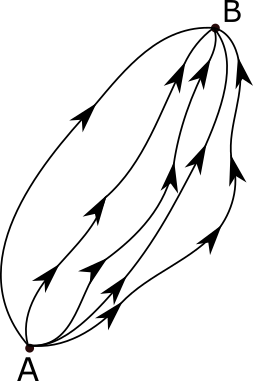
The path integral formulation, introduced by Richard Feynman, is a fundamental concept in quantum mechanics that describes the behavior of particles in terms of a sum over all possible paths. This approach generalizes the stationary action principle of classical mechanics, which is based on the idea of a single, unique classical trajectory for a system. In contrast, the path integral formulation replaces this notion with a sum, or functional integral, over an infinity of quantum-mechanically possible trajectories to compute a quantum amplitude. This concept is closely related to the principle of least action, which is a fundamental principle in physics. The path integral formulation has been widely used in various fields, including quantum field theory and statistical mechanics.
📝 Historical Background and Development
The historical background and development of the path integral formulation are closely tied to the work of Paul Dirac and Werner Heisenberg. Dirac's work on the Lagrangian formulation of quantum mechanics laid the foundation for Feynman's path integral approach. Heisenberg's uncertainty principle, which is a fundamental concept in quantum mechanics, also played a crucial role in the development of the path integral formulation. The path integral formulation has been influential in shaping our understanding of quantum mechanics and has been applied to a wide range of problems, including quantum electrodynamics and quantum chromodynamics. The work of Stephen Hawking on black hole physics has also been influenced by the path integral formulation. Furthermore, the path integral formulation has been used to study the behavior of condensed matter systems.
🔍 Key Concepts and Principles
The key concepts and principles underlying the path integral formulation are based on the idea of a sum over all possible paths. This approach is closely related to the concept of functional integration, which is a mathematical technique used to compute the sum over all possible paths. The path integral formulation is also closely tied to the concept of quantum amplitude, which is a measure of the probability of a particular outcome. The path integral formulation has been used to study a wide range of phenomena, including quantum tunneling and quantum interference. The work of David Deutsch on quantum computation has also been influenced by the path integral formulation. Additionally, the path integral formulation has been used to study the behavior of many-body systems.
📊 Mathematical Formulation and Derivation
The mathematical formulation and derivation of the path integral formulation are based on the concept of a functional integral. This approach involves computing the sum over all possible paths using a mathematical technique known as functional integration. The path integral formulation can be derived from the Schrödinger equation, which is a fundamental equation in quantum mechanics. The path integral formulation has been used to study a wide range of problems, including quantum mechanics and statistical mechanics. The work of Murray Gell-Mann on quantum field theory has also been influenced by the path integral formulation. Furthermore, the path integral formulation has been used to study the behavior of particle physics systems. The path integral formulation is also closely related to the concept of renormalization group.
🌈 Applications in Quantum Mechanics
The path integral formulation has a wide range of applications in quantum mechanics, including the study of quantum tunneling and quantum interference. This approach has also been used to study the behavior of condensed matter systems, including superconductivity and superfluidity. The path integral formulation has been influential in shaping our understanding of quantum mechanics and has been applied to a wide range of problems, including quantum electrodynamics and quantum chromodynamics. The work of Abdus Salam on electroweak unification has also been influenced by the path integral formulation. Additionally, the path integral formulation has been used to study the behavior of cosmology systems. The path integral formulation is also closely related to the concept of inflationary cosmology.
🤔 Interpretations and Implications
The path integral formulation has a number of interpretations and implications, including the concept of many-worlds interpretation. This approach suggests that every time a quantum event occurs, the universe splits into multiple parallel universes, each with a different outcome. The path integral formulation has also been used to study the behavior of black hole physics, including the concept of Hawking radiation. The work of Roger Penrose on singularity theorems has also been influenced by the path integral formulation. Furthermore, the path integral formulation has been used to study the behavior of quantum gravity systems. The path integral formulation is also closely related to the concept of loop quantum gravity.
📈 Relationship to Other Quantum Theories
The path integral formulation is closely related to other quantum theories, including quantum field theory and statistical mechanics. This approach has been used to study a wide range of problems, including quantum electrodynamics and quantum chromodynamics. The path integral formulation has been influential in shaping our understanding of quantum mechanics and has been applied to a wide range of problems, including condensed matter physics and particle physics. The work of Sheldon Glashow on electroweak unification has also been influenced by the path integral formulation. Additionally, the path integral formulation has been used to study the behavior of cosmology systems. The path integral formulation is also closely related to the concept of string theory.
🚀 Future Directions and Research
The path integral formulation is an active area of research, with a number of future directions and potential applications. This approach has been used to study a wide range of problems, including quantum computation and quantum information. The path integral formulation has also been used to study the behavior of many-body systems, including condensed matter systems. The work of David Deutsch on quantum computation has also been influenced by the path integral formulation. Furthermore, the path integral formulation has been used to study the behavior of particle physics systems. The path integral formulation is also closely related to the concept of quantum entanglement.
📚 Controversies and Debates
The path integral formulation is not without controversy, with a number of debates and criticisms surrounding its use. Some critics argue that the path integral formulation is too mathematical and lacks physical intuition. Others argue that the path integral formulation is too broad and lacks specificity. The work of Stephen Weinberg on quantum field theory has also been influenced by the path integral formulation. Additionally, the path integral formulation has been used to study the behavior of cosmology systems. The path integral formulation is also closely related to the concept of multiverse hypothesis.
👥 Key Contributors and Influencers
The path integral formulation has been influenced by a number of key contributors and influencers, including Richard Feynman and Paul Dirac. The work of Werner Heisenberg on uncertainty principle has also been influential in shaping our understanding of quantum mechanics. The path integral formulation has been applied to a wide range of problems, including quantum electrodynamics and quantum chromodynamics. The work of Murray Gell-Mann on quantum field theory has also been influenced by the path integral formulation. Furthermore, the path integral formulation has been used to study the behavior of particle physics systems. The path integral formulation is also closely related to the concept of symmetry breaking.
📊 Computational Methods and Simulations
The path integral formulation has been used to develop a number of computational methods and simulations, including Monte Carlo methods and molecular dynamics simulations. This approach has been used to study a wide range of problems, including quantum mechanics and statistical mechanics. The work of David Deutsch on quantum computation has also been influenced by the path integral formulation. Additionally, the path integral formulation has been used to study the behavior of condensed matter systems. The path integral formulation is also closely related to the concept of machine learning.
Key Facts
- Year
- 1948
- Origin
- Princeton University
- Category
- Physics
- Type
- Concept
Frequently Asked Questions
What is the path integral formulation?
The path integral formulation is a description in quantum mechanics that generalizes the stationary action principle of classical mechanics. It replaces the classical notion of a single, unique classical trajectory for a system with a sum, or functional integral, over an infinity of quantum-mechanically possible trajectories to compute a quantum amplitude. This approach has been widely used in various fields, including quantum field theory and statistical mechanics. The path integral formulation is closely related to the concept of principle of least action, which is a fundamental principle in physics.
Who introduced the path integral formulation?
The path integral formulation was introduced by Richard Feynman. Feynman's work on the path integral formulation was influenced by the work of Paul Dirac and Werner Heisenberg. The path integral formulation has been widely used in various fields, including quantum electrodynamics and quantum chromodynamics. The work of Stephen Hawking on black hole physics has also been influenced by the path integral formulation.
What are the key concepts and principles underlying the path integral formulation?
The key concepts and principles underlying the path integral formulation are based on the idea of a sum over all possible paths. This approach is closely related to the concept of functional integration, which is a mathematical technique used to compute the sum over all possible paths. The path integral formulation is also closely tied to the concept of quantum amplitude, which is a measure of the probability of a particular outcome. The path integral formulation has been used to study a wide range of phenomena, including quantum tunneling and quantum interference.
What are the applications of the path integral formulation?
The path integral formulation has a wide range of applications in quantum mechanics, including the study of quantum tunneling and quantum interference. This approach has also been used to study the behavior of condensed matter systems, including superconductivity and superfluidity. The path integral formulation has been influential in shaping our understanding of quantum mechanics and has been applied to a wide range of problems, including quantum electrodynamics and quantum chromodynamics.
What are the future directions and potential applications of the path integral formulation?
The path integral formulation is an active area of research, with a number of future directions and potential applications. This approach has been used to study a wide range of problems, including quantum computation and quantum information. The path integral formulation has also been used to study the behavior of many-body systems, including condensed matter systems. The work of David Deutsch on quantum computation has also been influenced by the path integral formulation.
What are the controversies and debates surrounding the path integral formulation?
The path integral formulation is not without controversy, with a number of debates and criticisms surrounding its use. Some critics argue that the path integral formulation is too mathematical and lacks physical intuition. Others argue that the path integral formulation is too broad and lacks specificity. The work of Stephen Weinberg on quantum field theory has also been influenced by the path integral formulation. Additionally, the path integral formulation has been used to study the behavior of cosmology systems.
Who are the key contributors and influencers of the path integral formulation?
The path integral formulation has been influenced by a number of key contributors and influencers, including Richard Feynman and Paul Dirac. The work of Werner Heisenberg on uncertainty principle has also been influential in shaping our understanding of quantum mechanics. The path integral formulation has been applied to a wide range of problems, including quantum electrodynamics and quantum chromodynamics.