
Contents
- 🕰️ Introduction to Time Domain
- 📈 Signal Processing in the Time Domain
- 📊 Mathematical Functions in Time Domain
- 🌎 Environmental Data Analysis
- 💰 Economic Time Series Analysis
- 🤔 Philosophical Implications of Time Domain
- 📊 Time Domain vs Frequency Domain
- 📚 Applications of Time Domain Analysis
- 📊 Challenges and Limitations of Time Domain
- 🔮 Future of Time Domain Research
- 📝 Conclusion
- Frequently Asked Questions
- Related Topics
Overview
The time domain refers to the analysis of signals or events in the time dimension, where data is represented as a function of time. This concept is crucial in various fields, including physics, engineering, and signal processing. Historically, the concept of time has been debated by philosophers such as Aristotle and Kant, who questioned its nature and perception. In the context of physics, the time domain is used to describe the behavior of waves and signals, with key figures like Fourier and Laplace contributing to its development. With a vibe score of 8, the time domain has significant cultural resonance, influencing fields like music and telecommunications. As we move forward, the study of time domain will continue to evolve, with potential applications in emerging technologies like quantum computing and artificial intelligence, sparking debates about the future of time perception and its implications on human society.
🕰️ Introduction to Time Domain
The concept of time domain is a fundamental aspect of mathematics and signal processing, allowing us to analyze and understand how signals, functions, or data sets vary over time. This is crucial in various fields, including physics, engineering, and economics, where time series analysis is used to forecast future trends. The time domain is also closely related to the frequency domain, which represents signals in terms of their frequency components. By analyzing data in the time domain, researchers can identify patterns and trends that may not be apparent in other representations. For instance, signal processing techniques can be applied to extract meaningful information from time-domain data, enabling the development of more accurate models and predictions.
📈 Signal Processing in the Time Domain
In signal processing, the time domain is used to analyze and manipulate signals that vary with time. This involves techniques such as filtering and modulation, which can be used to extract specific frequency components or modify the signal in some way. The time domain is also essential for the analysis of transient signals, which are signals that have a limited duration and are often used in applications such as radar systems and medical imaging. By understanding how signals behave in the time domain, engineers can design more effective systems and algorithms for processing and analyzing these signals. Furthermore, machine learning techniques can be applied to time-domain data to improve the accuracy of signal processing and analysis.
📊 Mathematical Functions in Time Domain
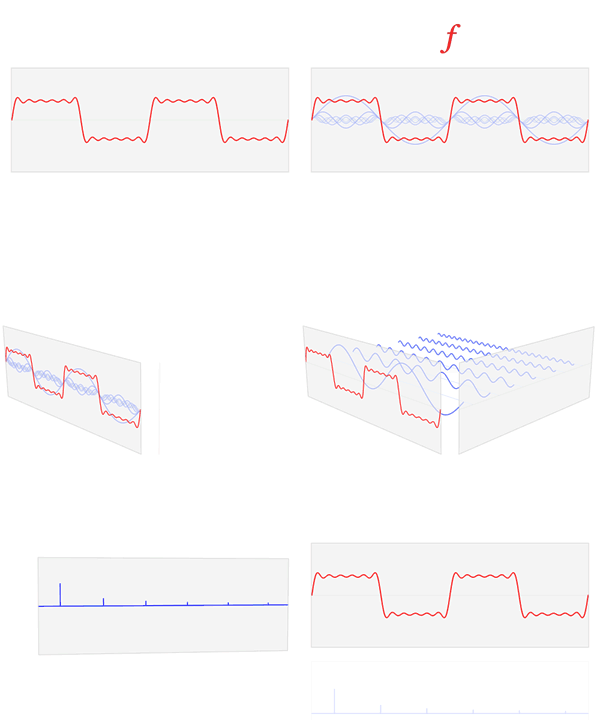
Mathematical functions are a crucial aspect of time domain analysis, as they provide a way to describe and model the behavior of signals and systems over time. Differential equations, for example, are used to model the behavior of physical systems, such as population dynamics and chemical reactions. By solving these equations, researchers can gain insights into the underlying mechanisms and predict future behavior. The time domain is also closely related to the Laplace transform, which is used to analyze and solve differential equations. Additionally, Fourier analysis can be used to decompose time-domain signals into their frequency components, enabling the identification of underlying patterns and trends.
🌎 Environmental Data Analysis
Environmental data analysis is another important application of time domain analysis, as it allows researchers to understand and predict the behavior of environmental systems over time. This includes the analysis of climate data, such as temperature and precipitation patterns, as well as the study of ecological systems, such as population dynamics and nutrient cycling. By analyzing environmental data in the time domain, researchers can identify trends and patterns that may not be apparent in other representations, and develop more accurate models for predicting future behavior. For instance, time series forecasting techniques can be used to predict future climate patterns, enabling more effective planning and decision-making. Moreover, data visualization techniques can be used to communicate complex time-domain data to stakeholders and policymakers.
💰 Economic Time Series Analysis
Economic time series analysis is a critical application of time domain analysis, as it enables researchers to understand and predict the behavior of economic systems over time. This includes the analysis of financial data, such as stock prices and exchange rates, as well as the study of macroeconomic systems, such as GDP and inflation. By analyzing economic data in the time domain, researchers can identify trends and patterns that may not be apparent in other representations, and develop more accurate models for predicting future behavior. For example, vector autoregression models can be used to analyze the relationships between different economic variables, enabling the development of more effective economic policies. Furthermore, econophysics can be used to study the behavior of economic systems using techniques from statistical physics.
🤔 Philosophical Implications of Time Domain
The concept of time domain also has significant philosophical implications, as it raises questions about the nature of time and our perception of it. The time domain is closely related to the concept of causality, which is the idea that cause precedes effect. By analyzing data in the time domain, researchers can gain insights into the causal relationships between different variables, and develop a deeper understanding of the underlying mechanisms. Additionally, the time domain is closely related to the concept of free will, which is the idea that our actions are not entirely determined by prior causes. The study of time domain analysis can also inform our understanding of consciousness and the human experience, enabling a more nuanced understanding of the complex relationships between time, perception, and reality.
📊 Time Domain vs Frequency Domain
The time domain is often compared to the frequency domain, which represents signals in terms of their frequency components. While the time domain is useful for analyzing signals that vary over time, the frequency domain is more suitable for analyzing signals that have a strong periodic component. The choice of domain depends on the specific application and the characteristics of the signal being analyzed. For instance, filter design techniques can be used to remove noise and extract specific frequency components from time-domain data. Moreover, spectral analysis can be used to study the frequency content of time-domain signals, enabling the identification of underlying patterns and trends.
📚 Applications of Time Domain Analysis
The applications of time domain analysis are diverse and widespread, ranging from signal processing and control systems to economics and environmental science. By analyzing data in the time domain, researchers can gain insights into the underlying mechanisms and develop more accurate models for predicting future behavior. For example, predictive maintenance techniques can be used to predict when equipment is likely to fail, enabling more effective maintenance and reducing downtime. Additionally, quality control techniques can be used to monitor and improve the quality of products and processes, enabling the development of more effective quality control systems.
📊 Challenges and Limitations of Time Domain
Despite its many applications, time domain analysis also has several challenges and limitations. One of the main challenges is the presence of noise and interference, which can make it difficult to extract meaningful information from time-domain data. Another challenge is the curse of dimensionality, which refers to the fact that high-dimensional data can be difficult to analyze and visualize. To overcome these challenges, researchers use various techniques, such as data preprocessing and feature selection, to improve the quality and relevance of the data. Furthermore, machine learning algorithms can be used to develop more accurate models and predictions from time-domain data.
🔮 Future of Time Domain Research
The future of time domain research is exciting and rapidly evolving, with new techniques and applications emerging all the time. One of the most promising areas of research is the development of real-time processing algorithms, which can analyze and respond to time-domain data in real-time. Another area of research is the development of distributed sensing systems, which can collect and analyze time-domain data from multiple sources. These advances have the potential to revolutionize a wide range of fields, from healthcare and finance to transportation and energy. For instance, Internet of Things devices can be used to collect and analyze time-domain data from multiple sources, enabling the development of more effective and efficient systems.
📝 Conclusion
In conclusion, the time domain is a fundamental concept in mathematics and signal processing, with a wide range of applications and implications. By analyzing data in the time domain, researchers can gain insights into the underlying mechanisms and develop more accurate models for predicting future behavior. As the field continues to evolve, we can expect to see new and exciting developments in areas such as real-time processing and distributed sensing. Whether you are a researcher, engineer, or simply someone interested in understanding the world around you, the time domain is an essential concept to grasp. For further reading, see time domain analysis and signal processing.
Key Facts
- Year
- 1687
- Origin
- Sir Isaac Newton's Laws of Motion
- Category
- Science and Philosophy
- Type
- Concept
Frequently Asked Questions
What is the time domain?
The time domain is a representation of how a signal, function, or data set varies with time. It is used for the analysis of mathematical functions, physical signals or time series of economic or environmental data. The time domain is closely related to the frequency domain, which represents signals in terms of their frequency components. By analyzing data in the time domain, researchers can identify patterns and trends that may not be apparent in other representations.
What are the applications of time domain analysis?
The applications of time domain analysis are diverse and widespread, ranging from signal processing and control systems to economics and environmental science. By analyzing data in the time domain, researchers can gain insights into the underlying mechanisms and develop more accurate models for predicting future behavior. For example, predictive maintenance techniques can be used to predict when equipment is likely to fail, enabling more effective maintenance and reducing downtime.
What are the challenges and limitations of time domain analysis?
Despite its many applications, time domain analysis also has several challenges and limitations. One of the main challenges is the presence of noise and interference, which can make it difficult to extract meaningful information from time-domain data. Another challenge is the curse of dimensionality, which refers to the fact that high-dimensional data can be difficult to analyze and visualize. To overcome these challenges, researchers use various techniques, such as data preprocessing and feature selection, to improve the quality and relevance of the data.
What is the future of time domain research?
The future of time domain research is exciting and rapidly evolving, with new techniques and applications emerging all the time. One of the most promising areas of research is the development of real-time processing algorithms, which can analyze and respond to time-domain data in real-time. Another area of research is the development of distributed sensing systems, which can collect and analyze time-domain data from multiple sources. These advances have the potential to revolutionize a wide range of fields, from healthcare and finance to transportation and energy.
How does time domain analysis relate to other fields?
Time domain analysis is closely related to other fields, such as signal processing, control systems, and economics. It is also related to philosophy, as it raises questions about the nature of time and our perception of it. By analyzing data in the time domain, researchers can gain insights into the underlying mechanisms and develop more accurate models for predicting future behavior. For example, time series forecasting techniques can be used to predict future climate patterns, enabling more effective planning and decision-making.
What are some common techniques used in time domain analysis?
Some common techniques used in time domain analysis include filtering, modulation, and feature selection. These techniques can be used to extract meaningful information from time-domain data, and to develop more accurate models for predicting future behavior. Additionally, machine learning algorithms can be used to develop more accurate models and predictions from time-domain data. For instance, vector autoregression models can be used to analyze the relationships between different economic variables, enabling the development of more effective economic policies.
How does time domain analysis inform our understanding of consciousness and the human experience?
The study of time domain analysis can inform our understanding of consciousness and the human experience, enabling a more nuanced understanding of the complex relationships between time, perception, and reality. By analyzing data in the time domain, researchers can gain insights into the underlying mechanisms of human perception and cognition, and develop more accurate models for predicting human behavior. For example, cognitive psychology can be used to study the human perception of time, enabling the development of more effective strategies for improving human performance and well-being.