
Contents
- 🔍 Introduction to Policy Iteration
- 📊 Markov Decision Processes: The Foundation
- 🤖 Policy Iteration: A Step-by-Step Guide
- 📈 Improving Policies with Value Iteration
- 📊 Solving MDPs with Stochastic Dynamic Programming
- 🚀 Applications of Policy Iteration in AI
- 🤝 Relationship Between Policy Iteration and Reinforcement Learning
- 📊 Challenges and Limitations of Policy Iteration
- 📈 Future Directions and Advances in Policy Iteration
- 📊 Real-World Examples of Policy Iteration in Action
- 📊 Best Practices for Implementing Policy Iteration
- Frequently Asked Questions
- Related Topics
Overview
Policy iteration is a fundamental concept in reinforcement learning, enabling agents to learn optimal policies in complex, uncertain environments. This iterative process involves two primary components: policy evaluation and policy improvement. By evaluating the current policy and improving it based on the learned value function, agents can adapt to changing conditions and maximize rewards. The algorithm's effectiveness is evident in its widespread adoption across various domains, from robotics to finance. However, critics argue that policy iteration can be computationally expensive and sensitive to hyperparameters, highlighting the need for ongoing research and optimization. As reinforcement learning continues to advance, policy iteration remains a crucial building block, with potential applications in autonomous systems, personalized recommendation systems, and beyond. With a vibe score of 8, policy iteration is a topic of significant cultural energy, reflecting its growing importance in the AI community.
🔍 Introduction to Policy Iteration
Policy iteration is a powerful algorithm used in Artificial Intelligence to improve decision-making in complex, uncertain environments. It is a key component of Markov Decision Processes (MDPs), which provide a mathematical framework for modeling sequential decision-making problems. By combining policy iteration with Reinforcement Learning, developers can create adaptive systems that learn from experience and improve over time. The History of Artificial Intelligence has seen significant advancements in policy iteration, enabling its application in various fields. For instance, Deep Learning has been instrumental in enhancing policy iteration capabilities.
📊 Markov Decision Processes: The Foundation
A Markov Decision Process is a mathematical model used to represent sequential decision-making problems under uncertainty. It consists of a set of states, actions, transitions, and rewards, and is often solved using stochastic dynamic programming. Policy iteration is a key algorithm used to solve MDPs, as it allows developers to improve the policy (or decision-making strategy) over time. The Mathematics of Machine Learning plays a crucial role in understanding MDPs and policy iteration. By leveraging Linear Algebra and Probability Theory, developers can better comprehend the underlying mechanics of policy iteration.
🤖 Policy Iteration: A Step-by-Step Guide
Policy iteration involves two main steps: policy evaluation and policy improvement. During policy evaluation, the algorithm assesses the current policy and estimates its value function, which represents the expected return or reward. The Value Iteration algorithm is then used to improve the policy by selecting actions that maximize the value function. This process is repeated until the policy converges or a stopping criterion is reached. The Convergence of Policy Iteration is a critical aspect of the algorithm, as it ensures that the policy improves over time. By understanding the Complexity of Policy Iteration, developers can optimize the algorithm for better performance.
📈 Improving Policies with Value Iteration
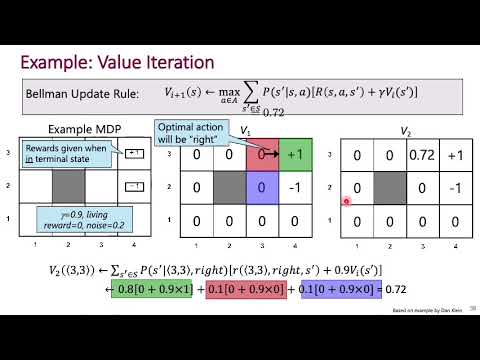
Value iteration is a related algorithm that can be used to improve policies. It works by iteratively updating the value function to reflect the expected return under the current policy. By combining value iteration with policy iteration, developers can create more efficient and effective decision-making systems. The Relationship between Policy Iteration and Value Iteration is essential to understanding how these algorithms interact. For example, Dynamic Programming can be used to solve MDPs, and policy iteration can be used to improve the policy. The Application of Policy Iteration in Robotics has been particularly successful, enabling robots to learn from experience and adapt to new situations.
📊 Solving MDPs with Stochastic Dynamic Programming
Stochastic dynamic programming is a method used to solve MDPs by breaking down the problem into smaller sub-problems and solving them recursively. Policy iteration can be used in conjunction with stochastic dynamic programming to improve the policy and solve the MDP. The Stochastic Dynamic Programming approach has been instrumental in solving complex MDPs. By leveraging Monte Carlo Methods and Temporal Difference Learning, developers can create more efficient and effective decision-making systems. The Application of Stochastic Dynamic Programming in Finance has been particularly successful, enabling financial institutions to make better investment decisions.
🚀 Applications of Policy Iteration in AI
Policy iteration has numerous applications in AI, including Robotics, Natural Language Processing, and Computer Vision. It can be used to improve decision-making in complex, uncertain environments, such as autonomous vehicles or smart homes. The Application of Policy Iteration in Healthcare has been particularly successful, enabling medical professionals to make better diagnoses and treatment decisions. By leveraging Policy Iteration and Reinforcement Learning, developers can create adaptive systems that learn from experience and improve over time. For instance, Personalized Medicine can be enhanced using policy iteration, enabling medical professionals to tailor treatment plans to individual patients.
🤝 Relationship Between Policy Iteration and Reinforcement Learning
Policy iteration is closely related to reinforcement learning, which involves learning from experience and improving decision-making over time. By combining policy iteration with reinforcement learning, developers can create adaptive systems that learn from experience and improve over time. The Relationship between Policy Iteration and Reinforcement Learning is essential to understanding how these algorithms interact. For example, Q-Learning can be used to learn the value function, and policy iteration can be used to improve the policy. The Application of Reinforcement Learning in Gaming has been particularly successful, enabling game developers to create more engaging and challenging games.
📊 Challenges and Limitations of Policy Iteration
Despite its many advantages, policy iteration also has several challenges and limitations. One of the main challenges is the curse of dimensionality, which refers to the exponential increase in complexity as the number of states and actions increases. The Curse of Dimensionality can be mitigated using Dimensionality Reduction techniques, such as Principal Component Analysis. Another challenge is the need for a good initial policy, which can be difficult to obtain in practice. The Importance of Initial Policies cannot be overstated, as it can significantly impact the performance of the algorithm. By understanding the Limitations of Policy Iteration, developers can optimize the algorithm for better performance.
📈 Future Directions and Advances in Policy Iteration
Future research directions for policy iteration include the development of more efficient algorithms, the incorporation of additional constraints and objectives, and the application of policy iteration to new domains. The Future of Policy Iteration is promising, with potential applications in Autonomous Vehicles, Smart Homes, and Healthcare. By leveraging Policy Iteration and Reinforcement Learning, developers can create adaptive systems that learn from experience and improve over time. For instance, Explainable AI can be enhanced using policy iteration, enabling developers to create more transparent and trustworthy AI systems.
📊 Real-World Examples of Policy Iteration in Action
Real-world examples of policy iteration in action include autonomous vehicles, smart homes, and healthcare systems. In each of these domains, policy iteration can be used to improve decision-making and adapt to changing circumstances. The Application of Policy Iteration in Autonomous Vehicles has been particularly successful, enabling vehicles to navigate complex environments and make decisions in real-time. By leveraging Policy Iteration and Reinforcement Learning, developers can create adaptive systems that learn from experience and improve over time. For example, Traffic Management can be enhanced using policy iteration, enabling traffic managers to optimize traffic flow and reduce congestion.
📊 Best Practices for Implementing Policy Iteration
Best practices for implementing policy iteration include starting with a simple problem and gradually increasing complexity, using a good initial policy, and monitoring performance and adjusting the algorithm as needed. The Best Practices for Policy Iteration are essential to understanding how to optimize the algorithm for better performance. By leveraging Policy Iteration and Reinforcement Learning, developers can create adaptive systems that learn from experience and improve over time. For instance, Debugging Policy Iteration can be challenging, but by understanding the Common Pitfalls in Policy Iteration, developers can avoid common mistakes and optimize the algorithm for better performance.
Key Facts
- Year
- 1957
- Origin
- Richard Bellman's Work on Dynamic Programming
- Category
- Artificial Intelligence
- Type
- Algorithm
Frequently Asked Questions
What is policy iteration?
Policy iteration is a powerful algorithm used in Artificial Intelligence to improve decision-making in complex, uncertain environments. It is a key component of Markov Decision Processes (MDPs), which provide a mathematical framework for modeling sequential decision-making problems. By combining policy iteration with Reinforcement Learning, developers can create adaptive systems that learn from experience and improve over time.
How does policy iteration work?
Policy iteration involves two main steps: policy evaluation and policy improvement. During policy evaluation, the algorithm assesses the current policy and estimates its value function, which represents the expected return or reward. The Value Iteration algorithm is then used to improve the policy by selecting actions that maximize the value function. This process is repeated until the policy converges or a stopping criterion is reached.
What are the applications of policy iteration?
Policy iteration has numerous applications in AI, including Robotics, Natural Language Processing, and Computer Vision. It can be used to improve decision-making in complex, uncertain environments, such as autonomous vehicles or smart homes. The Application of Policy Iteration in Healthcare has been particularly successful, enabling medical professionals to make better diagnoses and treatment decisions.
What are the challenges and limitations of policy iteration?
Despite its many advantages, policy iteration also has several challenges and limitations. One of the main challenges is the curse of dimensionality, which refers to the exponential increase in complexity as the number of states and actions increases. Another challenge is the need for a good initial policy, which can be difficult to obtain in practice.
How can policy iteration be improved?
Future research directions for policy iteration include the development of more efficient algorithms, the incorporation of additional constraints and objectives, and the application of policy iteration to new domains. By leveraging Policy Iteration and Reinforcement Learning, developers can create adaptive systems that learn from experience and improve over time.
What are the best practices for implementing policy iteration?
Best practices for implementing policy iteration include starting with a simple problem and gradually increasing complexity, using a good initial policy, and monitoring performance and adjusting the algorithm as needed. By leveraging Policy Iteration and Reinforcement Learning, developers can create adaptive systems that learn from experience and improve over time.
How does policy iteration relate to reinforcement learning?
Policy iteration is closely related to reinforcement learning, which involves learning from experience and improving decision-making over time. By combining policy iteration with reinforcement learning, developers can create adaptive systems that learn from experience and improve over time. The Relationship between Policy Iteration and Reinforcement Learning is essential to understanding how these algorithms interact.