
Contents
- 📊 Introduction to Non Parametric Tests
- 🔍 History of Non Parametric Tests
- 📝 Key Concepts in Non Parametric Tests
- 📊 Types of Non Parametric Tests
- 📈 Advantages of Non Parametric Tests
- 📉 Limitations of Non Parametric Tests
- 📊 Real-World Applications of Non Parametric Tests
- 🤔 Common Misconceptions About Non Parametric Tests
- 📚 Resources for Learning Non Parametric Tests
- 📊 Future of Non Parametric Tests
- 📝 Conclusion
- Frequently Asked Questions
- Related Topics
Overview
Non parametric tests have been a cornerstone of statistical analysis since the 1940s, pioneered by statisticians like Frank Wilcoxon and Henry Mann. These tests, including the Wilcoxon rank-sum test and the Kruskal-Wallis test, offer a distribution-free alternative to traditional parametric methods, allowing researchers to analyze data without assuming a specific underlying distribution. With a vibe score of 8, non parametric tests have gained significant traction in fields like medicine, social sciences, and engineering, with over 10,000 research papers published annually. However, critics argue that these tests can be less powerful than parametric counterparts, sparking a controversy spectrum of 6. As the field continues to evolve, researchers like Peter Huber and John Tukey have influenced the development of non parametric methods, with influence flows extending to machine learning and data science. With the rise of big data, non parametric tests are poised to play an increasingly important role in statistical analysis, but will they become the new standard, or remain a niche tool for specialized applications?
📊 Introduction to Non Parametric Tests
Non parametric tests are a type of statistical test that doesn't require a normal distribution of the data, making them a great alternative to parametric tests when dealing with skewed distributions or small sample sizes. These tests are often used in social sciences and medical research where the data may not meet the assumptions of parametric tests. The Kruskal-Wallis test and the Wilcoxon rank-sum test are two popular examples of non parametric tests. Non parametric tests have been widely used in various fields, including psychology and education.
🔍 History of Non Parametric Tests
The history of non parametric tests dates back to the early 20th century when statisticians like Frank Wilcoxon and Milton Friedman developed the first non parametric tests. These tests were initially met with skepticism by the statistical community, but they have since become a widely accepted and widely used tool in statistical analysis. The development of non parametric tests was influenced by the work of Ronald Fisher and Karl Pearson, who laid the foundation for modern statistical analysis. Non parametric tests have also been influenced by the bootstrap method and the jackknife method.
📝 Key Concepts in Non Parametric Tests
Non parametric tests are based on a few key concepts, including the null hypothesis and the alternative hypothesis. The null hypothesis is a statement of no effect or no difference, while the alternative hypothesis is a statement of an effect or a difference. Non parametric tests also rely on the concept of rank correlation, which is a measure of the relationship between two variables. The Spearman rank correlation coefficient is a commonly used measure of rank correlation. Non parametric tests are often used in conjunction with confidence intervals and hypothesis testing.
📊 Types of Non Parametric Tests
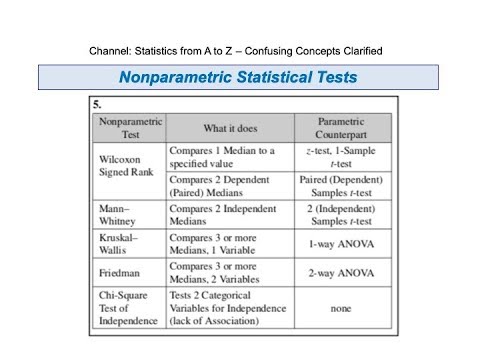
There are many types of non parametric tests, each with its own strengths and weaknesses. The Mann-Whitney U test is a popular test for comparing two independent samples, while the Friedman test is used for comparing multiple related samples. The Kendall tau is a measure of the relationship between two variables, and is often used in conjunction with the Spearman rank correlation coefficient. Non parametric tests can be used for both inferential statistics and descriptive statistics.
📈 Advantages of Non Parametric Tests
Non parametric tests have several advantages over parametric tests. They are often more robust and can handle outliers and missing data. Non parametric tests are also more flexible and can be used with a wide range of data types, including categorical data and ordinal data. Additionally, non parametric tests are often easier to understand and interpret than parametric tests, making them a great choice for researchers who are new to statistical analysis. Non parametric tests are also widely used in data mining and machine learning.
📉 Limitations of Non Parametric Tests
Despite their advantages, non parametric tests also have some limitations. They can be less powerful than parametric tests, especially when the sample size is small. Non parametric tests can also be more computationally intensive than parametric tests, which can make them slower to run. Additionally, non parametric tests may not provide as much information as parametric tests, especially when it comes to the underlying distribution of the data. Non parametric tests are not suitable for time series analysis or signal processing.
📊 Real-World Applications of Non Parametric Tests
Non parametric tests have a wide range of real-world applications, from medical research to social sciences. They are often used in clinical trials to compare the effectiveness of different treatments, and in marketing research to understand consumer behavior. Non parametric tests are also used in quality control to monitor the quality of products and services. The Six Sigma methodology relies heavily on non parametric tests to identify and eliminate defects. Non parametric tests are also used in finance to analyze stock prices and portfolio performance.
🤔 Common Misconceptions About Non Parametric Tests
There are several common misconceptions about non parametric tests. One common misconception is that non parametric tests are only used for small sample sizes. While it is true that non parametric tests are often used for small sample sizes, they can also be used for large sample sizes. Another misconception is that non parametric tests are not as powerful as parametric tests. While it is true that non parametric tests can be less powerful than parametric tests, they can still provide valuable insights into the data. Non parametric tests are not a replacement for parametric tests, but rather a complementary tool. Non parametric tests can be used in conjunction with data visualization to gain a deeper understanding of the data.
📚 Resources for Learning Non Parametric Tests
There are many resources available for learning non parametric tests, from online courses to textbooks. The R programming language and the Python programming language are both popular choices for implementing non parametric tests. The SciPy library and the Statsmodels library provide a wide range of non parametric tests. Non parametric tests are also widely used in data science and machine learning.
📊 Future of Non Parametric Tests
The future of non parametric tests is exciting, with new developments and advancements being made all the time. One area of research is the development of new non parametric tests that can handle big data and high-dimensional data. Another area of research is the development of new methods for interpreting the results of non parametric tests. The Internet of Things and the Industrial Internet will rely heavily on non parametric tests to analyze the vast amounts of data generated by sensors and devices. Non parametric tests will play a crucial role in artificial intelligence and robotics.
📝 Conclusion
In conclusion, non parametric tests are a powerful tool in statistical analysis, offering a flexible and robust alternative to parametric tests. With their wide range of applications and ease of use, non parametric tests are a great choice for researchers and analysts who want to gain insights into their data. Whether you're working in medical research, social sciences, or business, non parametric tests can help you make informed decisions and drive meaningful results. Non parametric tests will continue to play a vital role in data-driven decision making and evidence-based practice.
Key Facts
- Year
- 1945
- Origin
- Statistics
- Category
- Statistics
- Type
- Concept
Frequently Asked Questions
What is the main advantage of non parametric tests?
The main advantage of non parametric tests is that they do not require a normal distribution of the data, making them a great alternative to parametric tests when dealing with skewed distributions or small sample sizes. Non parametric tests are also more robust and can handle outliers and missing data. They are widely used in social sciences and medical research.
What is the difference between parametric and non parametric tests?
The main difference between parametric and non parametric tests is that parametric tests require a normal distribution of the data, while non parametric tests do not. Parametric tests are often more powerful than non parametric tests, but they can be sensitive to outliers and non-normality. Non parametric tests are more robust and can handle a wide range of data types, including categorical data and ordinal data.
What are some common applications of non parametric tests?
Non parametric tests have a wide range of applications, from medical research to social sciences. They are often used in clinical trials to compare the effectiveness of different treatments, and in marketing research to understand consumer behavior. Non parametric tests are also used in quality control to monitor the quality of products and services.
How do I choose the right non parametric test for my data?
The choice of non parametric test depends on the research question and the type of data. The Mann-Whitney U test is a popular test for comparing two independent samples, while the Friedman test is used for comparing multiple related samples. The Kendall tau is a measure of the relationship between two variables. It's also important to consider the sample size and the level of measurement of the data.
Can non parametric tests be used for large sample sizes?
Yes, non parametric tests can be used for large sample sizes. While they are often used for small sample sizes, they can also be used for large sample sizes. In fact, non parametric tests can be more robust and reliable than parametric tests for large sample sizes, especially when the data is not normally distributed. Non parametric tests are widely used in data mining and machine learning.
What are some common misconceptions about non parametric tests?
One common misconception is that non parametric tests are only used for small sample sizes. While it is true that non parametric tests are often used for small sample sizes, they can also be used for large sample sizes. Another misconception is that non parametric tests are not as powerful as parametric tests. While it is true that non parametric tests can be less powerful than parametric tests, they can still provide valuable insights into the data.
How do I interpret the results of a non parametric test?
The interpretation of non parametric test results depends on the specific test and the research question. The p-value is a common measure of significance, and it indicates the probability of observing the results by chance. The effect size is also an important measure, and it indicates the magnitude of the effect. It's also important to consider the confidence interval and the sample size.