
Contents
- 🔍 Introduction to High Pressure Physics
- 💡 History of High Pressure Research
- 🔬 Experimental Techniques in High Pressure Physics
- 📊 Theoretical Models of High Pressure Behavior
- 🌎 Applications of High Pressure Physics in Geology
- 🚀 High Pressure Physics in Materials Science
- 🔩 Diamond Anvil Cells: A Key Tool in High Pressure Research
- 🤔 Challenges and Limitations in High Pressure Physics
- 🌈 Future Directions in High Pressure Physics Research
- 📚 Conclusion and Further Reading
- Frequently Asked Questions
- Related Topics
Overview
High pressure physics is a field of research that explores the behavior of matter under extreme conditions, where pressures exceed 100,000 times that of the Earth's atmosphere. This realm is home to exotic phenomena such as superconductivity, superfluidity, and quantum criticality. Researchers like Isaac F. Silvera and Eugene Gregoryanz have made groundbreaking discoveries, including the creation of metallic hydrogen and the observation of superconductivity at room temperature. The study of high pressure physics has far-reaching implications for our understanding of the Earth's core, the properties of materials, and the behavior of matter in extreme environments. With the development of advanced experimental techniques, such as diamond anvil cells, scientists can now probe the properties of matter at pressures exceeding 3.5 million times that of the Earth's atmosphere. As research in this field continues to advance, we can expect to uncover new and exciting phenomena that challenge our current understanding of the physical world.
🔍 Introduction to High Pressure Physics
High pressure physics is a fascinating field that explores the behavior of materials under extreme conditions, often reaching thousands or millions of times atmospheric pressure. This field of study has numerous applications in Materials Science, Geology, and Engineering. The effects of high pressure on materials can be dramatic, leading to changes in their crystal structure, electronic properties, and even their very composition. Researchers use a variety of techniques, including Diamond Anvil Cells, to create and measure high pressure environments. For example, the Diamond Anvil Cell can generate pressures of up to 3.5 million times atmospheric pressure, allowing scientists to study the behavior of materials under conditions similar to those found at the Earth's core.
💡 History of High Pressure Research
The history of high pressure research dates back to the early 20th century, when scientists such as Pierre Weiss and Lev Landau began exploring the properties of materials under high pressure. Since then, the field has expanded rapidly, with the development of new experimental techniques and theoretical models. Today, high pressure physics is a vibrant and interdisciplinary field, with applications in Materials Science, Geology, and Biology. The study of high pressure physics has also led to the discovery of new materials and phenomena, such as Superconductivity and Superfluidity. Researchers have also used high pressure techniques to study the properties of Nanomaterials and Biomaterials.
🔬 Experimental Techniques in High Pressure Physics
Experimental techniques in high pressure physics are diverse and often highly specialized. In addition to Diamond Anvil Cells, researchers use other devices such as Piston Cylinder Cells and Toroidal Cells to generate high pressure environments. These devices can be used to study a wide range of materials, from simple metals and alloys to complex Biological Systems. Theoretical models, such as Density Functional Theory, are also essential for understanding the behavior of materials under high pressure. By combining experimental and theoretical approaches, researchers can gain a deeper understanding of the complex phenomena that occur at high pressure. For example, the study of Phase Transitions under high pressure can provide valuable insights into the behavior of materials under extreme conditions.
📊 Theoretical Models of High Pressure Behavior
Theoretical models of high pressure behavior are crucial for understanding the complex phenomena that occur at high pressure. Researchers use a variety of theoretical approaches, including Quantum Mechanics and Statistical Mechanics, to model the behavior of materials under high pressure. These models can be used to predict the properties of materials under high pressure, such as their Electrical Conductivity and Thermal Conductivity. Theoretical models can also be used to study the behavior of materials under high pressure in Geological Systems, such as the Earth's core and mantle. By combining theoretical and experimental approaches, researchers can gain a deeper understanding of the complex phenomena that occur at high pressure. For example, the study of High Pressure Phases can provide valuable insights into the behavior of materials under extreme conditions.
🌎 Applications of High Pressure Physics in Geology
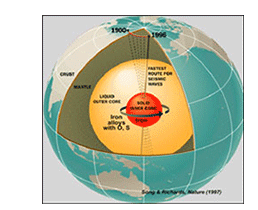
High pressure physics has numerous applications in geology, particularly in the study of the Earth's interior. By subjecting rocks and minerals to high pressure, researchers can simulate the conditions found at great depths within the Earth and gain insights into the Earth's internal structure and dynamics. For example, the study of High Pressure Mineralogy can provide valuable insights into the behavior of minerals under high pressure. High pressure physics can also be used to study the properties of Geological Fluids and their role in shaping the Earth's crust. The study of high pressure physics can also provide valuable insights into the behavior of materials under high pressure in Planetary Science, such as the study of the interior of Mars and Venus.
🚀 High Pressure Physics in Materials Science
High pressure physics is also essential for the development of new materials with unique properties. By subjecting materials to high pressure, researchers can create new phases with enhanced Mechanical Properties, Electrical Properties, and Thermal Properties. For example, the study of High Pressure Synthesis can provide valuable insights into the behavior of materials under high pressure. High pressure physics can also be used to study the properties of Nanomaterials and Biomaterials under high pressure. The study of high pressure physics can also provide valuable insights into the behavior of materials under high pressure in Energy Storage and Energy Generation.
🔩 Diamond Anvil Cells: A Key Tool in High Pressure Research
Diamond anvil cells are a key tool in high pressure research, allowing scientists to generate extremely high pressures in a controlled environment. These cells consist of two diamond anvils that are pressed together to create a small sample chamber, where the material of interest is placed. The diamond anvils are capable of withstanding enormous pressures, making them ideal for high pressure research. The study of Diamond Anvil Cell can provide valuable insights into the behavior of materials under high pressure. Researchers have used diamond anvil cells to study a wide range of materials, from simple metals and alloys to complex Biological Systems. The study of high pressure physics using diamond anvil cells can also provide valuable insights into the behavior of materials under high pressure in Geological Systems.
🤔 Challenges and Limitations in High Pressure Physics
Despite the many advances in high pressure physics, there are still significant challenges and limitations in the field. One of the major challenges is the difficulty of generating and measuring high pressure environments, which requires highly specialized equipment and expertise. Additionally, the study of high pressure physics often requires the use of complex theoretical models and computational simulations, which can be time-consuming and computationally intensive. The study of high pressure physics can also be limited by the availability of High Pressure Facilities and the lack of standardization in high pressure research. However, researchers are actively working to overcome these challenges and push the boundaries of high pressure physics. For example, the development of new High Pressure Techniques can provide valuable insights into the behavior of materials under high pressure.
🌈 Future Directions in High Pressure Physics Research
The future of high pressure physics is exciting and rapidly evolving, with new experimental techniques and theoretical models being developed all the time. One of the most promising areas of research is the study of high pressure behavior in Complex Systems, such as Biological Systems and Nanomaterials. The study of high pressure physics can also provide valuable insights into the behavior of materials under high pressure in Energy Storage and Energy Generation. Additionally, the development of new High Pressure Facilities and the advancement of High Pressure Techniques will enable researchers to study high pressure phenomena in greater detail than ever before. As high pressure physics continues to advance, we can expect to see new breakthroughs and discoveries that will transform our understanding of the behavior of materials under extreme conditions.
📚 Conclusion and Further Reading
In conclusion, high pressure physics is a vibrant and interdisciplinary field that has numerous applications in Materials Science, Geology, and Engineering. The study of high pressure physics has led to the discovery of new materials and phenomena, and has provided valuable insights into the behavior of materials under extreme conditions. As researchers continue to push the boundaries of high pressure physics, we can expect to see new breakthroughs and discoveries that will transform our understanding of the behavior of materials under high pressure. For further reading, see High Pressure Physics and Materials Science.
Key Facts
- Year
- 2019
- Origin
- Early 20th century, with significant advancements in the 1960s and 1970s
- Category
- Physics
- Type
- Scientific Field
Frequently Asked Questions
What is high pressure physics?
High pressure physics is the study of the behavior of materials under extreme conditions, often reaching thousands or millions of times atmospheric pressure. This field of study has numerous applications in Materials Science, Geology, and Engineering. The effects of high pressure on materials can be dramatic, leading to changes in their crystal structure, electronic properties, and even their very composition.
What are the applications of high pressure physics?
High pressure physics has numerous applications in Materials Science, Geology, and Engineering. The study of high pressure physics can provide valuable insights into the behavior of materials under high pressure, which can be used to develop new materials with unique properties. Additionally, high pressure physics can be used to study the properties of Geological Fluids and their role in shaping the Earth's crust.
What is a diamond anvil cell?
A diamond anvil cell is a device used to generate extremely high pressures in a controlled environment. It consists of two diamond anvils that are pressed together to create a small sample chamber, where the material of interest is placed. Diamond anvil cells are capable of withstanding enormous pressures, making them ideal for high pressure research.
What are the challenges and limitations of high pressure physics?
Despite the many advances in high pressure physics, there are still significant challenges and limitations in the field. One of the major challenges is the difficulty of generating and measuring high pressure environments, which requires highly specialized equipment and expertise. Additionally, the study of high pressure physics often requires the use of complex theoretical models and computational simulations, which can be time-consuming and computationally intensive.
What is the future of high pressure physics?
The future of high pressure physics is exciting and rapidly evolving, with new experimental techniques and theoretical models being developed all the time. One of the most promising areas of research is the study of high pressure behavior in Complex Systems, such as Biological Systems and Nanomaterials. The study of high pressure physics can also provide valuable insights into the behavior of materials under high pressure in Energy Storage and Energy Generation.
How does high pressure physics relate to other fields of study?
High pressure physics is an interdisciplinary field that has connections to Materials Science, Geology, Engineering, and Biology. The study of high pressure physics can provide valuable insights into the behavior of materials under extreme conditions, which can be used to develop new materials with unique properties. Additionally, high pressure physics can be used to study the properties of Geological Fluids and their role in shaping the Earth's crust.
What are some of the key tools and techniques used in high pressure physics?
Some of the key tools and techniques used in high pressure physics include Diamond Anvil Cells, Piston Cylinder Cells, and Toroidal Cells. These devices can be used to generate high pressure environments and study the behavior of materials under extreme conditions. Additionally, researchers use complex theoretical models and computational simulations to understand the behavior of materials under high pressure.