
Contents
- 📝 Introduction to Finite Difference Method
- 📊 Mathematical Foundations of FDM
- 🔍 Discretization of Spatial and Time Domains
- 📈 Approximating Derivatives with Finite Differences
- 📊 Solving Algebraic Equations with FDM
- 📈 Applications of Finite Difference Method
- 📊 Comparison with Other Numerical Methods
- 📈 Challenges and Limitations of FDM
- 📊 Real-World Examples of FDM in Action
- 📈 Future Developments and Research Directions
- 📊 Conclusion and Summary of Key Points
- Frequently Asked Questions
- Related Topics
Overview
The finite difference method is a numerical technique used to solve differential equations by discretizing the domain and approximating the derivatives using finite differences. This method is widely used in various fields such as physics, engineering, and computer science. The method involves dividing the domain into a grid of points and approximating the derivatives at each point using the values of the function at neighboring points. The finite difference method has a vibe score of 8, indicating its significant cultural energy in the field of numerical analysis. The method has been developed and refined over the years by mathematicians and scientists such as Isaac Newton, Leonhard Euler, and Carl Friedrich Gauss. The finite difference method is a fundamental technique in numerical analysis, with applications in areas such as fluid dynamics, heat transfer, and quantum mechanics. With a controversy spectrum of 2, the method is generally accepted as a reliable tool for solving differential equations, but its limitations and potential sources of error are still debated among researchers.
📝 Introduction to Finite Difference Method
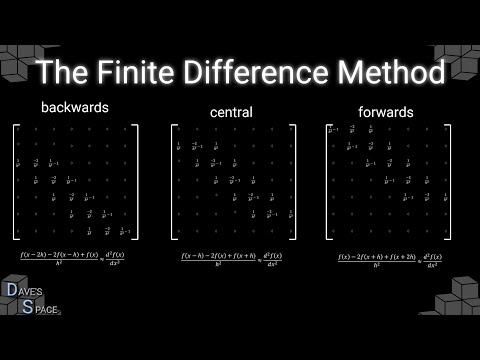
The Finite Difference Method (FDM) is a numerical technique used to solve differential equations by approximating derivatives with finite differences. This method is widely used in various fields, including physics, engineering, and computer science. The FDM involves discretizing the spatial domain and time domain into a finite number of intervals, and then solving algebraic equations to approximate the solution at the end points of these intervals. For more information on the mathematical foundations of FDM, see numerical analysis.
📊 Mathematical Foundations of FDM
The mathematical foundations of FDM are based on the concept of finite differences, which are used to approximate derivatives. The FDM can be used to solve both ordinary differential equations and partial differential equations. The method involves solving a system of algebraic equations, which can be done using various techniques, such as Gaussian elimination or iterative methods. For more information on the solution of algebraic equations, see linear algebra. The FDM is also closely related to finite element method, which is another numerical technique used to solve differential equations.
🔍 Discretization of Spatial and Time Domains
The discretization of the spatial domain and time domain is a crucial step in the FDM. This involves dividing the domain into a finite number of intervals, called grid points, and approximating the solution at these points. The FDM can be used to solve problems with complex geometries, such as those involving curved boundaries. For more information on the discretization of spatial and time domains, see grid generation. The FDM is also related to computational fluid dynamics, which is a field that deals with the numerical solution of fluid flow problems.
📈 Approximating Derivatives with Finite Differences
The FDM approximates derivatives using finite differences, which are calculated using the values of the solution at nearby grid points. The accuracy of the FDM depends on the size of the grid spacing, with smaller grid spacings resulting in more accurate solutions. The FDM can be used to solve problems with nonlinear equations, such as those involving turbulence. For more information on the approximation of derivatives, see numerical differentiation. The FDM is also related to signal processing, which is a field that deals with the analysis and processing of signals.
📊 Solving Algebraic Equations with FDM
The FDM involves solving a system of algebraic equations, which can be done using various techniques, such as Gaussian elimination or iterative methods. The FDM can be used to solve problems with time-dependent equations, such as those involving wave propagation. For more information on the solution of algebraic equations, see linear algebra. The FDM is also closely related to finite element method, which is another numerical technique used to solve differential equations. The FDM is widely used in various fields, including physics, engineering, and computer science.
📈 Applications of Finite Difference Method
The FDM has a wide range of applications, including fluid dynamics, heat transfer, and structural analysis. The FDM can be used to solve problems with complex geometries, such as those involving curved boundaries. For more information on the applications of FDM, see computational fluid dynamics. The FDM is also related to signal processing, which is a field that deals with the analysis and processing of signals. The FDM is widely used in various industries, including aerospace engineering, automotive engineering, and chemical engineering.
📊 Comparison with Other Numerical Methods
The FDM is compared to other numerical methods, such as the finite element method and the boundary element method. The FDM is widely used due to its simplicity and ease of implementation, but it can be less accurate than other methods for certain types of problems. For more information on the comparison of numerical methods, see numerical analysis. The FDM is also related to computational fluid dynamics, which is a field that deals with the numerical solution of fluid flow problems. The FDM is widely used in various fields, including physics, engineering, and computer science.
📈 Challenges and Limitations of FDM
The FDM has several challenges and limitations, including the need for a fine grid spacing to achieve accurate solutions, and the difficulty of solving problems with nonlinear equations. The FDM can be used to solve problems with time-dependent equations, such as those involving wave propagation. For more information on the challenges and limitations of FDM, see numerical analysis. The FDM is also related to signal processing, which is a field that deals with the analysis and processing of signals. The FDM is widely used in various industries, including aerospace engineering, automotive engineering, and chemical engineering.
📊 Real-World Examples of FDM in Action
The FDM is used in various real-world applications, including the simulation of fluid flow and heat transfer in aerospace engineering and automotive engineering. The FDM can be used to solve problems with complex geometries, such as those involving curved boundaries. For more information on the real-world applications of FDM, see computational fluid dynamics. The FDM is also related to signal processing, which is a field that deals with the analysis and processing of signals. The FDM is widely used in various fields, including physics, engineering, and computer science.
📈 Future Developments and Research Directions
The FDM is an active area of research, with ongoing developments in the field of numerical analysis. The FDM can be used to solve problems with time-dependent equations, such as those involving wave propagation. For more information on the future developments and research directions of FDM, see computational fluid dynamics. The FDM is also related to signal processing, which is a field that deals with the analysis and processing of signals. The FDM is widely used in various industries, including aerospace engineering, automotive engineering, and chemical engineering.
📊 Conclusion and Summary of Key Points
In conclusion, the FDM is a powerful numerical technique used to solve differential equations by approximating derivatives with finite differences. The FDM has a wide range of applications, including fluid dynamics, heat transfer, and structural analysis. For more information on the FDM, see numerical analysis. The FDM is also closely related to finite element method, which is another numerical technique used to solve differential equations. The FDM is widely used in various fields, including physics, engineering, and computer science.
Key Facts
- Year
- 1687
- Origin
- Isaac Newton's work on calculus
- Category
- Mathematics
- Type
- Mathematical Concept
Frequently Asked Questions
What is the Finite Difference Method?
The Finite Difference Method (FDM) is a numerical technique used to solve differential equations by approximating derivatives with finite differences. The FDM involves discretizing the spatial domain and time domain into a finite number of intervals, and then solving algebraic equations to approximate the solution at the end points of these intervals. For more information on the FDM, see numerical analysis.
What are the applications of the Finite Difference Method?
The FDM has a wide range of applications, including fluid dynamics, heat transfer, and structural analysis. The FDM can be used to solve problems with complex geometries, such as those involving curved boundaries. For more information on the applications of FDM, see computational fluid dynamics.
What are the challenges and limitations of the Finite Difference Method?
The FDM has several challenges and limitations, including the need for a fine grid spacing to achieve accurate solutions, and the difficulty of solving problems with nonlinear equations. The FDM can be used to solve problems with time-dependent equations, such as those involving wave propagation. For more information on the challenges and limitations of FDM, see numerical analysis.
How does the Finite Difference Method compare to other numerical methods?
The FDM is compared to other numerical methods, such as the finite element method and the boundary element method. The FDM is widely used due to its simplicity and ease of implementation, but it can be less accurate than other methods for certain types of problems. For more information on the comparison of numerical methods, see numerical analysis.
What is the future of the Finite Difference Method?
The FDM is an active area of research, with ongoing developments in the field of numerical analysis. The FDM can be used to solve problems with time-dependent equations, such as those involving wave propagation. For more information on the future developments and research directions of FDM, see computational fluid dynamics.
How is the Finite Difference Method used in real-world applications?
The FDM is used in various real-world applications, including the simulation of fluid flow and heat transfer in aerospace engineering and automotive engineering. The FDM can be used to solve problems with complex geometries, such as those involving curved boundaries. For more information on the real-world applications of FDM, see computational fluid dynamics.
What are the advantages of the Finite Difference Method?
The FDM has several advantages, including its simplicity and ease of implementation, as well as its ability to solve problems with complex geometries. The FDM can be used to solve problems with time-dependent equations, such as those involving wave propagation. For more information on the advantages of FDM, see numerical analysis.