
Contents
- 🎵 Origins and Discovery
- ⚙️ Neural Architecture and Function
- 📊 Activity Patterns and States
- 👥 Key Researchers and Institutions
- 🌍 Implications for Mental Health
- ⚡ Neuroimaging Techniques
- 🤔 Controversies and Unanswered Questions
- 🔮 Future Research Directions
- 💡 Understanding Your Own DMN
- 📚 Related Concepts in Neuroscience
- References
Overview
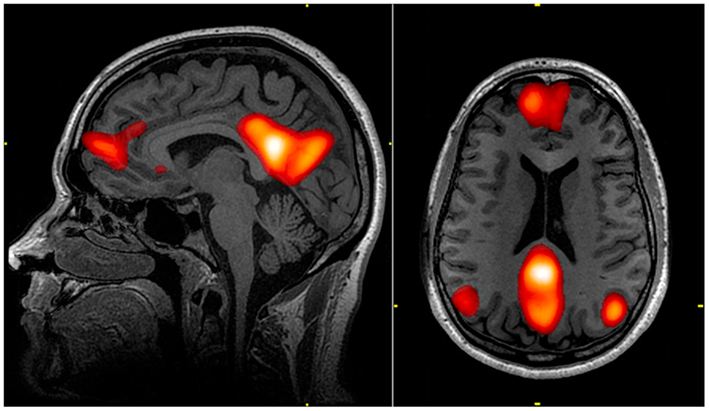
The concept of the Default Mode Network (DMN) emerged in the early 2000s, primarily from observations made using functional magnetic resonance imaging (fMRI). Researchers like Marcus Raichle at Washington University in St. Louis noted a consistent pattern: certain brain regions showed decreased activity during goal-directed tasks but increased activity during periods of rest. This observation led to the hypothesis of a 'default' mode of brain function, distinct from task-specific processing. Initial studies in the early 2000s, often involving fMRI scans, identified a core set of interconnected regions, including the posterior cingulate cortex (PCC) and medial prefrontal cortex (mPFC), that consistently deactivated during cognitive tasks. This network was initially termed the 'task-negative network' due to its inverse relationship with task-positive networks, but the term 'default mode network' gained prominence, emphasizing its role in intrinsic brain activity.
⚙️ Neural Architecture and Function
The DMN is not a single anatomical structure but a distributed network of interconnected brain regions. Its core components typically include the posterior cingulate cortex (PCC), the medial prefrontal cortex (mPFC), the angular gyrus, and the precuneus. These regions work in concert to support internally focused cognition. For instance, the mPFC is heavily involved in self-referential processing and social cognition, while the PCC and precuneus are crucial for autobiographical memory retrieval and future thinking. The network's connectivity is thought to be particularly robust, allowing for rapid communication between these disparate areas to form a coherent internal narrative. Disruptions in the functional connectivity within the DMN are increasingly implicated in various neurological and psychiatric disorders, highlighting its importance in maintaining healthy cognitive function.
📊 Activity Patterns and States
DMN activity is most pronounced during states of wakeful rest, such as daydreaming, mind-wandering, and introspection. During these periods, the network orchestrates a stream of consciousness that often involves reflecting on past experiences, contemplating future possibilities, and considering one's own thoughts and feelings. However, the DMN is not solely a 'rest' network; it can also be active during certain types of cognitive tasks that involve self-referential processing or complex social reasoning. For example, thinking about the mental states of others (theory of mind) or recalling personal memories can engage DMN regions. However, highly demanding external tasks that require focused attention, like solving complex mathematical problems or performing intricate motor skills, typically lead to a suppression of DMN activity, allowing 'task-positive' networks to dominate.
👥 Key Researchers and Institutions
The identification and characterization of the DMN have been the result of collaborative efforts by numerous neuroscientists and research institutions worldwide. Key figures like Marcus Raichle and Patricia Goldman-Rakic (whose work on the prefrontal cortex laid foundational groundwork) have been instrumental. Major research centers such as Washington University in St. Louis, Stanford University, and the Max Planck Institutes have contributed significantly through advanced neuroimaging studies. The development of sophisticated analytical techniques for processing fMRI data by researchers at institutions like Carnegie Mellon University has also been crucial in mapping the network's connectivity and dynamics. These collective efforts have transformed our understanding of intrinsic brain function.
🌍 Implications for Mental Health
Dysregulation of the DMN is a prominent feature in a wide array of mental health conditions. In major depressive disorder, studies often show hyperactivity and increased connectivity within the DMN, potentially reflecting rumination and excessive self-criticism. Conversely, in Alzheimer's disease, the DMN is one of the first networks to show significant amyloid-beta deposition and reduced connectivity, impacting memory and cognitive function. Conditions like autism spectrum disorder and schizophrenia have also been associated with altered DMN activity and connectivity, suggesting its role in social cognition and self-awareness deficits. Understanding these links is vital for developing targeted therapeutic interventions, such as cognitive behavioral therapy or novel neuromodulation techniques.
⚡ Neuroimaging Techniques
The study of the DMN heavily relies on advanced neuroimaging techniques, primarily fMRI. fMRI measures brain activity by detecting changes in blood flow, allowing researchers to infer which brain regions are active during specific mental states or tasks. Electroencephalography (EEG) and magnetoencephalography (MEG) are also employed, offering higher temporal resolution to capture the rapid dynamics of neural activity within the DMN. Diffusion tensor imaging (DTI) is used to map the white matter tracts that connect the various DMN regions, providing insights into the structural basis of its functional connectivity. These techniques, often used in combination, allow for a comprehensive understanding of the DMN's complex architecture and function.
🤔 Controversies and Unanswered Questions
Despite significant progress, several controversies and unanswered questions surround the DMN. One ongoing debate concerns its precise definition and boundaries; different studies sometimes report slightly different sets of core regions. The exact functional role of the DMN also remains a subject of discussion: is it purely for 'rest,' or does it have active roles in c
Key Facts
- Category
- medicine
- Type
- topic