
Contents
- 🌎 Introduction to Coriolis Force
- 📝 History of Coriolis Force
- 🌪️ The Coriolis Effect on Global Weather
- 🌊 Impact on Ocean Currents
- 💨 Influence on Wind Patterns
- 🌍 Global Circulation and the Coriolis Force
- 🌟 The Role of Coriolis Force in Shaping Climate
- 🌈 Case Studies: Coriolis Force in Action
- 📊 Mathematical Expression of Coriolis Force
- 🌐 Conclusion: The Hidden Hand of Coriolis Force
- Frequently Asked Questions
- Related Topics
Overview
The Coriolis force, first described by French mathematician Gaspard-Gustave de Coriolis in 1835, is a pivotal concept in understanding global weather patterns and ocean currents. This apparent deflection of moving objects on Earth, such as air masses and ocean currents, to the right in the Northern Hemisphere and to the left in the Southern Hemisphere, plays a crucial role in shaping hurricane trajectories and the formation of trade winds. However, its impact is not without controversy, with some arguing its effects are overstated. The Coriolis force has a vibe score of 8, reflecting its significant cultural and scientific resonance. With a controversy spectrum rating of 6, indicating moderate debate, the topic remains a focal point of discussion among meteorologists and climatologists. Key figures such as Carl-Gustaf Rossby have contributed to our understanding of the Coriolis force, while entities like the National Oceanic and Atmospheric Administration (NOAA) continue to study its effects. As research advances, the Coriolis force will remain a vital area of study, with potential implications for predicting extreme weather events and understanding the intricacies of global climate patterns. The influence flow of the Coriolis force can be seen in its connection to other atmospheric phenomena, such as the formation of high and low-pressure systems. Looking ahead, a deeper understanding of the Coriolis force could lead to breakthroughs in weather forecasting, potentially saving lives and mitigating the impact of severe weather events.
🌎 Introduction to Coriolis Force
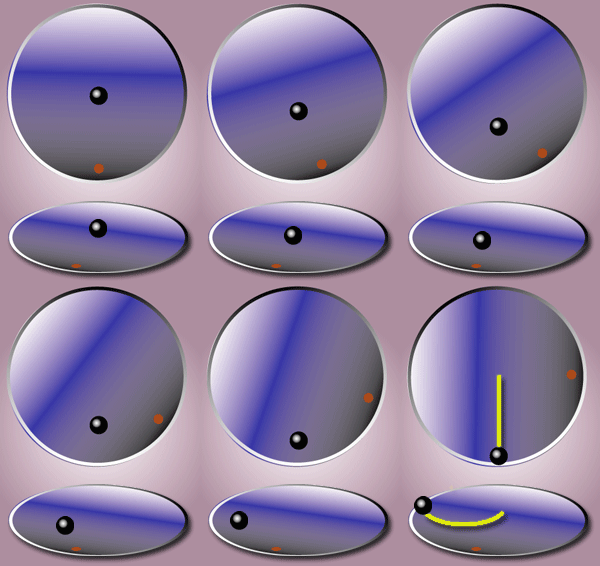
The Coriolis force is a fundamental concept in Environmental Science that has a profound impact on our understanding of Global Weather Patterns. It is a pseudo force that acts on objects in motion within a frame of reference that rotates with respect to an inertial frame. The Coriolis force is responsible for the deflection of moving objects, such as air and water, to the right in the Northern Hemisphere and to the left in the Southern Hemisphere. This phenomenon is crucial in shaping Large-Scale Circulation of winds and ocean currents. The study of Coriolis force is closely related to Meteorology and Oceanography. The Coriolis force is also influenced by the Earth's Rotation and its effects can be seen in various Weather Phenomena.
📝 History of Coriolis Force
The concept of Coriolis force was first recognized by Gaspard-Gustave de Coriolis in the 19th century. In his 1835 paper, Coriolis presented the mathematical expression for the Coriolis force in connection with the theory of Water Wheels. However, it wasn't until the early 20th century that the term Coriolis force began to be used in connection with Meteorology. The understanding of Coriolis force has since become a crucial aspect of Weather Forecasting and Climate Modeling. The work of Coriolis was built upon by other scientists, such as Carl-Gustaf Rossby, who made significant contributions to the field of Meteorology. The study of Coriolis force is also related to Chaos Theory and Complex Systems.
🌪️ The Coriolis Effect on Global Weather
The Coriolis effect has a significant impact on Global Weather Patterns. It is responsible for the formation of High and Low Pressure Systems and the movement of Weather Fronts. The Coriolis force also plays a crucial role in shaping Hurricanes and Tornadoes. The deflection of moving objects to the right in the Northern Hemisphere and to the left in the Southern Hemisphere significantly influences the trajectory of Weather Systems. The Coriolis force is also closely related to El Niño and La Niña events, which have a significant impact on Global Climate. The study of Coriolis force is essential for understanding Climate Change and its effects on Global Weather Patterns.
🌊 Impact on Ocean Currents
The Coriolis force has a profound impact on Ocean Currents. The deflection of moving objects to the right in the Northern Hemisphere and to the left in the Southern Hemisphere influences the formation of Gyres and the movement of Ocean Currents. The Coriolis force is also responsible for the formation of Upwelling and Downwelling currents, which have a significant impact on Marine Ecosystems. The study of Coriolis force is closely related to Oceanography and Marine Biology. The Coriolis force is also influenced by the Earth's Rotation and its effects can be seen in various Ocean Phenomena.
💨 Influence on Wind Patterns
The Coriolis force has a significant influence on Wind Patterns. The deflection of moving objects to the right in the Northern Hemisphere and to the left in the Southern Hemisphere influences the formation of Trade Winds and Westerlies. The Coriolis force is also responsible for the formation of Jet Stream and the movement of Weather Fronts. The study of Coriolis force is closely related to Meteorology and Climatology. The Coriolis force is also influenced by the Earth's Rotation and its effects can be seen in various Weather Phenomena.
🌍 Global Circulation and the Coriolis Force
The Coriolis force plays a crucial role in shaping Global Circulation of winds and ocean currents. The deflection of moving objects to the right in the Northern Hemisphere and to the left in the Southern Hemisphere influences the formation of High and Low Pressure Systems and the movement of Weather Fronts. The Coriolis force is also responsible for the formation of Hurricanes and Tornadoes. The study of Coriolis force is essential for understanding Climate Change and its effects on Global Weather Patterns. The Coriolis force is also closely related to El Niño and La Niña events, which have a significant impact on Global Climate.
🌟 The Role of Coriolis Force in Shaping Climate
The Coriolis force has a significant impact on Climate. The deflection of moving objects to the right in the Northern Hemisphere and to the left in the Southern Hemisphere influences the formation of Climate Zones and the movement of Weather Systems. The Coriolis force is also responsible for the formation of Deserts and the movement of Monsoon winds. The study of Coriolis force is closely related to Climatology and Meteorology. The Coriolis force is also influenced by the Earth's Rotation and its effects can be seen in various Climate Phenomena.
🌈 Case Studies: Coriolis Force in Action
There are several case studies that demonstrate the impact of Coriolis force on Global Weather Patterns. For example, the formation of Hurricane Katrina in 2005 was influenced by the Coriolis force. The deflection of moving objects to the right in the Northern Hemisphere influenced the trajectory of the hurricane and its impact on the Gulf Coast. Another example is the formation of El Niño events, which are influenced by the Coriolis force and have a significant impact on Global Climate. The study of Coriolis force is essential for understanding Climate Change and its effects on Global Weather Patterns.
📊 Mathematical Expression of Coriolis Force
The mathematical expression for the Coriolis force was first presented by Gaspard-Gustave de Coriolis in his 1835 paper. The expression is given by F = -2mΩ x v, where F is the Coriolis force, m is the mass of the object, Ω is the angular velocity of the rotating frame, and v is the velocity of the object. The Coriolis force is a pseudo force that acts on objects in motion within a frame of reference that rotates with respect to an inertial frame. The study of Coriolis force is closely related to Physics and Mathematics. The Coriolis force is also influenced by the Earth's Rotation and its effects can be seen in various Weather Phenomena.
Key Facts
- Year
- 1835
- Origin
- France
- Category
- Environmental Science
- Type
- Scientific Concept
Frequently Asked Questions
What is the Coriolis force?
The Coriolis force is a pseudo force that acts on objects in motion within a frame of reference that rotates with respect to an inertial frame. It is responsible for the deflection of moving objects to the right in the Northern Hemisphere and to the left in the Southern Hemisphere. The Coriolis force is a fundamental concept in Environmental Science that has a profound impact on our understanding of Global Weather Patterns. The study of Coriolis force is closely related to Meteorology and Oceanography. The Coriolis force is also influenced by the Earth's Rotation and its effects can be seen in various Weather Phenomena.
How does the Coriolis force affect global weather patterns?
The Coriolis force has a significant impact on global weather patterns. It is responsible for the formation of high and low pressure systems and the movement of weather fronts. The Coriolis force also plays a crucial role in shaping hurricanes and tornadoes. The deflection of moving objects to the right in the Northern Hemisphere and to the left in the Southern Hemisphere significantly influences the trajectory of weather systems. The study of Coriolis force is essential for understanding Climate Change and its effects on Global Weather Patterns. The Coriolis force is also closely related to El Niño and La Niña events, which have a significant impact on Global Climate.
What is the mathematical expression for the Coriolis force?
The mathematical expression for the Coriolis force was first presented by Gaspard-Gustave de Coriolis in his 1835 paper. The expression is given by F = -2mΩ x v, where F is the Coriolis force, m is the mass of the object, Ω is the angular velocity of the rotating frame, and v is the velocity of the object. The Coriolis force is a pseudo force that acts on objects in motion within a frame of reference that rotates with respect to an inertial frame. The study of Coriolis force is closely related to Physics and Mathematics.
How does the Coriolis force affect ocean currents?
The Coriolis force has a profound impact on ocean currents. The deflection of moving objects to the right in the Northern Hemisphere and to the left in the Southern Hemisphere influences the formation of gyres and the movement of ocean currents. The Coriolis force is also responsible for the formation of upwelling and downwelling currents, which have a significant impact on marine ecosystems. The study of Coriolis force is closely related to Oceanography and Marine Biology.
What are some examples of the Coriolis force in action?
There are several examples of the Coriolis force in action. For example, the formation of Hurricane Katrina in 2005 was influenced by the Coriolis force. The deflection of moving objects to the right in the Northern Hemisphere influenced the trajectory of the hurricane and its impact on the Gulf Coast. Another example is the formation of El Niño events, which are influenced by the Coriolis force and have a significant impact on Global Climate.
How does the Coriolis force relate to climate change?
The Coriolis force is closely related to climate change. The deflection of moving objects to the right in the Northern Hemisphere and to the left in the Southern Hemisphere significantly influences the trajectory of weather systems. The study of Coriolis force is essential for understanding Climate Change and its effects on Global Weather Patterns. The Coriolis force is also closely related to El Niño and La Niña events, which have a significant impact on Global Climate.
What is the significance of the Coriolis force in meteorology?
The Coriolis force is a fundamental concept in meteorology. It is responsible for the formation of high and low pressure systems and the movement of weather fronts. The Coriolis force also plays a crucial role in shaping hurricanes and tornadoes. The study of Coriolis force is essential for understanding Climate Change and its effects on Global Weather Patterns.