
Contents
- 🔍 Introduction to Vanishing Gradients
- 📈 The Mathematics Behind Vanishing Gradients
- 🤖 Impact on Deep Learning Models
- 📊 The Role of Activation Functions
- 📈 Exploding Gradients: The Inverse Problem
- 🔧 Techniques for Mitigating Vanishing Gradients
- 📊 Batch Normalization and Vanishing Gradients
- 📈 Residual Connections and Vanishing Gradients
- 🤝 The Interplay Between Vanishing and Exploding Gradients
- 🔮 Future Directions for Vanishing Gradient Research
- 📊 Case Studies: Real-World Applications of Vanishing Gradient Mitigation
- 📈 Conclusion: Vanishing Gradients in the Context of Deep Learning
- Frequently Asked Questions
- Related Topics
Overview
Vanishing gradients, a phenomenon where gradients used to update weights in neural networks become infinitesimally small, have been a longstanding challenge in deep learning. First identified in the 1990s by researchers like Yoshua Bengio, this issue hinders the training of deep neural networks, causing them to learn slowly or not at all. The problem arises from the nature of backpropagation, where gradients are multiplied together, leading to diminishing values as they propagate backwards through the network. This has significant implications for model performance, with vanishing gradients often resulting in underfitting or requiring specialized architectures like residual networks to mitigate. Researchers have proposed various solutions, including gradient clipping, batch normalization, and alternative activation functions, but the issue remains a topic of active research. As deep learning continues to advance, understanding and addressing vanishing gradients will be crucial for developing more efficient and effective models, with potential applications in areas like natural language processing and computer vision.
🔍 Introduction to Vanishing Gradients
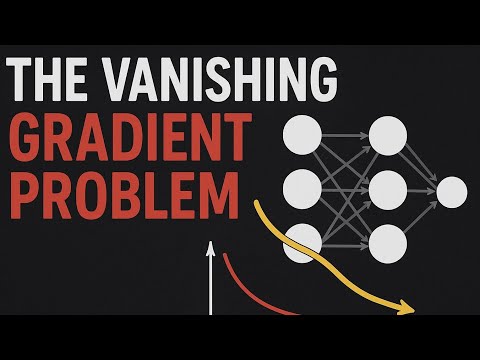
The vanishing gradient problem is a critical issue in deep learning, where the gradients of earlier weights in a neural network become exponentially smaller than those of later weights. This occurs due to the repeated multiplication of gradients during backpropagation, as explained in Backpropagation. As a result, the training process can become unstable, slow, or even halt entirely. Researchers have been working to address this issue, with techniques such as Batch Normalization and Residual Connections showing promise. The vanishing gradient problem is closely related to the Exploding Gradient Problem, which occurs when weight gradients at earlier layers become exponentially larger.
📈 The Mathematics Behind Vanishing Gradients
The mathematics behind vanishing gradients can be understood by examining the process of backpropagation. During backpropagation, the gradients of the loss function with respect to each weight are calculated using the chain rule. As the number of forward propagation steps increases, the gradients of earlier weights are calculated with increasingly many multiplications, leading to an exponential decrease in gradient magnitude. This can be mitigated using techniques such as Gradient Clipping and Weight Initialization. The choice of Activation Function also plays a crucial role in vanishing gradients, with functions like ReLU and Tanh exhibiting different properties.
🤖 Impact on Deep Learning Models
The impact of vanishing gradients on deep learning models can be significant. If the gradients of earlier weights become too small, the model may not be able to learn effectively, leading to poor performance on the task at hand. This can be particularly problematic in applications such as Image Recognition and Natural Language Processing, where deep neural networks are commonly used. Researchers have been exploring various techniques to mitigate vanishing gradients, including the use of RNNs and LSTMs. The vanishing gradient problem is also closely related to the Vanishing and Exploding Gradient Problem.
📊 The Role of Activation Functions
The role of activation functions in vanishing gradients is critical. Different activation functions exhibit different properties, with some being more prone to vanishing gradients than others. For example, the Sigmoid activation function has a narrow range of values, which can lead to vanishing gradients. In contrast, the ReLU activation function has a wider range of values, making it less prone to vanishing gradients. The choice of activation function depends on the specific application and the architecture of the neural network. Researchers have also been exploring the use of Custom Activation Functions to mitigate vanishing gradients.
📈 Exploding Gradients: The Inverse Problem
The exploding gradient problem is the inverse of the vanishing gradient problem, where the gradients of earlier weights become exponentially larger. This can occur when the learning rate is too high or when the neural network is too deep. The exploding gradient problem can be mitigated using techniques such as Gradient Clipping and Weight Regularization. The exploding gradient problem is closely related to the Vanishing Gradient Problem, and researchers have been working to develop techniques that can address both issues simultaneously. The use of Batch Normalization and Residual Connections can also help to mitigate the exploding gradient problem.
🔧 Techniques for Mitigating Vanishing Gradients
Several techniques have been developed to mitigate vanishing gradients, including Batch Normalization and Residual Connections. Batch normalization involves normalizing the inputs to each layer, which can help to reduce the effect of vanishing gradients. Residual connections involve adding a skip connection between layers, which can help to propagate gradients more effectively. Other techniques, such as Gradient Clipping and Weight Initialization, can also be used to mitigate vanishing gradients. Researchers have also been exploring the use of Custom Architectures to address the vanishing gradient problem.
📊 Batch Normalization and Vanishing Gradients
Batch normalization is a technique that can help to mitigate vanishing gradients by normalizing the inputs to each layer. This involves calculating the mean and variance of the inputs and then scaling and shifting the inputs to have a mean of zero and a variance of one. Batch normalization can help to reduce the effect of vanishing gradients by reducing the sensitivity of the neural network to the scale of the inputs. The use of batch normalization can also help to improve the stability of the training process and reduce the risk of overfitting. Batch normalization is closely related to Layer Normalization and Instance Normalization.
📈 Residual Connections and Vanishing Gradients
Residual connections are a technique that can help to mitigate vanishing gradients by adding a skip connection between layers. This involves adding the input to a layer to the output of the layer, which can help to propagate gradients more effectively. Residual connections can help to reduce the effect of vanishing gradients by providing a path for gradients to flow through the neural network. The use of residual connections can also help to improve the stability of the training process and reduce the risk of overfitting. Residual connections are closely related to Dense Connections and Skip Connections.
🤝 The Interplay Between Vanishing and Exploding Gradients
The interplay between vanishing and exploding gradients is complex and not fully understood. Researchers have been working to develop techniques that can address both issues simultaneously, such as Gradient Clipping and Weight Regularization. The use of Batch Normalization and Residual Connections can also help to mitigate both vanishing and exploding gradients. The choice of Activation Function and Optimization Algorithm also plays a crucial role in addressing both issues. Further research is needed to fully understand the interplay between vanishing and exploding gradients and to develop effective techniques for mitigating both issues.
🔮 Future Directions for Vanishing Gradient Research
Future research directions for vanishing gradient research include the development of new techniques for mitigating vanishing gradients, such as Custom Architectures and Custom Activation Functions. Researchers are also exploring the use of Explainable AI techniques to better understand the vanishing gradient problem and to develop more effective techniques for addressing it. The use of Transfer Learning and Meta-Learning can also help to mitigate vanishing gradients by leveraging pre-trained models and adapting them to new tasks. Further research is needed to fully understand the vanishing gradient problem and to develop effective techniques for addressing it.
📊 Case Studies: Real-World Applications of Vanishing Gradient Mitigation
Case studies have shown that mitigating vanishing gradients can have a significant impact on the performance of deep learning models. For example, in Image Recognition tasks, the use of Batch Normalization and Residual Connections can help to improve the accuracy of the model. In Natural Language Processing tasks, the use of RNNs and LSTMs can help to mitigate vanishing gradients and improve the performance of the model. The choice of Activation Function and Optimization Algorithm also plays a crucial role in mitigating vanishing gradients. Further research is needed to fully understand the impact of vanishing gradients on deep learning models and to develop effective techniques for addressing it.
📈 Conclusion: Vanishing Gradients in the Context of Deep Learning
In conclusion, vanishing gradients are a critical issue in deep learning, where the gradients of earlier weights in a neural network become exponentially smaller than those of later weights. The vanishing gradient problem can be mitigated using techniques such as Batch Normalization and Residual Connections. The choice of Activation Function and Optimization Algorithm also plays a crucial role in addressing the vanishing gradient problem. Further research is needed to fully understand the vanishing gradient problem and to develop effective techniques for addressing it. The use of Explainable AI techniques can also help to better understand the vanishing gradient problem and to develop more effective techniques for addressing it.
Key Facts
- Year
- 1991
- Origin
- Sepp Hochreiter's 1991 thesis
- Category
- Artificial Intelligence
- Type
- Concept
Frequently Asked Questions
What is the vanishing gradient problem?
The vanishing gradient problem is a critical issue in deep learning, where the gradients of earlier weights in a neural network become exponentially smaller than those of later weights. This occurs due to the repeated multiplication of gradients during backpropagation, as explained in Backpropagation. The vanishing gradient problem can be mitigated using techniques such as Batch Normalization and Residual Connections.
How does the choice of activation function affect vanishing gradients?
The choice of Activation Function plays a crucial role in vanishing gradients. Different activation functions exhibit different properties, with some being more prone to vanishing gradients than others. For example, the Sigmoid activation function has a narrow range of values, which can lead to vanishing gradients. In contrast, the ReLU activation function has a wider range of values, making it less prone to vanishing gradients.
What is the difference between vanishing and exploding gradients?
The vanishing gradient problem and the Exploding Gradient Problem are two related but distinct issues in deep learning. The vanishing gradient problem occurs when the gradients of earlier weights become exponentially smaller, while the exploding gradient problem occurs when the gradients of earlier weights become exponentially larger. Both issues can be mitigated using techniques such as Gradient Clipping and Weight Regularization.
How can batch normalization help to mitigate vanishing gradients?
Batch normalization is a technique that can help to mitigate vanishing gradients by normalizing the inputs to each layer. This involves calculating the mean and variance of the inputs and then scaling and shifting the inputs to have a mean of zero and a variance of one. Batch normalization can help to reduce the effect of vanishing gradients by reducing the sensitivity of the neural network to the scale of the inputs.
What is the role of residual connections in mitigating vanishing gradients?
Residual connections are a technique that can help to mitigate vanishing gradients by adding a skip connection between layers. This involves adding the input to a layer to the output of the layer, which can help to propagate gradients more effectively. Residual connections can help to reduce the effect of vanishing gradients by providing a path for gradients to flow through the neural network.
How can explainable AI techniques help to address the vanishing gradient problem?
Explainable AI techniques can help to better understand the vanishing gradient problem and to develop more effective techniques for addressing it. By providing insights into the behavior of the neural network, explainable AI techniques can help to identify the root causes of vanishing gradients and to develop targeted solutions. The use of explainable AI techniques can also help to improve the transparency and interpretability of deep learning models.
What is the impact of vanishing gradients on deep learning models?
The impact of vanishing gradients on deep learning models can be significant. If the gradients of earlier weights become too small, the model may not be able to learn effectively, leading to poor performance on the task at hand. The vanishing gradient problem can also lead to overfitting, where the model becomes too specialized to the training data and fails to generalize to new data. The use of techniques such as Batch Normalization and Residual Connections can help to mitigate vanishing gradients and improve the performance of deep learning models.