
Contents
Overview
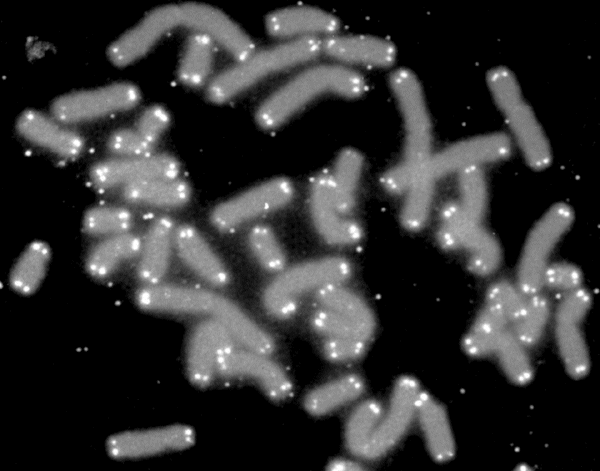
Telomeres are a crucial component of eukaryotic cells, consisting of repetitive nucleotide sequences at the ends of linear chromosomes. These sequences, typically composed of TTAGGG repeats in humans, are bound by specialized proteins that form a protective cap, shielding the chromosome ends from DNA degradation and fusion. The discovery of telomeres is attributed to Barbara McClintock, who first observed them in the 1930s while studying maize genetics at Cornell University. Since then, researchers like Elizabeth Blackburn and Carol Greider have made significant contributions to our understanding of telomeres, including the discovery of telomerase, an enzyme that maintains telomere length.
⚙️ How Telomeres Work
The function of telomeres is multifaceted, involving the protection of chromosome ends from DNA repair systems, which might otherwise mistake the ends for double-strand breaks. This protection is essential for maintaining genome stability, as telomere shortening can lead to chromosome fusion and instability. Telomeres also play a role in regulating cellular aging, as their length decreases with each cell division. This process has been studied extensively in the context of cancer research, where telomerase is often overexpressed, allowing cancer cells to maintain their telomeres and continue dividing indefinitely. Researchers at Stanford University and Harvard University have made significant contributions to our understanding of telomeres in cancer.
🌎 Telomeres in Human Health
In humans, telomeres have been implicated in various diseases, including cancer, aging, and telomere-related diseases. Short telomeres have been linked to increased risk of age-related diseases, such as cardiovascular disease and dementia. Conversely, longer telomeres have been associated with improved health outcomes and increased lifespan. The study of telomeres has also led to the development of new diagnostic tools, such as telomere length testing, which can provide insights into an individual's biological age. Companies like Illumina and Thermo Fisher Scientific offer telomere length testing services, which have been used in research studies at Johns Hopkins University and University of California, Los Angeles.
🔮 Telomere Length and Aging
The relationship between telomeres and aging is complex, with telomere shortening considered a hallmark of aging. As we age, our telomeres naturally shorten due to the end-replication problem, where the enzyme telomerase is not sufficient to maintain telomere length. This shortening can lead to cellular senescence, a state in which cells become inactive and can no longer divide. Researchers have explored various strategies to maintain or lengthen telomeres, including telomerase activation and lifestyle interventions, such as exercise and stress reduction, which have been studied at National Institutes of Health and Mayo Clinic.
Key Facts
- Year
- 1930s
- Origin
- Eukaryotic cells
- Category
- chronic-conditions
- Type
- concept
Frequently Asked Questions
What is the function of telomeres?
Telomeres protect the terminal regions of chromosomal DNA from progressive degradation and ensure the integrity of linear chromosomes by preventing DNA repair systems from mistaking the very ends of the DNA strand for a double-strand break. This process has been studied extensively by researchers at Stanford University and Harvard University.
How do telomeres relate to aging?
Telomeres naturally shorten with each cell division, leading to cellular senescence and aging. This process has been explored by scientists such as Elizabeth Blackburn and Carol Greider, who have made significant contributions to our understanding of telomeres and aging.
Can telomeres be lengthened?
Yes, telomeres can be lengthened through various strategies, including telomerase activation and lifestyle interventions, such as exercise and stress reduction, which have been studied at National Institutes of Health and Mayo Clinic.
What is the relationship between telomeres and cancer?
Telomeres play a critical role in cancer development, as cancer cells often exhibit telomerase activation, allowing them to maintain their telomeres and continue dividing indefinitely. This has been studied extensively in the context of cancer research, where telomerase is often overexpressed.
How are telomeres measured?
Telomeres can be measured using various techniques, including telomere length testing, which can provide insights into an individual's biological age. Companies like Illumina and Thermo Fisher Scientific offer telomere length testing services, which have been used in research studies at Johns Hopkins University and University of California, Los Angeles.