
Summary
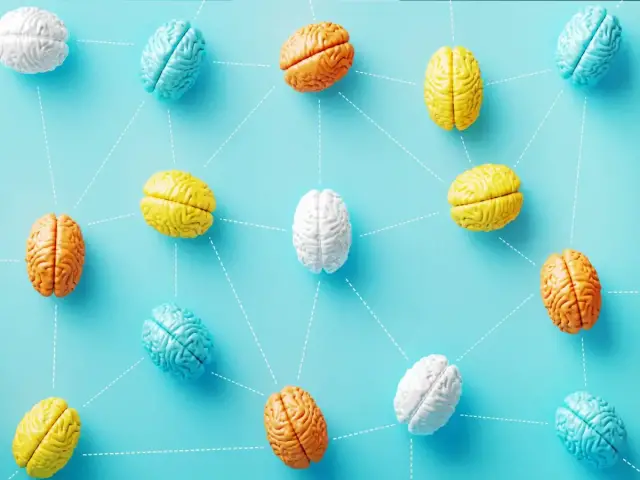
Research has consistently shown that relationships are key to a long, happy life. Neuroscientist Ben Rein's new book, Why Brains Need Friends, explains that our brains are exquisitely optimized for social connection, releasing **oxytocin**, **serotonin**, and **dopamine** in response to socializing. These neurochemicals play a role in making us want to connect, and have positive health effects, including reducing **stress**, **anxiety**, and **inflammation**. According to Rein, our brains are built to resonate with others' feelings through **emotional contagion**, an element of **empathy** that helps us understand and care about others. This is evident in the way we unconsciously mimic each other's facial expressions, triggering a milder version of the same feeling in ourselves. For example, when we see someone smile, our brain interprets our facial muscles and we feel a bit happier. This reinforcing system has evolutionary roots, linked to **safety** and **reproduction**, our two strongest biological drives. As Rein notes, 'our brains are built so that social connection feels good and is inherently reinforcing. This keeps us together—and therefore keeps us alive.' This concept is closely related to the idea of [[social-support-networks|social support networks]], which are crucial for our mental and physical well-being. Additionally, the release of **oxytocin** during social interactions can have a positive impact on our **mental-health**, reducing symptoms of **depression** and **anxiety**. Our brains' ability to form and maintain social connections is a key aspect of our overall health and happiness. By understanding the neuroscience behind social connection, we can better appreciate the importance of nurturing our relationships and building strong **social-support-networks**. This is particularly relevant in today's society, where people are increasingly experiencing **social-isolation** and **loneliness**. As we continue to navigate the complexities of modern life, it's essential to prioritize our relationships and make time for **socializing**, whether it's with friends, family, or colleagues. By doing so, we can harness the power of our brains' social connection systems and reap the many benefits that come with it, including improved **mental-health**, increased **happiness**, and a stronger sense of **community**.
Key Takeaways
- Our brains are optimized for social connection, releasing oxytocin, serotonin, and dopamine in response to socializing
- Social connection has positive health effects, including reducing stress, anxiety, and inflammation
- Our brains' social connection systems can be influenced by a range of factors, including culture, upbringing, and life experiences
- Building strong social support networks can have a positive impact on our mental and physical health
- Prioritizing social connection and building strong relationships is essential for our overall health and happiness
Balanced Perspective
The book Why Brains Need Friends provides a balanced perspective on the importance of relationships in our lives. While it highlights the many benefits of social connection, it also acknowledges the complexities and challenges of building and maintaining relationships. For example, **social-anxiety** and **fear-of-rejection** can make it difficult for people to form and maintain social connections. Additionally, the book notes that our brains' social connection systems can be influenced by a range of factors, including **culture**, **upbringing**, and **life-experiences**. By understanding these factors, we can better appreciate the importance of social connection and take steps to build stronger, more meaningful relationships. This is closely related to the concept of [[attachment-theory|attachment theory]], which explains how our early relationships with caregivers shape our expectations and behaviors in relationships throughout our lives.
Optimistic View
The book Why Brains Need Friends offers a hopeful perspective on the importance of relationships in our lives. By understanding how our brains are optimized for social connection, we can take steps to nurture our relationships and build stronger, more meaningful connections with others. This can have a positive impact on our **mental-health**, reducing symptoms of **depression** and **anxiety**, and increasing our overall sense of **well-being**. As Rein notes, 'our brains are built to resonate with others' feelings,' which can help us build stronger, more empathetic relationships. By prioritizing social connection and building strong **social-support-networks**, we can create a more supportive and compassionate community, where everyone has the opportunity to thrive. This is closely related to the concept of [[emotional-intelligence|emotional intelligence]], which is essential for building and maintaining strong relationships.
Critical View
While the book Why Brains Need Friends highlights the importance of relationships in our lives, it also raises concerns about the potential negative consequences of social isolation. For example, **loneliness** and **social-isolation** can have serious negative effects on our **mental-health** and **physical-health**, including increased risk of **depression**, **anxiety**, and **heart-disease**. Additionally, the book notes that our brains' social connection systems can be influenced by a range of negative factors, including **social-media**, **trauma**, and **stress**. By understanding these risks, we can take steps to mitigate them and build stronger, more resilient relationships. However, this requires a nuanced understanding of the complex interplay between our brains, our relationships, and our environment. This is closely related to the concept of [[social-comparison-theory|social comparison theory]], which explains how we tend to compare ourselves to others and how this can impact our self-esteem and relationships.
Source
Originally reported by greatergood.berkeley.edu