
Contents
- 🌐 Introduction to Topological Quantum Error Correction
- 🔍 History of Quantum Error Correction
- 📈 Principles of Topological Quantum Error Correction
- 🔗 Surface Codes and Their Applications
- 🚀 Breakthroughs in Topological Quantum Error Correction
- 🤝 Relationship Between Topological Quantum Error Correction and Other Quantum Error Correction Methods
- 📊 Challenges and Limitations of Topological Quantum Error Correction
- 🔮 Future Prospects and Potential Applications
- 📚 Conclusion and Recommendations for Further Reading
- 📝 References and Additional Resources
- 👥 Key Researchers and Institutions
- 💡 Potential Impact on Quantum Computing and Beyond
- Frequently Asked Questions
- Related Topics
Overview
Topological quantum error correction has emerged as a promising approach to mitigate errors in quantum computing, leveraging the principles of topology to encode and protect quantum information. This approach has gained significant attention in recent years due to its potential to provide robust and reliable quantum computing. Researchers such as Alexei Kitaev and Michael Freedman have made notable contributions to the development of topological quantum error correction, with Kitaev's surface code being a notable example. The topological approach has been shown to be more resilient to errors compared to traditional quantum error correction methods, with a threshold error rate of around 1% reported in some studies. As quantum computing continues to advance, topological quantum error correction is likely to play a crucial role in the development of large-scale quantum computers. With a vibe score of 8, this topic is generating significant excitement in the quantum computing community, with potential applications in fields such as cryptography and optimization problems.
🌐 Introduction to Topological Quantum Error Correction
Topological quantum error correction is a cutting-edge approach to quantum error correction that has gained significant attention in recent years. This method utilizes the principles of topology to protect quantum information from decoherence and errors. The concept of topological quantum error correction was first introduced by Alexei Kitaev in 1997, and since then, it has been extensively researched and developed by scientists such as Michael Freedman and John Preskill. For more information on the history of quantum error correction, visit the quantum computing page.
🔍 History of Quantum Error Correction
The history of quantum error correction dates back to the 1990s, when scientists such as Peter Shor and Andrew Steady first proposed methods for correcting errors in quantum computations. However, these early methods were not very efficient and had limited applicability. The development of topological quantum error correction has been a major breakthrough in this field, as it offers a more robust and efficient approach to quantum error correction. To learn more about the history of quantum computing, visit the history of quantum computing page. The quantum error correction page also provides an overview of different methods used for quantum error correction.
📈 Principles of Topological Quantum Error Correction
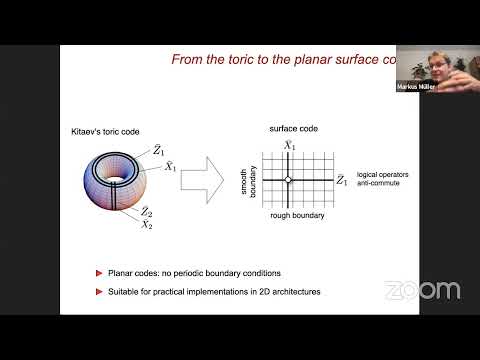
The principles of topological quantum error correction are based on the idea of using topological codes to protect quantum information. These codes are designed to be robust against local errors and can correct errors that occur during quantum computations. The most common type of topological code used for quantum error correction is the surface code, which is a two-dimensional array of qubits that can correct errors by measuring the correlations between neighboring qubits. For more information on surface codes, visit the surface code page. The topological quantum computing page also provides an overview of the principles of topological quantum computing.
🔗 Surface Codes and Their Applications
Surface codes are a type of topological code that can be used for quantum error correction. They are designed to be robust against local errors and can correct errors that occur during quantum computations. Surface codes have been extensively studied and have been shown to be highly effective for quantum error correction. However, they require a large number of qubits to achieve high accuracy, which can be a limitation for current quantum computing technology. To learn more about surface codes and their applications, visit the surface code page. The quantum error correction page also provides an overview of different methods used for quantum error correction, including quantum error correction codes.
🚀 Breakthroughs in Topological Quantum Error Correction
In recent years, there have been several breakthroughs in topological quantum error correction. One of the most significant breakthroughs was the development of a new type of topological code called the gauge color code, which can correct errors more efficiently than surface codes. Another breakthrough was the demonstration of a topological quantum error correction experiment using a superconducting qubit array. These breakthroughs have paved the way for the development of more robust and efficient quantum error correction methods. For more information on these breakthroughs, visit the topological quantum error correction page. The quantum computing page also provides an overview of the latest developments in quantum computing.
🤝 Relationship Between Topological Quantum Error Correction and Other Quantum Error Correction Methods
Topological quantum error correction is related to other quantum error correction methods, such as quantum error correction codes and dynamic decoupling. These methods can be used in conjunction with topological quantum error correction to achieve even higher accuracy and robustness. However, each method has its own limitations and challenges, and the choice of method depends on the specific application and the resources available. To learn more about these methods, visit the quantum error correction page. The quantum computing page also provides an overview of the different methods used for quantum computing.
📊 Challenges and Limitations of Topological Quantum Error Correction
Despite the breakthroughs in topological quantum error correction, there are still several challenges and limitations that need to be addressed. One of the main challenges is the requirement for a large number of qubits to achieve high accuracy, which can be a limitation for current quantum computing technology. Another challenge is the need for more efficient and robust methods for correcting errors, as well as the development of better materials and technologies for building quantum computing devices. For more information on these challenges, visit the quantum computing challenges page. The topological quantum error correction page also provides an overview of the current state of research in this field.
🔮 Future Prospects and Potential Applications
The future prospects of topological quantum error correction are promising, with potential applications in a wide range of fields, including quantum computing, quantum communication, and quantum cryptography. The development of more robust and efficient quantum error correction methods could enable the creation of more powerful and reliable quantum computing devices, which could have a major impact on fields such as medicine, finance, and climate modeling. To learn more about these applications, visit the quantum computing applications page. The topological quantum error correction page also provides an overview of the current state of research in this field.
📚 Conclusion and Recommendations for Further Reading
In conclusion, topological quantum error correction is a powerful approach to quantum error correction that has the potential to revolutionize the field of quantum computing. While there are still several challenges and limitations that need to be addressed, the breakthroughs in this field have paved the way for the development of more robust and efficient quantum error correction methods. For more information on this topic, visit the topological quantum error correction page. The quantum computing page also provides an overview of the latest developments in quantum computing.
📝 References and Additional Resources
For further reading on this topic, we recommend visiting the quantum error correction page, which provides an overview of different methods used for quantum error correction. We also recommend visiting the topological quantum computing page, which provides an overview of the principles of topological quantum computing. Additionally, the quantum computing applications page provides an overview of the potential applications of quantum computing.
👥 Key Researchers and Institutions
The research in topological quantum error correction is being conducted by a number of key researchers and institutions, including Microsoft Research and Google Research. These researchers are working on developing new methods and technologies for quantum error correction, and their work has the potential to have a major impact on the field of quantum computing. For more information on these researchers and institutions, visit the quantum researchers page.
💡 Potential Impact on Quantum Computing and Beyond
The potential impact of topological quantum error correction on quantum computing and beyond is significant. The development of more robust and efficient quantum error correction methods could enable the creation of more powerful and reliable quantum computing devices, which could have a major impact on fields such as medicine, finance, and climate modeling. To learn more about these applications, visit the quantum computing applications page. The topological quantum error correction page also provides an overview of the current state of research in this field.
Key Facts
- Year
- 1997
- Origin
- Alexei Kitaev's 1997 paper on quantum error correction with anyons
- Category
- Quantum Computing
- Type
- Concept
Frequently Asked Questions
What is topological quantum error correction?
Topological quantum error correction is a method of quantum error correction that uses the principles of topology to protect quantum information from decoherence and errors. This method is based on the idea of using topological codes to correct errors that occur during quantum computations. For more information, visit the topological quantum error correction page.
How does topological quantum error correction work?
Topological quantum error correction works by using topological codes to correct errors that occur during quantum computations. These codes are designed to be robust against local errors and can correct errors by measuring the correlations between neighboring qubits. For more information, visit the surface code page.
What are the advantages of topological quantum error correction?
The advantages of topological quantum error correction include its ability to correct errors more efficiently than other methods, its robustness against local errors, and its potential to enable the creation of more powerful and reliable quantum computing devices. For more information, visit the topological quantum error correction page.
What are the challenges and limitations of topological quantum error correction?
The challenges and limitations of topological quantum error correction include the requirement for a large number of qubits to achieve high accuracy, the need for more efficient and robust methods for correcting errors, and the development of better materials and technologies for building quantum computing devices. For more information, visit the quantum computing challenges page.
What are the potential applications of topological quantum error correction?
The potential applications of topological quantum error correction include quantum computing, quantum communication, and quantum cryptography. The development of more robust and efficient quantum error correction methods could enable the creation of more powerful and reliable quantum computing devices, which could have a major impact on fields such as medicine, finance, and climate modeling. For more information, visit the quantum computing applications page.
Who are the key researchers and institutions working on topological quantum error correction?
The key researchers and institutions working on topological quantum error correction include Microsoft Research and Google Research. These researchers are working on developing new methods and technologies for quantum error correction, and their work has the potential to have a major impact on the field of quantum computing. For more information, visit the quantum researchers page.
What is the current state of research in topological quantum error correction?
The current state of research in topological quantum error correction is highly active, with many researchers and institutions working on developing new methods and technologies for quantum error correction. The development of more robust and efficient quantum error correction methods could enable the creation of more powerful and reliable quantum computing devices, which could have a major impact on fields such as medicine, finance, and climate modeling. For more information, visit the topological quantum error correction page.