
Contents
- 🔍 Introduction to Stabilizer Codes
- 💻 Quantum Error Correction with Stabilizer Codes
- 📈 Types of Stabilizer Codes
- 🔗 CSS Codes and Their Significance
- 📊 The Five-Qubit Error Correcting Code
- 🤔 Challenges and Limitations of Stabilizer Codes
- 📈 Applications of Stabilizer Codes in Quantum Computing
- 🔜 Future Directions and Research
- 📊 Stabilizer Codes and Quantum Information Processing
- 📈 Surface Codes and Their Role in Quantum Computing
- 📊 Toric Code and Its Importance
- 🔍 Conclusion and Future Prospects
- Frequently Asked Questions
- Related Topics
Overview
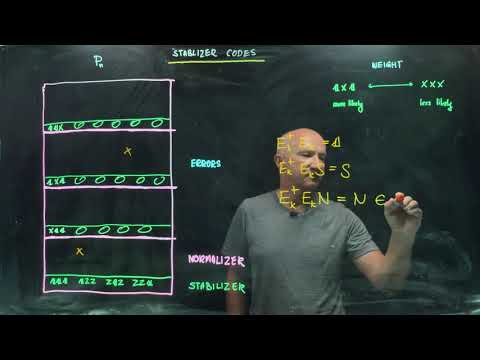
Stabilizer codes are a fundamental concept in quantum error correction, enabling the protection of quantum information from decoherence and errors. Developed by Daniel Gottesman in 1996, stabilizer codes are based on the principles of classical coding theory, but adapted for the unique challenges of quantum computing. The stabilizer formalism provides a framework for constructing and analyzing quantum error-correcting codes, including the famous surface code and Shor's code. With a vibe rating of 8, stabilizer codes have a significant impact on the development of quantum computing and quantum information processing. Researchers like Robert Calderbank and Peter Shor have contributed to the advancement of stabilizer codes, which have been experimentally demonstrated in various quantum systems. As quantum computing continues to evolve, stabilizer codes will play a crucial role in enabling reliable and large-scale quantum computation.
🔍 Introduction to Stabilizer Codes
Stabilizer codes are a crucial component of quantum computing and quantum communication, enabling the correction of errors that occur during quantum information processing. As explained in Quantum Error Correction, these codes are designed to detect and correct errors that arise due to the fragile nature of quantum bits, or qubits. Stabilizer codes, in particular, have gained significant attention in recent years due to their potential to enable large-scale quantum computing. For instance, Toric Code and Surface Code are types of stabilizer codes that have shown great promise in this regard.
💻 Quantum Error Correction with Stabilizer Codes
Quantum error correction is essential for reliable quantum computing, and stabilizer codes play a vital role in this process. By using a combination of qubits and carefully designed codes, stabilizer codes can detect and correct errors that occur during quantum computations. This is particularly important in Quantum Computing, where even small errors can quickly propagate and destroy the fragile quantum states required for computation. Stabilizer codes, such as CSS Codes, have been shown to be highly effective in correcting errors and maintaining the integrity of quantum information.
📈 Types of Stabilizer Codes
There are several types of stabilizer codes, each with its own strengths and weaknesses. CSS Codes, for example, are a special class of stabilizer codes that have been widely studied and implemented. These codes are particularly useful for quantum error correction due to their ability to correct both bit-flip and phase-flip errors. Another example of a stabilizer code is the Five-Qubit Error Correcting Code, which is not a CSS code but still provides robust error correction capabilities. The Quantum Error Correction techniques used in these codes are crucial for reliable quantum computing.
🔗 CSS Codes and Their Significance
CSS codes are a significant class of stabilizer codes that have gained considerable attention in recent years. These codes are named after their inventors, Calderbank, Shor, and Steane, and are characterized by their ability to correct both bit-flip and phase-flip errors. CSS Codes are particularly useful for quantum error correction due to their high error correction thresholds and relatively simple implementation. The Toric Code and Surface Code are examples of CSS codes that have been widely studied and implemented in various quantum computing architectures.
📊 The Five-Qubit Error Correcting Code
The five-qubit error correcting code is an example of a stabilizer code that is not a CSS code. Despite this, it still provides robust error correction capabilities and has been widely studied in the context of quantum error correction. This code is particularly interesting due to its small size and relatively simple implementation, making it an attractive option for small-scale quantum computing applications. The Quantum Computing community has been exploring the use of such codes in Quantum Information Processing applications.
🤔 Challenges and Limitations of Stabilizer Codes
While stabilizer codes have shown great promise for quantum error correction, they are not without their challenges and limitations. One of the primary limitations of stabilizer codes is their requirement for a large number of qubits, which can be difficult to scale up to large numbers. Additionally, the error correction thresholds of stabilizer codes can be relatively low, requiring careful implementation and calibration to achieve reliable error correction. The Quantum Error Correction techniques used in these codes must be carefully optimized to address these challenges.
📈 Applications of Stabilizer Codes in Quantum Computing
Stabilizer codes have a wide range of applications in quantum computing, from small-scale quantum simulations to large-scale quantum computing architectures. These codes are particularly useful for applications that require robust error correction, such as Quantum Cryptography and Quantum Simulation. The Toric Code and Surface Code are examples of stabilizer codes that have been widely used in these applications due to their high error correction thresholds and relatively simple implementation.
🔜 Future Directions and Research
Future research directions for stabilizer codes include the development of new codes with higher error correction thresholds and more efficient implementation. Additionally, the integration of stabilizer codes with other quantum error correction techniques, such as Dynamic Decoupling, is an active area of research. The Quantum Computing community is also exploring the use of stabilizer codes in Quantum Machine Learning applications.
📊 Stabilizer Codes and Quantum Information Processing
Stabilizer codes are a crucial component of quantum information processing, enabling the reliable transmission and processing of quantum information. These codes are particularly useful for applications that require robust error correction, such as Quantum Teleportation and Quantum Superdense Coding. The Toric Code and Surface Code are examples of stabilizer codes that have been widely used in these applications due to their high error correction thresholds and relatively simple implementation.
📈 Surface Codes and Their Role in Quantum Computing
Surface codes are a type of stabilizer code that have gained significant attention in recent years due to their high error correction thresholds and relatively simple implementation. These codes are particularly useful for applications that require robust error correction, such as Quantum Computing and Quantum Simulation. The Surface Code is an example of a surface code that has been widely studied and implemented in various quantum computing architectures.
📊 Toric Code and Its Importance
The toric code is a type of stabilizer code that has been widely studied and implemented in various quantum computing architectures. This code is particularly interesting due to its high error correction threshold and relatively simple implementation, making it an attractive option for small-scale quantum computing applications. The Toric Code is an example of a CSS code, which is a special class of stabilizer codes that have been widely studied and implemented.
🔍 Conclusion and Future Prospects
In conclusion, stabilizer codes are a crucial component of quantum computing and quantum communication, enabling the correction of errors that occur during quantum information processing. These codes have shown great promise for quantum error correction and have been widely studied and implemented in various quantum computing architectures. Future research directions for stabilizer codes include the development of new codes with higher error correction thresholds and more efficient implementation, as well as the integration of stabilizer codes with other quantum error correction techniques.
Key Facts
- Year
- 1996
- Origin
- Daniel Gottesman
- Category
- Quantum Computing
- Type
- Concept
Frequently Asked Questions
What is a stabilizer code?
A stabilizer code is a class of quantum codes used for quantum error correction. These codes are designed to detect and correct errors that occur during quantum computations. Stabilizer codes, such as Toric Code and Surface Code, have shown great promise in this regard. The Quantum Error Correction techniques used in these codes are crucial for reliable quantum computing.
What is the difference between a stabilizer code and a CSS code?
A CSS code is a special class of stabilizer code that is characterized by its ability to correct both bit-flip and phase-flip errors. While all CSS codes are stabilizer codes, not all stabilizer codes are CSS codes. The CSS Code is an example of a CSS code that has been widely studied and implemented.
What is the five-qubit error correcting code?
The five-qubit error correcting code is an example of a stabilizer code that is not a CSS code. Despite this, it still provides robust error correction capabilities and has been widely studied in the context of quantum error correction. The Five-Qubit Error Correcting Code is particularly interesting due to its small size and relatively simple implementation.
What are the applications of stabilizer codes?
Stabilizer codes have a wide range of applications in quantum computing, from small-scale quantum simulations to large-scale quantum computing architectures. These codes are particularly useful for applications that require robust error correction, such as Quantum Cryptography and Quantum Simulation.
What is the future of stabilizer codes?
Future research directions for stabilizer codes include the development of new codes with higher error correction thresholds and more efficient implementation. Additionally, the integration of stabilizer codes with other quantum error correction techniques, such as Dynamic Decoupling, is an active area of research. The Quantum Computing community is also exploring the use of stabilizer codes in Quantum Machine Learning applications.
How do stabilizer codes work?
Stabilizer codes work by using a combination of qubits and carefully designed codes to detect and correct errors that occur during quantum computations. The Quantum Error Correction techniques used in these codes are crucial for reliable quantum computing. The Toric Code and Surface Code are examples of stabilizer codes that have been widely studied and implemented in various quantum computing architectures.
What is the significance of CSS codes?
CSS codes are a special class of stabilizer codes that have been widely studied and implemented. These codes are particularly useful for quantum error correction due to their high error correction thresholds and relatively simple implementation. The CSS Code is an example of a CSS code that has been widely studied and implemented.