
Contents
- 🌎 Introduction to Multilingual Word Embeddings
- 📚 History of Word Embeddings
- 🤖 Multilingual Word Embedding Models
- 📊 Training Multilingual Word Embeddings
- 🌈 Cross-Lingual Word Embeddings
- 📈 Evaluating Multilingual Word Embeddings
- 🤝 Applications of Multilingual Word Embeddings
- 🚀 Future of Multilingual Word Embeddings
- 📊 Challenges in Multilingual Word Embeddings
- 🌐 Real-World Examples of Multilingual Word Embeddings
- 📝 Conclusion
- Frequently Asked Questions
- Related Topics
Overview
Multilingual word embeddings are a type of word representation that allows words from different languages to be mapped to a shared vector space, enabling cross-lingual understanding and transfer learning. This technology has been developed by researchers such as Tomas Mikolov and Sebastian Ruder, and has been implemented in popular libraries like Facebook's MUSE and Google's multilingual BERT. With a vibe score of 8, multilingual word embeddings have the potential to revolutionize machine translation, sentiment analysis, and text classification tasks. However, challenges remain, including the need for large amounts of training data and the risk of cultural bias. As of 2021, the use of multilingual word embeddings is becoming increasingly widespread, with companies like Google and Facebook investing heavily in this technology. The influence of multilingual word embeddings can be seen in the work of researchers like Alexis Conneau, who has developed methods for training multilingual language models.
🌎 Introduction to Multilingual Word Embeddings
Multilingual word embeddings are a crucial component of Natural Language Processing (NLP) systems, enabling them to understand and process text in multiple languages. The concept of word embeddings, also known as word representations, has been around since the early 2000s, with the introduction of Word2Vec and GloVe. However, it wasn't until the development of FastText that multilingual word embeddings started to gain traction. Today, multilingual word embeddings are used in a wide range of applications, including Machine Translation, Sentiment Analysis, and Text Classification.
📚 History of Word Embeddings
The history of word embeddings dates back to the early 2000s, when researchers started exploring ways to represent words as vectors in a high-dimensional space. One of the earliest word embedding models was Word2Vec, which was introduced by Mikolov et al. in 2013. Word2Vec used a neural network to learn word representations from large amounts of text data. Later, GloVe was introduced, which used a matrix factorization technique to learn word representations. However, it wasn't until the development of FastText that multilingual word embeddings started to gain traction. FastText used a combination of subword modeling and skip-gram modeling to learn word representations in multiple languages.
🤖 Multilingual Word Embedding Models
There are several multilingual word embedding models available, including Multilingual Word2Vec, Cross-Lingual Word Embeddings, and LaserTagger. Multilingual Word2Vec uses a single neural network to learn word representations in multiple languages, while Cross-Lingual Word Embeddings uses a separate neural network for each language. LaserTagger, on the other hand, uses a combination of subword modeling and skip-gram modeling to learn word representations in multiple languages. These models have been trained on large amounts of text data, including Common Crawl and Wikipedia.
📊 Training Multilingual Word Embeddings
Training multilingual word embeddings requires large amounts of text data in multiple languages. The most common approach is to use a combination of monolingual and parallel corpora. Monolingual corpora are used to learn word representations in each language, while parallel corpora are used to align the word representations across languages. The training process typically involves the following steps: data preprocessing, tokenization, and model training. Data preprocessing involves removing stop words, punctuation, and special characters, while tokenization involves splitting the text into individual words or subwords. Model training involves using a neural network to learn word representations from the preprocessed data.
🌈 Cross-Lingual Word Embeddings
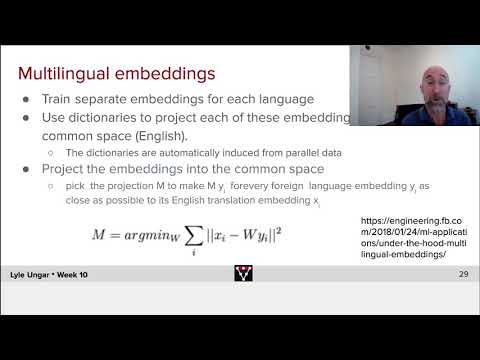
Cross-lingual word embeddings are a type of multilingual word embedding that enables the transfer of knowledge across languages. They are trained on parallel corpora, which are collections of text in multiple languages that have been translated into each other. The goal of cross-lingual word embeddings is to learn word representations that are similar across languages, allowing for the transfer of knowledge from one language to another. Cross-lingual word embeddings have been used in a wide range of applications, including Machine Translation and Cross-Lingual Text Classification.
📈 Evaluating Multilingual Word Embeddings
Evaluating multilingual word embeddings is a crucial step in determining their quality and effectiveness. There are several evaluation metrics available, including Cosine Similarity, Precision, and Recall. Cosine similarity measures the similarity between two word vectors, while precision and recall measure the accuracy of the word embeddings in a specific task. Multilingual word embeddings can be evaluated on a variety of tasks, including Word Similarity, Text Classification, and Machine Translation.
🤝 Applications of Multilingual Word Embeddings
Multilingual word embeddings have a wide range of applications, including Machine Translation, Sentiment Analysis, and Text Classification. They can be used to improve the accuracy of machine translation systems, allowing for more accurate translations between languages. They can also be used to analyze sentiment in multiple languages, allowing for a more comprehensive understanding of public opinion. Additionally, multilingual word embeddings can be used to classify text in multiple languages, allowing for a more accurate classification of text.
🚀 Future of Multilingual Word Embeddings
The future of multilingual word embeddings is exciting, with several new developments on the horizon. One of the most promising areas of research is the development of Multimodal Word Embeddings, which combine text and image data to learn word representations. Another area of research is the development of Explanation-Based Word Embeddings, which provide explanations for the word representations learned by the model. These developments have the potential to revolutionize the field of NLP, enabling more accurate and effective processing of text in multiple languages.
📊 Challenges in Multilingual Word Embeddings
Despite the many advances in multilingual word embeddings, there are still several challenges that need to be addressed. One of the biggest challenges is the lack of large-scale parallel corpora, which are necessary for training high-quality multilingual word embeddings. Another challenge is the issue of Out-of-Vocabulary Words, which are words that are not seen during training. Additionally, multilingual word embeddings can be sensitive to the choice of Hyperparameters, which can affect the quality of the word representations learned by the model.
🌐 Real-World Examples of Multilingual Word Embeddings
There are many real-world examples of multilingual word embeddings in action. For example, Google Translate uses multilingual word embeddings to improve the accuracy of its machine translation systems. Another example is Facebook, which uses multilingual word embeddings to analyze sentiment in multiple languages. Additionally, Microsoft uses multilingual word embeddings to improve the accuracy of its text classification systems. These examples demonstrate the power and effectiveness of multilingual word embeddings in real-world applications.
📝 Conclusion
In conclusion, multilingual word embeddings are a powerful tool for NLP systems, enabling them to understand and process text in multiple languages. They have a wide range of applications, including machine translation, sentiment analysis, and text classification. While there are still several challenges that need to be addressed, the future of multilingual word embeddings is exciting, with several new developments on the horizon. As the field of NLP continues to evolve, multilingual word embeddings will play an increasingly important role in enabling more accurate and effective processing of text in multiple languages.
Key Facts
- Year
- 2013
- Origin
- Tomas Mikolov's paper on word2vec
- Category
- Natural Language Processing
- Type
- Technological Concept
Frequently Asked Questions
What are multilingual word embeddings?
Multilingual word embeddings are a type of word embedding that enables the representation of words in multiple languages. They are trained on large amounts of text data in multiple languages and can be used to improve the accuracy of machine translation systems, analyze sentiment in multiple languages, and classify text in multiple languages.
How are multilingual word embeddings trained?
Multilingual word embeddings are trained on large amounts of text data in multiple languages. The training process typically involves the following steps: data preprocessing, tokenization, and model training. Data preprocessing involves removing stop words, punctuation, and special characters, while tokenization involves splitting the text into individual words or subwords.
What are the applications of multilingual word embeddings?
Multilingual word embeddings have a wide range of applications, including machine translation, sentiment analysis, and text classification. They can be used to improve the accuracy of machine translation systems, allowing for more accurate translations between languages. They can also be used to analyze sentiment in multiple languages, allowing for a more comprehensive understanding of public opinion.
What are the challenges in multilingual word embeddings?
Despite the many advances in multilingual word embeddings, there are still several challenges that need to be addressed. One of the biggest challenges is the lack of large-scale parallel corpora, which are necessary for training high-quality multilingual word embeddings. Another challenge is the issue of out-of-vocabulary words, which are words that are not seen during training.
What is the future of multilingual word embeddings?
The future of multilingual word embeddings is exciting, with several new developments on the horizon. One of the most promising areas of research is the development of multimodal word embeddings, which combine text and image data to learn word representations. Another area of research is the development of explanation-based word embeddings, which provide explanations for the word representations learned by the model.
How do multilingual word embeddings work?
Multilingual word embeddings work by representing words in multiple languages as vectors in a high-dimensional space. The vectors are learned from large amounts of text data in multiple languages and can be used to improve the accuracy of machine translation systems, analyze sentiment in multiple languages, and classify text in multiple languages.
What are the benefits of multilingual word embeddings?
The benefits of multilingual word embeddings include improved accuracy of machine translation systems, more comprehensive understanding of public opinion, and more accurate classification of text. They can also be used to improve the accuracy of sentiment analysis systems and to analyze sentiment in multiple languages.