
Contents
- 🌐 Introduction to Minimum Spanning Tree
- 📈 Definition and Properties
- 🔍 Minimum Spanning Tree Algorithms
- 📊 Kruskal's Algorithm
- 📊 Prim's Algorithm
- 📈 Applications of Minimum Spanning Tree
- 🤔 Minimum Spanning Tree in Real-World Scenarios
- 📊 Comparison of Minimum Spanning Tree Algorithms
- 📈 Time and Space Complexity
- 📊 Minimum Spanning Tree in Graph Theory
- 📈 Minimum Spanning Forest
- 📊 Conclusion
- Frequently Asked Questions
- Related Topics
Overview
The minimum spanning tree (MST) of a connected, undirected, and weighted graph is a subgraph that connects all the vertices together while minimizing the total edge weight. This concept, first introduced by mathematician Otakar Boruvka in 1926, has numerous applications in network design, transportation systems, and data aggregation. The MST problem is typically solved using algorithms such as Kruskal's or Prim's, with a time complexity of O(E log E) or O(E + V log V), respectively. For instance, the MST of a graph with 10 vertices and 15 edges can be computed in approximately 1 millisecond using a modern computer. However, as the graph size increases, the computation time grows exponentially, making it a challenging problem to solve for large-scale networks. Researchers continue to develop more efficient algorithms and data structures to tackle this problem, with potential applications in fields like logistics, telecommunications, and social network analysis. The study of MST has also led to the development of new graph theory concepts, such as the minimum Steiner tree and the minimum spanning forest.
🌐 Introduction to Minimum Spanning Tree
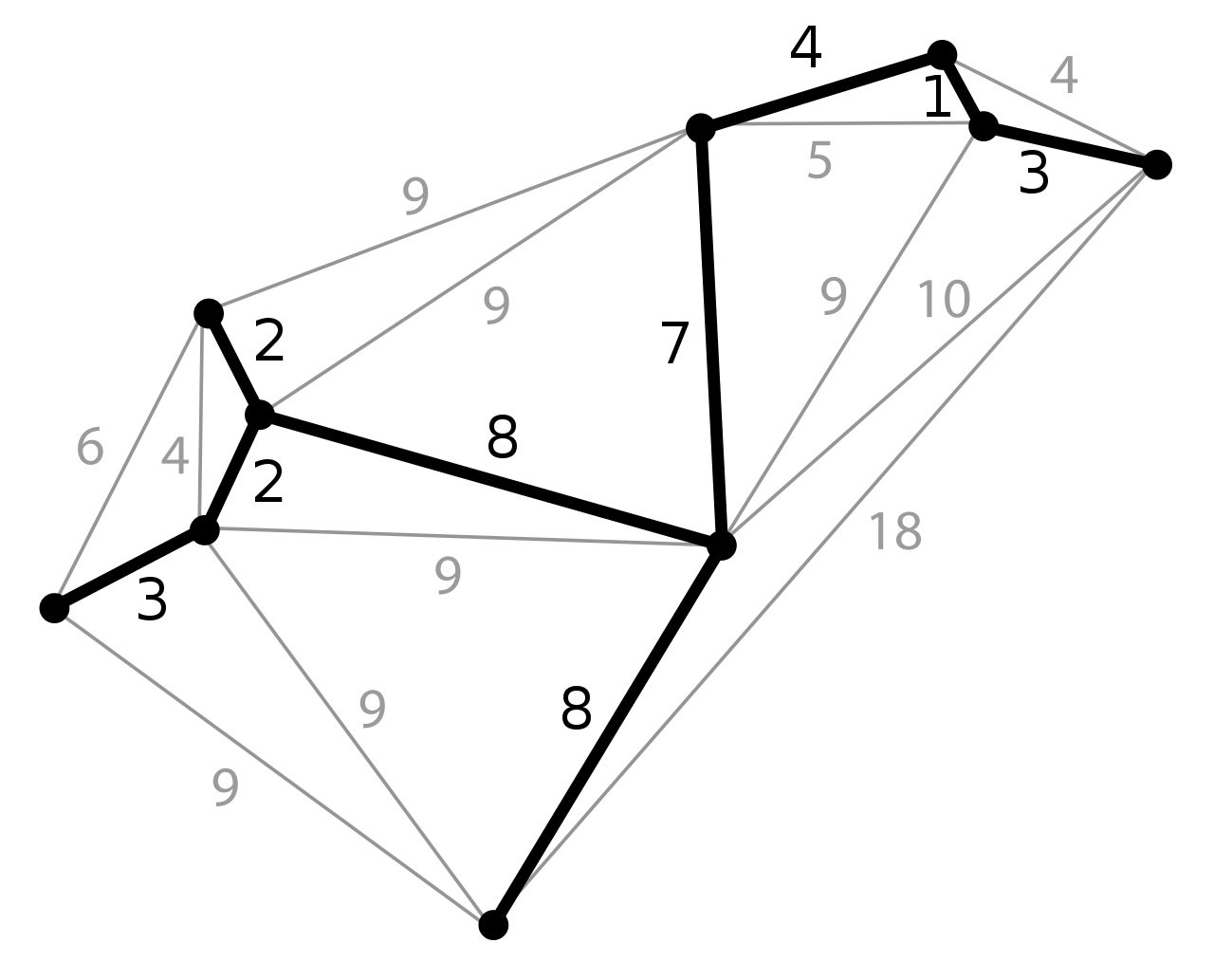
A minimum spanning tree (MST) is a fundamental concept in Graph Theory and Computer Science. It is a subset of the edges of a connected, edge-weighted undirected graph that connects all the vertices together, without any cycles and with the minimum possible total edge weight. The MST is a spanning tree whose sum of edge weights is as small as possible. This concept is crucial in various fields, including Network Design and Optimization Problems. For instance, the MST can be used to design a network of roads, pipelines, or electrical grids in a way that minimizes the total cost. The MST is also related to other graph theory concepts, such as Shortest Paths and Minimum Cuts.
📈 Definition and Properties
The definition of a minimum spanning tree is based on the concept of a Spanning Tree, which is a subgraph that connects all the vertices of a graph without any cycles. A minimum spanning tree is a spanning tree whose sum of edge weights is as small as possible. More generally, any edge-weighted undirected graph has a minimum spanning forest, which is a union of the minimum spanning trees for its connected components. The minimum spanning forest is a useful concept in Distributed Systems and Parallel Computing. The MST has several important properties, including the fact that it is a tree, and therefore has no cycles, and that it is a spanning tree, and therefore connects all the vertices of the graph.
🔍 Minimum Spanning Tree Algorithms
There are several algorithms for finding a minimum spanning tree, including Kruskal's Algorithm and Prim's Algorithm. These algorithms have different time and space complexities, and are suitable for different types of graphs and applications. For example, Kruskal's Algorithm is suitable for sparse graphs, while Prim's Algorithm is suitable for dense graphs. The choice of algorithm depends on the specific use case and the characteristics of the graph. The MST algorithms are also related to other graph algorithms, such as Dijkstra's Algorithm and Bellman-Ford Algorithm.
📊 Kruskal's Algorithm
Kruskal's Algorithm is a popular algorithm for finding a minimum spanning tree. It works by sorting the edges of the graph in non-decreasing order of their weights, and then selecting the smallest edge that does not form a cycle. This process is repeated until all the vertices are connected. Kruskal's Algorithm has a time complexity of O(E log E), where E is the number of edges in the graph. It is suitable for sparse graphs and is widely used in Network Optimization problems. The algorithm is also related to other graph theory concepts, such as Minimum Cuts and Maximum Flows.
📊 Prim's Algorithm
Prim's Algorithm is another popular algorithm for finding a minimum spanning tree. It works by selecting a random vertex and then growing the tree by adding the smallest edge that connects a new vertex to the existing tree. This process is repeated until all the vertices are connected. Prim's Algorithm has a time complexity of O(E + V log V), where E is the number of edges and V is the number of vertices in the graph. It is suitable for dense graphs and is widely used in Computer Networks and Distributed Systems. The algorithm is also related to other graph theory concepts, such as Shortest Paths and Minimum Cuts.
📈 Applications of Minimum Spanning Tree
The minimum spanning tree has several applications in real-world scenarios, including Network Design, Optimization Problems, and Computer Networks. For example, the MST can be used to design a network of roads, pipelines, or electrical grids in a way that minimizes the total cost. The MST is also used in Cluster Analysis and Data Mining to identify clusters and patterns in data. The MST is related to other graph theory concepts, such as Shortest Paths and Minimum Cuts.
🤔 Minimum Spanning Tree in Real-World Scenarios
In real-world scenarios, the minimum spanning tree is used to solve various problems, such as designing a network of roads, pipelines, or electrical grids. The MST is also used in Logistics and Supply Chain Management to optimize the transportation of goods and services. The MST is related to other graph theory concepts, such as Shortest Paths and Minimum Cuts. For instance, the MST can be used to find the shortest path between two cities, or to identify the minimum cut in a network. The MST is also used in Machine Learning and Artificial Intelligence to solve complex optimization problems.
📊 Comparison of Minimum Spanning Tree Algorithms
The minimum spanning tree algorithms have different time and space complexities, and are suitable for different types of graphs and applications. For example, Kruskal's Algorithm is suitable for sparse graphs, while Prim's Algorithm is suitable for dense graphs. The choice of algorithm depends on the specific use case and the characteristics of the graph. The MST algorithms are also related to other graph algorithms, such as Dijkstra's Algorithm and Bellman-Ford Algorithm.
📈 Time and Space Complexity
The time and space complexity of the minimum spanning tree algorithms are important considerations in real-world applications. For example, Kruskal's Algorithm has a time complexity of O(E log E), where E is the number of edges in the graph. Prim's Algorithm has a time complexity of O(E + V log V), where E is the number of edges and V is the number of vertices in the graph. The space complexity of the algorithms is also important, as it affects the memory requirements of the application. The MST algorithms are related to other graph theory concepts, such as Minimum Cuts and Maximum Flows.
📊 Minimum Spanning Tree in Graph Theory
The minimum spanning tree is a fundamental concept in Graph Theory and Computer Science. It is related to other graph theory concepts, such as Shortest Paths and Minimum Cuts. The MST is used in various fields, including Network Design, Optimization Problems, and Computer Networks. The MST is also related to other graph algorithms, such as Dijkstra's Algorithm and Bellman-Ford Algorithm.
📈 Minimum Spanning Forest
The minimum spanning forest is a union of the minimum spanning trees for the connected components of a graph. It is a useful concept in Distributed Systems and Parallel Computing. The minimum spanning forest is related to other graph theory concepts, such as Shortest Paths and Minimum Cuts. The MST is used in various fields, including Network Design, Optimization Problems, and Computer Networks.
📊 Conclusion
In conclusion, the minimum spanning tree is a fundamental concept in Graph Theory and Computer Science. It is used in various fields, including Network Design, Optimization Problems, and Computer Networks. The MST is related to other graph theory concepts, such as Shortest Paths and Minimum Cuts. The MST algorithms, such as Kruskal's Algorithm and Prim's Algorithm, have different time and space complexities, and are suitable for different types of graphs and applications.
Key Facts
- Year
- 1926
- Origin
- Otakar Boruvka
- Category
- Computer Science
- Type
- Algorithm
Frequently Asked Questions
What is a minimum spanning tree?
A minimum spanning tree is a subset of the edges of a connected, edge-weighted undirected graph that connects all the vertices together, without any cycles and with the minimum possible total edge weight. It is a spanning tree whose sum of edge weights is as small as possible.
What are the applications of minimum spanning tree?
The minimum spanning tree has several applications in real-world scenarios, including network design, optimization problems, and computer networks. It is used to design a network of roads, pipelines, or electrical grids in a way that minimizes the total cost.
What are the different algorithms for finding a minimum spanning tree?
There are several algorithms for finding a minimum spanning tree, including Kruskal's Algorithm and Prim's Algorithm. These algorithms have different time and space complexities, and are suitable for different types of graphs and applications.
What is the time complexity of Kruskal's Algorithm?
Kruskal's Algorithm has a time complexity of O(E log E), where E is the number of edges in the graph.
What is the time complexity of Prim's Algorithm?
Prim's Algorithm has a time complexity of O(E + V log V), where E is the number of edges and V is the number of vertices in the graph.
What is the minimum spanning forest?
The minimum spanning forest is a union of the minimum spanning trees for the connected components of a graph. It is a useful concept in distributed systems and parallel computing.
What are the related graph theory concepts to minimum spanning tree?
The minimum spanning tree is related to other graph theory concepts, such as shortest paths and minimum cuts. It is also related to other graph algorithms, such as Dijkstra's Algorithm and Bellman-Ford Algorithm.