
Contents
- 📈 Introduction to Locally Linear Embedding
- 🔍 Understanding Nonlinear Dimensionality Reduction
- 📊 Locally Linear Embedding Algorithm
- 👥 Key Players in Locally Linear Embedding
- 📚 Applications of Locally Linear Embedding
- 🤔 Challenges and Limitations of Locally Linear Embedding
- 📊 Comparison with Other Dimensionality Reduction Techniques
- 🔮 Future Directions in Locally Linear Embedding
- 📝 Real-World Examples of Locally Linear Embedding
- 📊 Locally Linear Embedding in Machine Learning Pipelines
- 📈 Best Practices for Implementing Locally Linear Embedding
- 📝 Conclusion and Future Prospects
- Frequently Asked Questions
- Related Topics
Overview
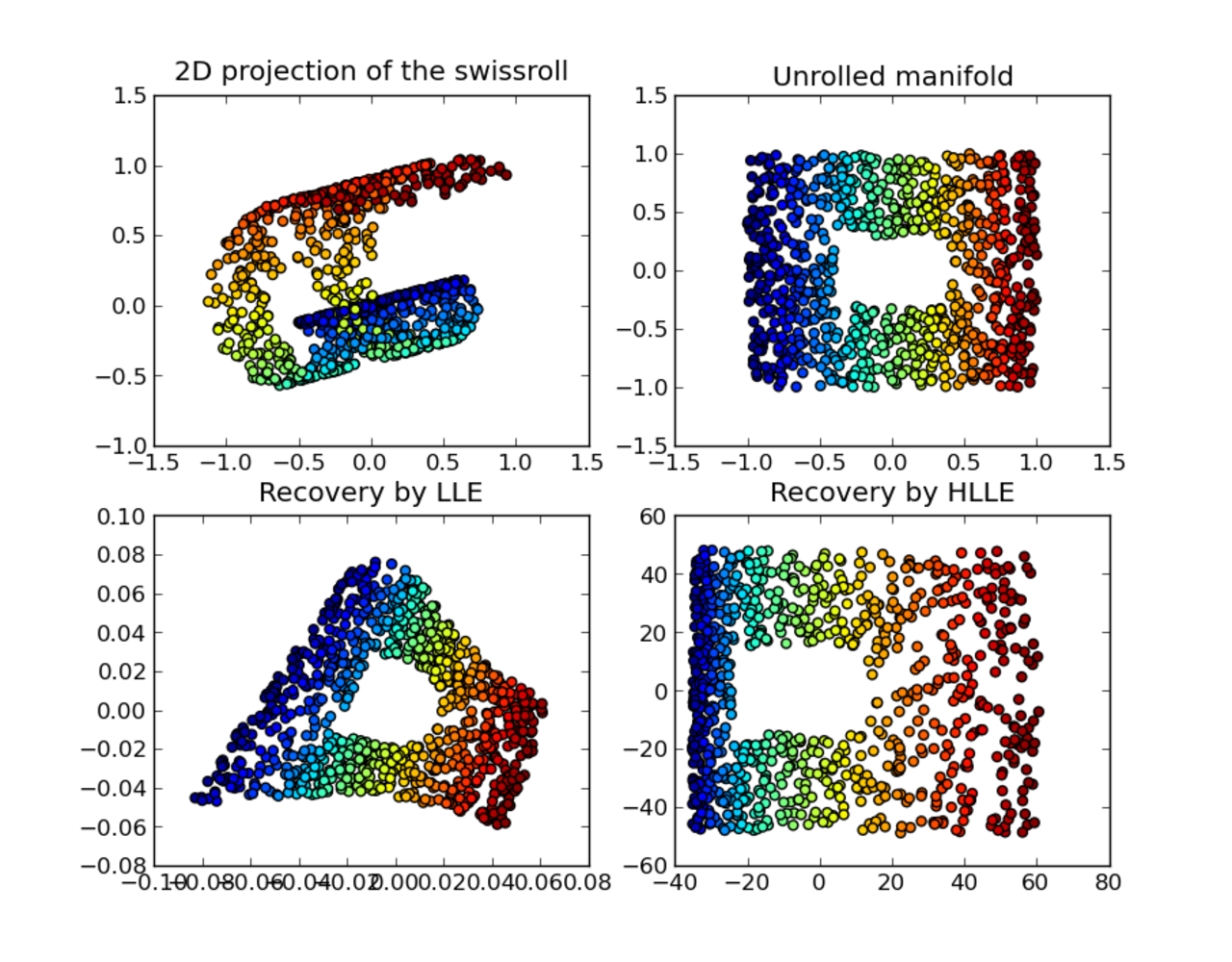
Locally Linear Embedding (LLE) is a dimensionality reduction technique used in machine learning to project high-dimensional data onto lower-dimensional latent manifolds. LLE is a type of nonlinear dimensionality reduction (NLDR) technique, also known as manifold learning. The goal of LLE is to preserve the local structure of the data in the high-dimensional space, while reducing the dimensionality. This is achieved by finding a set of weights that best reconstruct each data point from its neighbors, and then using these weights to compute the low-dimensional embedding. LLE has been widely used in data visualization and pattern recognition tasks, and has been shown to be effective in image processing and text analysis applications.
🔍 Understanding Nonlinear Dimensionality Reduction
Nonlinear dimensionality reduction (NLDR) techniques, such as LLE, aim to project high-dimensional data onto lower-dimensional latent manifolds, with the goal of either visualizing the data in the low-dimensional space, or learning the mapping itself. NLDR techniques can be understood as generalizations of linear decomposition methods used for dimensionality reduction, such as singular value decomposition and principal component analysis. LLE is a popular NLDR technique that has been widely used in various applications, including bioinformatics and recommendation systems. LLE is particularly useful when the data lies on a manifold with a complex structure, and the goal is to preserve the local geometry of the data.
📊 Locally Linear Embedding Algorithm
The LLE algorithm works by first computing the weights that best reconstruct each data point from its neighbors, and then using these weights to compute the low-dimensional embedding. The algorithm consists of three main steps: (1) computing the neighbors of each data point, (2) computing the weights that best reconstruct each data point from its neighbors, and (3) computing the low-dimensional embedding using the weights. The LLE algorithm is a non-convex optimization problem, and the solution is typically found using an iterative algorithm. LLE has been shown to be effective in clustering and classification tasks, and has been used in various applications, including image segmentation and natural language processing.
👥 Key Players in Locally Linear Embedding
The development of LLE is attributed to Sam T. Roweis and Lawrence K. Saul, who introduced the technique in 2000. Since then, LLE has been widely used in various applications, and has been extended to handle large-scale data and high-dimensional data. Other key players in the development of LLE include Joshua B. Tenenbaum and Vincent Silva, who have made significant contributions to the field of NLDR. LLE has also been influenced by other NLDR techniques, such as Isomap and Laplacian Eigenmaps.
📚 Applications of Locally Linear Embedding
LLE has been widely used in various applications, including data visualization, pattern recognition, and machine learning. LLE is particularly useful when the data lies on a manifold with a complex structure, and the goal is to preserve the local geometry of the data. LLE has been used in image processing and text analysis applications, and has been shown to be effective in clustering and classification tasks. LLE has also been used in bioinformatics and recommendation systems, and has been extended to handle large-scale data and high-dimensional data.
🤔 Challenges and Limitations of Locally Linear Embedding
Despite its effectiveness, LLE has several challenges and limitations. One of the main challenges is the choice of the number of neighbors, which can significantly affect the quality of the embedding. Another challenge is the computational cost of the algorithm, which can be high for large datasets. LLE is also sensitive to the presence of noise and outliers in the data, and can be affected by the curse of dimensionality. To address these challenges, various extensions and modifications of LLE have been proposed, including sparse locally linear embedding and robust locally linear embedding.
📊 Comparison with Other Dimensionality Reduction Techniques
LLE can be compared to other dimensionality reduction techniques, such as principal component analysis (PCA) and t-distributed stochastic neighbor embedding (t-SNE). While PCA is a linear technique that is effective for linearly separable data, LLE is a nonlinear technique that is effective for data that lies on a manifold with a complex structure. t-SNE is another nonlinear technique that is similar to LLE, but uses a different approach to compute the low-dimensional embedding. LLE has been shown to be effective in clustering and classification tasks, and has been used in various applications, including image processing and text analysis.
🔮 Future Directions in Locally Linear Embedding
The future of LLE is promising, with various extensions and modifications being proposed to address the challenges and limitations of the technique. One of the main directions of research is the development of scalable locally linear embedding algorithms that can handle large-scale data and high-dimensional data. Another direction of research is the development of robust locally linear embedding algorithms that can handle noise and outliers in the data. LLE has also been extended to handle multi-modal data, and has been used in various applications, including image segmentation and natural language processing.
📝 Real-World Examples of Locally Linear Embedding
LLE has been used in various real-world applications, including image processing, text analysis, and bioinformatics. For example, LLE has been used to segment images and to cluster text documents. LLE has also been used in recommendation systems to recommend products to users based on their past purchases. LLE has been shown to be effective in clustering and classification tasks, and has been used in various applications, including data visualization and pattern recognition.
📊 Locally Linear Embedding in Machine Learning Pipelines
LLE can be used in machine learning pipelines to reduce the dimensionality of the data and to improve the performance of the model. LLE can be used as a preprocessing step to reduce the dimensionality of the data, and then the reduced data can be used as input to a machine learning model. LLE can also be used as a feature extraction technique to extract relevant features from the data. LLE has been shown to be effective in clustering and classification tasks, and has been used in various applications, including image processing and text analysis.
📈 Best Practices for Implementing Locally Linear Embedding
To implement LLE effectively, it is important to choose the right parameters, such as the number of neighbors and the dimensionality of the embedding. It is also important to preprocess the data to handle noise and outliers. LLE can be computationally expensive, and therefore it is important to use efficient algorithms and data structures to implement the technique. LLE has been shown to be effective in clustering and classification tasks, and has been used in various applications, including data visualization and pattern recognition.
📝 Conclusion and Future Prospects
In conclusion, LLE is a powerful technique for dimensionality reduction and manifold learning. LLE has been widely used in various applications, including data visualization, pattern recognition, and machine learning. LLE has been shown to be effective in clustering and classification tasks, and has been used in various applications, including image processing and text analysis. The future of LLE is promising, with various extensions and modifications being proposed to address the challenges and limitations of the technique.
Key Facts
- Year
- 2000
- Origin
- Stanford University
- Category
- Machine Learning
- Type
- Algorithm
Frequently Asked Questions
What is Locally Linear Embedding (LLE)?
LLE is a dimensionality reduction technique used in machine learning to project high-dimensional data onto lower-dimensional latent manifolds. LLE is a type of nonlinear dimensionality reduction (NLDR) technique, also known as manifold learning. The goal of LLE is to preserve the local structure of the data in the high-dimensional space, while reducing the dimensionality.
How does LLE work?
The LLE algorithm works by first computing the weights that best reconstruct each data point from its neighbors, and then using these weights to compute the low-dimensional embedding. The algorithm consists of three main steps: (1) computing the neighbors of each data point, (2) computing the weights that best reconstruct each data point from its neighbors, and (3) computing the low-dimensional embedding using the weights.
What are the advantages of LLE?
LLE has several advantages, including its ability to preserve the local structure of the data, its effectiveness in clustering and classification tasks, and its ability to handle nonlinear relationships between the data. LLE is also a flexible technique that can be used in various applications, including data visualization, pattern recognition, and machine learning.
What are the challenges and limitations of LLE?
LLE has several challenges and limitations, including the choice of the number of neighbors, the computational cost of the algorithm, and the sensitivity to noise and outliers in the data. LLE is also a non-convex optimization problem, and the solution is typically found using an iterative algorithm.
How does LLE compare to other dimensionality reduction techniques?
LLE can be compared to other dimensionality reduction techniques, such as principal component analysis (PCA) and t-distributed stochastic neighbor embedding (t-SNE). While PCA is a linear technique that is effective for linearly separable data, LLE is a nonlinear technique that is effective for data that lies on a manifold with a complex structure. t-SNE is another nonlinear technique that is similar to LLE, but uses a different approach to compute the low-dimensional embedding.
What are the future directions of LLE?
The future of LLE is promising, with various extensions and modifications being proposed to address the challenges and limitations of the technique. One of the main directions of research is the development of scalable locally linear embedding algorithms that can handle large-scale data and high-dimensional data. Another direction of research is the development of robust locally linear embedding algorithms that can handle noise and outliers in the data.
What are the real-world applications of LLE?
LLE has been used in various real-world applications, including image processing, text analysis, and bioinformatics. For example, LLE has been used to segment images and to cluster text documents. LLE has also been used in recommendation systems to recommend products to users based on their past purchases.