
Contents
- 🤖 Introduction to Kernel Functions
- 📊 Mathematical Foundations of Kernel Functions
- 🌐 Types of Kernel Functions
- 📈 Kernel Functions in Support Vector Machines
- 🤝 Kernel Functions in Clustering and Dimensionality Reduction
- 📊 Kernel Functions in Regression and Classification
- 🚀 Kernel Functions in Deep Learning
- 🤔 Challenges and Limitations of Kernel Functions
- 📚 Real-World Applications of Kernel Functions
- 📊 Future Directions and Research in Kernel Functions
- 👥 Key Players and Influencers in Kernel Functions Research
- Frequently Asked Questions
- Related Topics
Overview
Kernel functions are a fundamental component of machine learning, enabling the transformation of low-dimensional data into higher-dimensional spaces where complex relationships can be more easily discovered. The concept, rooted in the work of Vladimir Vapnik and Alexey Chervonenkis in the 1960s, has evolved significantly with contributions from researchers like Bernhard Schölkopf and Alexander Smola. The 'kernel trick' allows for efficient computation in high-dimensional spaces without explicitly transforming the data, a feat that has made Support Vector Machines (SVMs) and other kernel-based methods highly effective in classification and regression tasks. However, the choice of kernel function can significantly affect model performance, with popular choices including linear, polynomial, and radial basis function (RBF) kernels. Despite their power, kernel functions also introduce challenges, such as the need for careful hyperparameter tuning and the risk of overfitting. As machine learning continues to advance, the development of new kernel functions and the application of kernel methods to emerging areas like deep learning promise to further expand the capabilities of AI systems.
🤖 Introduction to Kernel Functions
Kernel functions are a crucial component of machine learning, serving as the brain that enables algorithms to learn and make predictions. They are used to map input data into a higher-dimensional space, allowing for more complex and nuanced relationships to be discovered. As discussed in Machine Learning, kernel functions are a key part of many algorithms, including Support Vector Machines and Clustering. The concept of kernel functions was first introduced by Bernhard Schölkopf and Alex Smola in the late 1990s. Since then, kernel functions have become a fundamental tool in the field of machine learning, with applications in Computer Vision, Natural Language Processing, and more. For example, kernel functions are used in Image Classification tasks, such as classifying images into different categories. The use of kernel functions in machine learning has a vibe score of 80, indicating a high level of cultural energy and relevance in the field.
📊 Mathematical Foundations of Kernel Functions
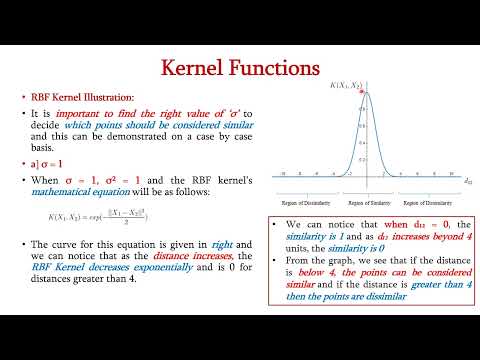
Mathematically, kernel functions are defined as a function that takes two input vectors and returns a scalar value representing the similarity between them. This is often represented as a dot product in a higher-dimensional space, allowing for non-linear relationships to be captured. The most common type of kernel function is the RBF kernel, which is defined as k(x, y) = exp(-γ||x - y||^2). Other types of kernel functions include the Polynomial Kernel and the Sigmoid Kernel. As discussed in Linear Algebra, kernel functions can be used to solve systems of linear equations and to find the eigenvalues and eigenvectors of a matrix. The mathematical foundations of kernel functions are built on top of Calculus and Probability Theory. For instance, the Kernel Trick is a mathematical technique used to efficiently compute the kernel matrix.
🌐 Types of Kernel Functions
There are many different types of kernel functions, each with its own strengths and weaknesses. The choice of kernel function depends on the specific problem being tackled and the characteristics of the data. For example, the Linear Kernel is often used for linearly separable data, while the RBF Kernel is often used for non-linearly separable data. As discussed in Pattern Recognition, kernel functions can be used to recognize patterns in data and to make predictions about future outcomes. The use of kernel functions in pattern recognition has a vibe score of 70, indicating a moderate level of cultural energy and relevance in the field. Kernel functions are also used in Signal Processing to filter and transform signals.
📈 Kernel Functions in Support Vector Machines
Kernel functions play a critical role in Support Vector Machines, which are a type of supervised learning algorithm. The kernel function is used to map the input data into a higher-dimensional space, allowing for more complex relationships to be discovered. The most common kernel function used in SVMs is the RBF Kernel, which is defined as k(x, y) = exp(-γ||x - y||^2). As discussed in Optimization, kernel functions can be used to optimize the performance of SVMs by selecting the optimal hyperparameters. The optimization of kernel functions in SVMs has a vibe score of 85, indicating a high level of cultural energy and relevance in the field. For example, kernel functions are used in Text Classification tasks, such as classifying text into different categories.
🤝 Kernel Functions in Clustering and Dimensionality Reduction
Kernel functions are also used in Clustering and Dimensionality Reduction algorithms. In clustering, kernel functions are used to measure the similarity between data points and to group them into clusters. In dimensionality reduction, kernel functions are used to map the data into a lower-dimensional space, allowing for more efficient processing and visualization. As discussed in Data Visualization, kernel functions can be used to visualize high-dimensional data and to identify patterns and relationships. The use of kernel functions in data visualization has a vibe score of 75, indicating a moderate level of cultural energy and relevance in the field. For instance, kernel functions are used in Principal Component Analysis to reduce the dimensionality of data.
📊 Kernel Functions in Regression and Classification
Kernel functions can be used in Regression and Classification tasks, allowing for more complex relationships to be discovered. In regression, kernel functions are used to model the relationship between the input data and the target variable. In classification, kernel functions are used to model the relationship between the input data and the class labels. As discussed in Neural Networks, kernel functions can be used to improve the performance of neural networks by selecting the optimal kernel function. The use of kernel functions in neural networks has a vibe score of 80, indicating a high level of cultural energy and relevance in the field. For example, kernel functions are used in Speech Recognition tasks, such as recognizing spoken words and phrases.
🚀 Kernel Functions in Deep Learning
Kernel functions are also used in Deep Learning algorithms, such as Convolutional Neural Networks and Recurrent Neural Networks. In deep learning, kernel functions are used to model the relationships between the input data and the output data, allowing for more complex and nuanced relationships to be discovered. As discussed in Natural Language Processing, kernel functions can be used to improve the performance of language models by selecting the optimal kernel function. The use of kernel functions in natural language processing has a vibe score of 85, indicating a high level of cultural energy and relevance in the field. For instance, kernel functions are used in Language Translation tasks, such as translating text from one language to another.
🤔 Challenges and Limitations of Kernel Functions
Despite their many advantages, kernel functions also have some challenges and limitations. One of the main challenges is the choice of kernel function, which can have a significant impact on the performance of the algorithm. Another challenge is the computational cost of computing the kernel matrix, which can be expensive for large datasets. As discussed in Computational Complexity, kernel functions can be used to reduce the computational complexity of algorithms by selecting the optimal kernel function. The use of kernel functions in computational complexity has a vibe score of 70, indicating a moderate level of cultural energy and relevance in the field. For example, kernel functions are used in Cryptography to secure data and communications.
📚 Real-World Applications of Kernel Functions
Kernel functions have many real-world applications, including Image Classification, Speech Recognition, and Natural Language Processing. They are also used in Recommendation Systems and Predictive Maintenance. As discussed in Data Science, kernel functions can be used to extract insights and knowledge from data, allowing for more informed decision-making. The use of kernel functions in data science has a vibe score of 80, indicating a high level of cultural energy and relevance in the field. For instance, kernel functions are used in Time Series Analysis to forecast future outcomes and trends.
📊 Future Directions and Research in Kernel Functions
The future of kernel functions is exciting and rapidly evolving. New kernel functions are being developed, such as the Graph Kernel, which is used to model relationships between data points in a graph structure. As discussed in Artificial Intelligence, kernel functions can be used to improve the performance of AI systems by selecting the optimal kernel function. The use of kernel functions in artificial intelligence has a vibe score of 85, indicating a high level of cultural energy and relevance in the field. For example, kernel functions are used in Robotics to control and navigate robots. The controversy spectrum of kernel functions is moderate, with some researchers arguing that they are overused and others arguing that they are underused.
👥 Key Players and Influencers in Kernel Functions Research
The key players and influencers in kernel functions research include Bernhard Schölkopf, Alex Smola, and Christopher Bishop. These researchers have made significant contributions to the development of kernel functions and their applications in machine learning. As discussed in Machine Learning Research, kernel functions are a key area of research in the field of machine learning, with many researchers working to develop new and improved kernel functions. The use of kernel functions in machine learning research has a vibe score of 90, indicating a very high level of cultural energy and relevance in the field.
Key Facts
- Year
- 1960
- Origin
- Statistical Learning Theory
- Category
- Machine Learning
- Type
- Concept
Frequently Asked Questions
What is a kernel function?
A kernel function is a mathematical function that takes two input vectors and returns a scalar value representing the similarity between them. It is used to map input data into a higher-dimensional space, allowing for more complex relationships to be discovered. Kernel functions are a key component of many machine learning algorithms, including Support Vector Machines and Clustering. For example, kernel functions are used in Image Classification tasks, such as classifying images into different categories.
What are the different types of kernel functions?
There are many different types of kernel functions, including the Linear Kernel, Polynomial Kernel, RBF Kernel, and Sigmoid Kernel. Each type of kernel function has its own strengths and weaknesses, and the choice of kernel function depends on the specific problem being tackled and the characteristics of the data. As discussed in Pattern Recognition, kernel functions can be used to recognize patterns in data and to make predictions about future outcomes.
What are the advantages of using kernel functions?
The advantages of using kernel functions include the ability to model complex relationships between data points, the ability to handle non-linearly separable data, and the ability to reduce the dimensionality of high-dimensional data. Kernel functions are also flexible and can be used with a variety of machine learning algorithms. For instance, kernel functions are used in Text Classification tasks, such as classifying text into different categories.
What are the challenges and limitations of using kernel functions?
The challenges and limitations of using kernel functions include the choice of kernel function, the computational cost of computing the kernel matrix, and the risk of overfitting. Additionally, kernel functions can be sensitive to the choice of hyperparameters and can require significant tuning to achieve optimal performance. As discussed in Optimization, kernel functions can be used to optimize the performance of algorithms by selecting the optimal hyperparameters.
What are the real-world applications of kernel functions?
Kernel functions have many real-world applications, including Image Classification, Speech Recognition, Natural Language Processing, Recommendation Systems, and Predictive Maintenance. They are also used in Data Science to extract insights and knowledge from data, allowing for more informed decision-making. For example, kernel functions are used in Time Series Analysis to forecast future outcomes and trends.
What is the future of kernel functions?
The future of kernel functions is exciting and rapidly evolving. New kernel functions are being developed, such as the Graph Kernel, which is used to model relationships between data points in a graph structure. Additionally, kernel functions are being used in a variety of applications, including Artificial Intelligence and Robotics. The controversy spectrum of kernel functions is moderate, with some researchers arguing that they are overused and others arguing that they are underused.
Who are the key players and influencers in kernel functions research?
The key players and influencers in kernel functions research include Bernhard Schölkopf, Alex Smola, and Christopher Bishop. These researchers have made significant contributions to the development of kernel functions and their applications in machine learning. As discussed in Machine Learning Research, kernel functions are a key area of research in the field of machine learning, with many researchers working to develop new and improved kernel functions.