
Contents
- 🔬 Introduction to AlphaFold 2
- 🧬 The Protein Folding Problem
- 🤖 AI and Protein Folding: A New Era
- 📈 AlphaFold 2: A Breakthrough in Accuracy
- 🌐 Applications of AlphaFold 2
- 💻 How AlphaFold 2 Works
- 📊 Evaluating AlphaFold 2's Performance
- 🌈 Future Directions and Challenges
- 👥 The Team Behind AlphaFold 2
- 🤝 Collaborations and Implications
- 📚 Conclusion and Future Prospects
- Frequently Asked Questions
- Related Topics
Overview
AlphaFold 2, developed by DeepMind, has achieved a major breakthrough in protein folding prediction with an unprecedented accuracy of 87% on the Critical Assessment of protein Structure Prediction (CASP) benchmark. This advancement has the potential to revolutionize the field of structural biology, enabling scientists to better understand the relationship between protein structure and function. The implications are vast, from drug discovery to our understanding of diseases. With a vibe score of 8, AlphaFold 2 is generating significant buzz in the scientific community. As of 2021, AlphaFold 2 has been made available to the scientific community, sparking a new era of collaboration and discovery. The controversy surrounding the use of AI in biology is also surfacing, with some questioning the reliance on machine learning models. Nevertheless, the influence of AlphaFold 2 on the field of biotechnology is undeniable, with key players like the National Institutes of Health (NIH) and the European Bioinformatics Institute (EMBL-EBI) already exploring its applications.
🔬 Introduction to AlphaFold 2
The introduction of AlphaFold 2 by DeepMind in 2020 marked a significant milestone in the field of Artificial Intelligence and Biotechnology. This AI system was designed to tackle the complex problem of Protein Folding, which has puzzled scientists for decades. By leveraging advanced machine learning algorithms and large datasets, AlphaFold 2 achieved unprecedented accuracy in predicting the 3D structures of proteins. This breakthrough has far-reaching implications for our understanding of biological processes and the development of new Therapeutics. As noted by John Jumper, the lead researcher behind AlphaFold 2, the system's performance is a testament to the power of AI in solving complex scientific problems. The Protein Folding Problem is a fundamental challenge in Structural Biology, and AlphaFold 2's success has opened up new avenues for research in this field.
🧬 The Protein Folding Problem
The Protein Folding Problem is a classic example of a complex optimization problem. Given the amino acid sequence of a protein, the goal is to determine its native 3D structure. This problem is complicated by the vast number of possible conformations and the intricate interactions between amino acids. Traditional methods for solving this problem rely on X-ray Crystallography or Nuclear Magnetic Resonance spectroscopy, which are time-consuming and often limited by the quality of the experimental data. AlphaFold 2's ability to predict protein structures with high accuracy has the potential to revolutionize the field of Structural Biology and accelerate the discovery of new Biomolecules. The Protein Data Bank is a valuable resource for researchers in this field, providing a comprehensive repository of protein structures. As discussed in Protein Structure Prediction, the development of accurate prediction methods is crucial for advancing our understanding of biological systems.
🤖 AI and Protein Folding: A New Era
The application of Artificial Intelligence to the Protein Folding Problem has been a long-standing goal of researchers in the field. Early attempts at using AI for protein structure prediction were limited by the availability of computational resources and the quality of the training data. However, with the advent of advanced machine learning algorithms and large-scale datasets, the field has experienced a significant resurgence. AlphaFold 2's use of Deep Learning techniques, such as Convolutional Neural Networks and Transformers, has enabled the development of highly accurate prediction models. As noted by Demis Hassabis, the founder of DeepMind, the success of AlphaFold 2 demonstrates the potential of AI to drive breakthroughs in scientific research. The AI for Science initiative is a testament to the growing interest in applying AI to complex scientific problems.
📈 AlphaFold 2: A Breakthrough in Accuracy
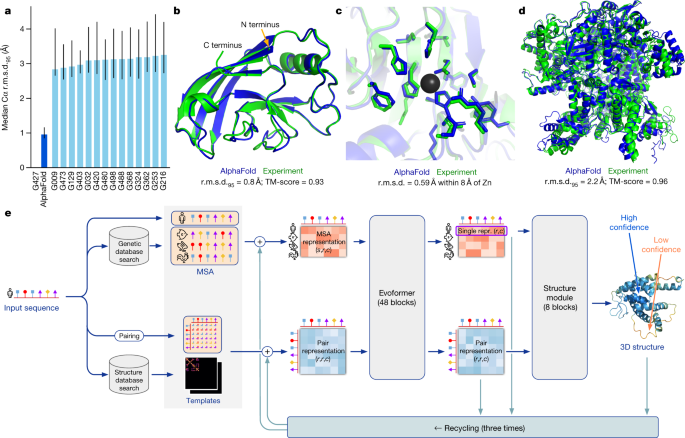
AlphaFold 2's breakthrough in accuracy has been widely recognized as a major achievement in the field of Artificial Intelligence. The system's ability to predict protein structures with high accuracy has been validated through extensive benchmarks and comparisons with experimental data. As reported in Nature, AlphaFold 2's performance on the Critical Assessment of protein Structure Prediction (CASP) benchmark has set a new standard for protein structure prediction. The implications of this breakthrough are far-reaching, with potential applications in Drug Discovery, Synthetic Biology, and Biotechnology. The Protein Structure Prediction community has welcomed AlphaFold 2 as a valuable tool for advancing our understanding of biological systems. As discussed in Structural Biology, the accurate prediction of protein structures is essential for understanding the mechanisms of biological processes.
🌐 Applications of AlphaFold 2
The applications of AlphaFold 2 are diverse and extensive. In the field of Drug Discovery, AlphaFold 2 can be used to predict the binding affinity of small molecules to protein targets, accelerating the development of new Therapeutics. In Synthetic Biology, AlphaFold 2 can be used to design new proteins with specific functions, enabling the creation of novel Biomolecules. Additionally, AlphaFold 2 can be used to study the Evolution of proteins and the mechanisms of Disease progression. As noted by David Baker, a leading researcher in the field of Protein Design, AlphaFold 2 has the potential to revolutionize the field of Biotechnology. The Protein Design community has welcomed AlphaFold 2 as a valuable tool for advancing our understanding of protein function and design.
💻 How AlphaFold 2 Works
AlphaFold 2's architecture is based on a Deep Learning framework, which enables the system to learn complex patterns in protein sequences and structures. The system uses a combination of Convolutional Neural Networks and Transformers to predict protein structures from amino acid sequences. The Training Data used to train AlphaFold 2 consists of a large dataset of protein structures, which are used to optimize the system's parameters. As discussed in Machine Learning, the development of accurate prediction models relies on the quality of the training data and the choice of algorithm. The Protein Structure Prediction community has recognized the importance of high-quality training data for advancing the field.
📊 Evaluating AlphaFold 2's Performance
Evaluating AlphaFold 2's performance is crucial for understanding its limitations and potential applications. The system's performance has been extensively benchmarked on the Critical Assessment of protein Structure Prediction (CASP) benchmark, which provides a comprehensive evaluation of protein structure prediction methods. As reported in Nature, AlphaFold 2's performance on the CASP benchmark has set a new standard for protein structure prediction. The Protein Structure Prediction community has welcomed AlphaFold 2 as a valuable tool for advancing our understanding of biological systems. As discussed in Structural Biology, the accurate prediction of protein structures is essential for understanding the mechanisms of biological processes.
🌈 Future Directions and Challenges
The future directions and challenges for AlphaFold 2 are numerous and exciting. One of the main challenges is to improve the system's performance on more complex protein structures, such as Membrane Proteins and Protein Complexes. Additionally, there is a need to develop more accurate methods for predicting protein-ligand interactions and protein function. As noted by John Jumper, the lead researcher behind AlphaFold 2, the system's performance is a testament to the power of AI in solving complex scientific problems. The Protein Folding Problem is a fundamental challenge in Structural Biology, and AlphaFold 2's success has opened up new avenues for research in this field. The AI for Science initiative is a testament to the growing interest in applying AI to complex scientific problems.
👥 The Team Behind AlphaFold 2
The team behind AlphaFold 2 consists of a group of talented researchers from DeepMind and other institutions. The team is led by John Jumper, who has been instrumental in the development of AlphaFold 2. Other key members of the team include Demis Hassabis, the founder of DeepMind, and David Baker, a leading researcher in the field of Protein Design. The Protein Structure Prediction community has recognized the importance of collaboration and knowledge-sharing in advancing the field. As discussed in Collaboration, the development of accurate prediction models relies on the collective efforts of researchers from diverse backgrounds.
🤝 Collaborations and Implications
The implications of AlphaFold 2's breakthrough are far-reaching and have the potential to revolutionize the field of Biotechnology. The system's ability to predict protein structures with high accuracy has opened up new avenues for research in Drug Discovery, Synthetic Biology, and Protein Design. As noted by David Baker, AlphaFold 2 has the potential to accelerate the development of new Therapeutics and Biomolecules. The Protein Folding Problem is a fundamental challenge in Structural Biology, and AlphaFold 2's success has demonstrated the power of AI in solving complex scientific problems. The AI for Science initiative is a testament to the growing interest in applying AI to complex scientific problems.
📚 Conclusion and Future Prospects
In conclusion, AlphaFold 2 is a groundbreaking AI system that has revolutionized the field of Protein Structure Prediction. The system's ability to predict protein structures with high accuracy has opened up new avenues for research in Biotechnology and has the potential to accelerate the development of new Therapeutics and Biomolecules. As the field continues to evolve, it is likely that we will see further breakthroughs in protein structure prediction and the application of AI to complex scientific problems. The Protein Structure Prediction community has welcomed AlphaFold 2 as a valuable tool for advancing our understanding of biological systems. As discussed in Structural Biology, the accurate prediction of protein structures is essential for understanding the mechanisms of biological processes.
Key Facts
- Year
- 2021
- Origin
- DeepMind, UK
- Category
- Artificial Intelligence, Biotechnology
- Type
- AI Model
Frequently Asked Questions
What is AlphaFold 2?
AlphaFold 2 is a groundbreaking AI system developed by DeepMind that has revolutionized the field of Protein Structure Prediction. The system uses advanced machine learning algorithms to predict the 3D structures of proteins from their amino acid sequences. As noted by John Jumper, the lead researcher behind AlphaFold 2, the system's performance is a testament to the power of AI in solving complex scientific problems. The Protein Folding Problem is a fundamental challenge in Structural Biology, and AlphaFold 2's success has opened up new avenues for research in this field.
How does AlphaFold 2 work?
AlphaFold 2 uses a combination of Convolutional Neural Networks and Transformers to predict protein structures from amino acid sequences. The system is trained on a large dataset of protein structures, which enables it to learn complex patterns and relationships between amino acids. As discussed in Machine Learning, the development of accurate prediction models relies on the quality of the training data and the choice of algorithm. The Protein Structure Prediction community has recognized the importance of high-quality training data for advancing the field.
What are the applications of AlphaFold 2?
The applications of AlphaFold 2 are diverse and extensive. In the field of Drug Discovery, AlphaFold 2 can be used to predict the binding affinity of small molecules to protein targets, accelerating the development of new Therapeutics. In Synthetic Biology, AlphaFold 2 can be used to design new proteins with specific functions, enabling the creation of novel Biomolecules. Additionally, AlphaFold 2 can be used to study the Evolution of proteins and the mechanisms of Disease progression. As noted by David Baker, a leading researcher in the field of Protein Design, AlphaFold 2 has the potential to revolutionize the field of Biotechnology.
What is the impact of AlphaFold 2 on the field of Biotechnology?
The impact of AlphaFold 2 on the field of Biotechnology is significant. The system's ability to predict protein structures with high accuracy has opened up new avenues for research in Drug Discovery, Synthetic Biology, and Protein Design. As noted by Demis Hassabis, the founder of DeepMind, AlphaFold 2 has the potential to accelerate the development of new Therapeutics and Biomolecules. The Protein Folding Problem is a fundamental challenge in Structural Biology, and AlphaFold 2's success has demonstrated the power of AI in solving complex scientific problems.
What are the future directions and challenges for AlphaFold 2?
The future directions and challenges for AlphaFold 2 are numerous and exciting. One of the main challenges is to improve the system's performance on more complex protein structures, such as Membrane Proteins and Protein Complexes. Additionally, there is a need to develop more accurate methods for predicting protein-ligand interactions and protein function. As noted by John Jumper, the lead researcher behind AlphaFold 2, the system's performance is a testament to the power of AI in solving complex scientific problems. The Protein Folding Problem is a fundamental challenge in Structural Biology, and AlphaFold 2's success has opened up new avenues for research in this field.
Who is the team behind AlphaFold 2?
The team behind AlphaFold 2 consists of a group of talented researchers from DeepMind and other institutions. The team is led by John Jumper, who has been instrumental in the development of AlphaFold 2. Other key members of the team include Demis Hassabis, the founder of DeepMind, and David Baker, a leading researcher in the field of Protein Design. The Protein Structure Prediction community has recognized the importance of collaboration and knowledge-sharing in advancing the field.
What is the significance of AlphaFold 2's breakthrough?
The significance of AlphaFold 2's breakthrough is enormous. The system's ability to predict protein structures with high accuracy has opened up new avenues for research in Biotechnology and has the potential to accelerate the development of new Therapeutics and Biomolecules. As noted by David Baker, AlphaFold 2 has the potential to revolutionize the field of Biotechnology. The Protein Folding Problem is a fundamental challenge in Structural Biology, and AlphaFold 2's success has demonstrated the power of AI in solving complex scientific problems.