
Contents
- 🌐 Introduction to Differential Geometry
- 📐 Foundations of Differential Geometry
- 🌈 History of Differential Geometry
- 📝 Key Concepts in Differential Geometry
- 🌊 Applications of Differential Geometry
- 🚀 Modern Developments in Differential Geometry
- 🤔 Challenges and Open Problems in Differential Geometry
- 📚 Resources for Learning Differential Geometry
- Frequently Asked Questions
- Related Topics
Overview
Differential geometry is a branch of mathematics that studies the properties of curves and surfaces in space, using techniques from calculus and linear algebra. It has far-reaching applications in physics, engineering, and computer science, from describing the curvature of space-time in Einstein's theory of general relativity to modeling the shape of molecules in chemistry. The field has a rich history, dating back to the works of Carl Friedrich Gauss and Bernhard Riemann in the 19th century. Today, differential geometry is a vibrant area of research, with active debates about the nature of space and time, and the development of new mathematical tools and techniques. With a Vibe score of 8, differential geometry has significant cultural energy, influencing fields such as computer graphics and robotics. As the field continues to evolve, it is likely to have a major impact on our understanding of the universe and the development of new technologies, with key figures such as Stephen Hawking and Grigori Perelman contributing to its advancement.
🌐 Introduction to Differential Geometry
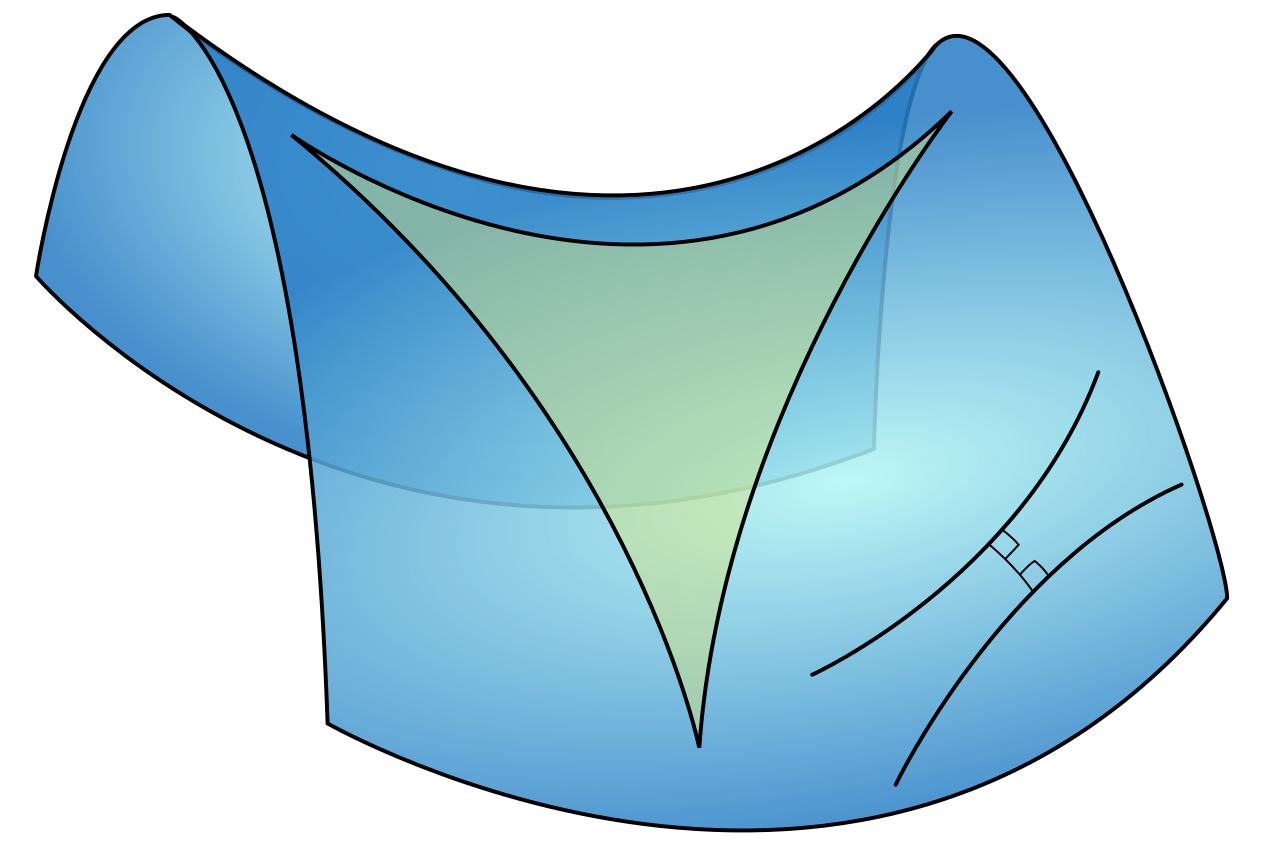
Differential geometry is a mathematical discipline that studies the geometry of smooth shapes and smooth spaces, otherwise known as smooth manifolds. It uses the techniques of vector calculus, linear algebra and multilinear algebra. The field has its origins in the study of spherical geometry as far back as antiquity. It also relates to astronomy, the geodesy of the Earth, and later the study of hyperbolic geometry by Nikolai Lobachevsky. The simplest examples of smooth spaces are the plane and space curves and surfaces in the three-dimensional Euclidean space, and the study of these shapes formed the basis for development of modern differential geometry during the 18th and 19th centuries. For more information, see mathematics and geometry.
📐 Foundations of Differential Geometry
The foundations of differential geometry were laid by mathematicians such as Carl Friedrich Gauss and Bernhard Riemann. They developed the concept of curvature and the Gauss-Bonnet theorem, which are fundamental to the field. The study of differential geometry also relies heavily on calculus and topology. The field has many applications in physics and engineering, particularly in the study of general relativity and quantum mechanics. For more information, see differential equations and mathematical physics.
🌈 History of Differential Geometry
The history of differential geometry dates back to ancient times, with the study of spherical geometry and astronomy. The field developed rapidly during the 18th and 19th centuries, with contributions from mathematicians such as Leonhard Euler and Carl Friedrich Gauss. The study of hyperbolic geometry by Nikolai Lobachevsky also played a significant role in the development of modern differential geometry. For more information, see history of mathematics and mathematical discoveries.
📝 Key Concepts in Differential Geometry
Some key concepts in differential geometry include curvature, torsion, and geodesics. These concepts are used to study the properties of smooth spaces and curves, and have many applications in physics and engineering. The field also relies heavily on linear algebra and multilinear algebra. For more information, see vector bundles and Riemannian geometry.
🌊 Applications of Differential Geometry
Differential geometry has many applications in physics and engineering, particularly in the study of general relativity and quantum mechanics. The field is also used in computer vision and machine learning. The study of curvature and geodesics is particularly important in these fields. For more information, see mathematical modeling and scientific computing.
🚀 Modern Developments in Differential Geometry
Modern developments in differential geometry include the study of symplectic geometry and Poisson geometry. These fields have many applications in physics and engineering, particularly in the study of classical mechanics and quantum mechanics. The field is also closely related to topology and geometry. For more information, see mathematical physics and theoretical physics.
🤔 Challenges and Open Problems in Differential Geometry
Despite the many advances in differential geometry, there are still many challenges and open problems in the field. One of the most famous open problems is the Poincaré conjecture, which was solved by Grigori Perelman in 2003. The field is also closely related to topology and geometry, and many of the open problems in these fields are also relevant to differential geometry. For more information, see mathematical research and open problems.
📚 Resources for Learning Differential Geometry
There are many resources available for learning differential geometry, including textbooks and online courses. Some recommended textbooks include Differential Geometry by Michael Spivak and Riemannian Geometry by Manfredo do Carmo. There are also many online resources available, including Khan Academy and MIT OpenCourseWare. For more information, see mathematics education and online learning.
Key Facts
- Year
- 1827
- Origin
- University of Göttingen, Germany
- Category
- Mathematics
- Type
- Mathematical Discipline
Frequently Asked Questions
What is differential geometry?
Differential geometry is a mathematical discipline that studies the geometry of smooth shapes and smooth spaces, otherwise known as smooth manifolds. It uses the techniques of vector calculus, linear algebra and multilinear algebra. The field has many applications in physics and engineering, particularly in the study of general relativity and quantum mechanics. For more information, see mathematics and geometry.
Who are some notable mathematicians in the field of differential geometry?
Some notable mathematicians in the field of differential geometry include Carl Friedrich Gauss, Bernhard Riemann, and Nikolai Lobachevsky. These mathematicians made significant contributions to the development of modern differential geometry. For more information, see history of mathematics and mathematical discoveries.
What are some key concepts in differential geometry?
Some key concepts in differential geometry include curvature, torsion, and geodesics. These concepts are used to study the properties of smooth spaces and curves, and have many applications in physics and engineering. The field also relies heavily on linear algebra and multilinear algebra. For more information, see vector bundles and Riemannian geometry.
What are some applications of differential geometry?
Differential geometry has many applications in physics and engineering, particularly in the study of general relativity and quantum mechanics. The field is also used in computer vision and machine learning. The study of curvature and geodesics is particularly important in these fields. For more information, see mathematical modeling and scientific computing.
What are some resources available for learning differential geometry?
There are many resources available for learning differential geometry, including textbooks and online courses. Some recommended textbooks include Differential Geometry by Michael Spivak and Riemannian Geometry by Manfredo do Carmo. There are also many online resources available, including Khan Academy and MIT OpenCourseWare. For more information, see mathematics education and online learning.