
Contents
- 📸 Introduction to Computed Tomography
- 🔍 History of Computed Tomography
- 🔬 How CT Scanners Work
- 📊 Tomographic Reconstruction Algorithms
- 👨💻 Role of Radiographers and Radiology Technologists
- 🤖 CT Scans and Metallic Implants
- 📈 Advantages of CT Scans over MRI
- 🚑 Emergency Applications of CT Scans
- 🔍 Future Developments in CT Technology
- 📊 Economic Impact of CT Scans
- 👥 Controversies and Debates Surrounding CT Scans
- 📝 Conclusion and Future Outlook
- Frequently Asked Questions
- Related Topics
Overview
Computed Tomography (CT) scans have been a cornerstone of medical imaging since their introduction in the 1970s by Sir Godfrey Hounsfield and Allan McLeod Cormack, who were awarded the Nobel Prize in Physiology or Medicine in 1979. With a vibe score of 8, CT scans have revolutionized the field of medicine, enabling doctors to non-invasively examine the internal structures of the body with unprecedented clarity. The first CT scanner, introduced in 1971, used a single beam of X-rays to produce a cross-sectional image of the body, with a resolution of 80x80 pixels. Today, modern CT scanners can produce images with a resolution of up to 1024x1024 pixels, using advanced technologies such as spiral CT and cone-beam CT. However, the high radiation doses associated with CT scans have sparked controversy, with some studies suggesting a link between CT scans and an increased risk of cancer, prompting the development of low-dose CT protocols and alternative imaging modalities. As the technology continues to evolve, with advancements in artificial intelligence and machine learning, CT scans are likely to remain a vital tool in medical diagnosis and treatment, with an estimated 300 million scans performed worldwide each year, generating a market size of over $8 billion.
📸 Introduction to Computed Tomography
Computed Tomography (CT) scans have revolutionized the field of medical imaging, providing detailed internal images of the body. This technique, formerly known as computed axial tomography, has become a crucial diagnostic tool in modern medicine. Medical Imaging techniques like CT scans have enabled doctors to non-invasively examine the internal structures of the body, leading to more accurate diagnoses and effective treatments. The development of CT scans is closely tied to the history of X-ray Technology, which has undergone significant advancements over the years. Today, CT scans are used in conjunction with other imaging modalities, such as MRI and Ultrasound, to provide a comprehensive understanding of the body's internal structures.
🔍 History of Computed Tomography
The history of Computed Tomography dates back to the 1960s, when the first CT scanner was developed by Godfrey Hounsfield and Allan McLeod Cormack. Their pioneering work led to the development of the first commercial CT scanner in 1971, which was capable of producing cross-sectional images of the body. Since then, CT technology has undergone rapid advancements, with improvements in Image Resolution, Scan Time, and Radiation Dose. The evolution of CT scanners has also been influenced by advances in Computer Technology and Algorithm Development.
🔬 How CT Scanners Work
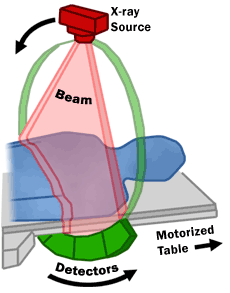
CT scanners use a rotating X-ray Tube and a row of detectors placed in a gantry to measure X-ray attenuations by different tissues inside the body. The multiple X-ray measurements taken from different angles are then processed on a computer using Tomographic Reconstruction Algorithms to produce tomographic (cross-sectional) images of a body. This process allows for the creation of detailed images of internal structures, including bones, organs, and blood vessels. The use of CT scans has become essential in various medical specialties, including Oncology, Neurology, and Cardiology.
📊 Tomographic Reconstruction Algorithms
Tomographic Reconstruction Algorithms play a crucial role in the production of high-quality CT images. These algorithms use mathematical techniques to reconstruct the internal structures of the body from the X-ray measurements. The development of advanced algorithms has enabled the creation of more detailed and accurate images, which has improved the diagnostic capabilities of CT scans. Artificial Intelligence and Machine Learning techniques are also being explored to further enhance the image reconstruction process. The use of these techniques has the potential to improve the accuracy and efficiency of CT scans, leading to better patient outcomes.
👨💻 Role of Radiographers and Radiology Technologists
Radiographers and radiology technologists are the personnel responsible for performing CT scans. These professionals undergo extensive training to operate CT scanners and ensure that patients receive the highest quality care. Their role involves preparing patients for the scan, operating the CT scanner, and ensuring that the images produced are of high quality. The importance of radiographers and radiology technologists cannot be overstated, as they play a critical role in the diagnostic process. Medical Imaging Technology has become an essential part of modern medicine, and the work of radiographers and radiology technologists is at the forefront of this field.
🤖 CT Scans and Metallic Implants
CT scans can be used in patients with metallic implants or pacemakers, for whom MRI is contraindicated. This is because CT scans use X-rays to produce images, whereas MRI uses strong magnetic fields, which can interact with metallic objects. The use of CT scans in these patients has become a vital diagnostic tool, allowing doctors to non-invasively examine internal structures without the risk of adverse reactions. However, the use of CT scans in patients with metallic implants requires careful consideration, as the presence of metal can affect the quality of the images produced. Image Artifacts can occur, which can lead to inaccurate diagnoses if not properly addressed.
📈 Advantages of CT Scans over MRI
CT scans have several advantages over MRI, including faster scan times and higher spatial resolution. CT scans can also be used to image a wider range of body parts, including the lungs, liver, and kidneys. Additionally, CT scans are often less expensive than MRI scans, making them a more accessible diagnostic tool for patients. However, MRI scans have their own advantages, including the ability to produce images of soft tissues and the absence of radiation exposure. The choice between CT scans and MRI scans ultimately depends on the specific diagnostic needs of the patient. Medical Imaging Modality selection is a critical decision that requires careful consideration of the patient's condition and the capabilities of each modality.
🚑 Emergency Applications of CT Scans
CT scans have become an essential tool in emergency medicine, allowing doctors to quickly and accurately diagnose a range of conditions, including strokes, head injuries, and internal bleeding. The speed and accuracy of CT scans have improved patient outcomes in emergency situations, where every minute counts. The use of CT scans in emergency medicine has also led to the development of new diagnostic protocols and treatment strategies. Emergency Medicine has become a critical area of application for CT scans, and their use has revolutionized the way doctors respond to emergency situations.
🔍 Future Developments in CT Technology
Future developments in CT technology are expected to focus on improving image resolution, reducing radiation dose, and increasing the speed of scan times. The use of Artificial Intelligence and Machine Learning techniques is also expected to play a major role in the development of new CT technologies. These advancements have the potential to further improve the diagnostic capabilities of CT scans, leading to better patient outcomes. The future of CT technology is exciting, with many potential applications and innovations on the horizon. Medical Imaging Innovation is an ongoing process, and CT scans are at the forefront of this field.
📊 Economic Impact of CT Scans
The economic impact of CT scans has been significant, with the global market for CT scanners expected to continue growing in the coming years. The cost of CT scans can be high, but the benefits of this diagnostic tool far outweigh the costs. CT scans have improved patient outcomes, reduced the need for invasive procedures, and enhanced the overall quality of care. The economic benefits of CT scans are not limited to the healthcare industry, as they have also had a positive impact on the economy as a whole. Healthcare Economics is a complex field, and the economic impact of CT scans is just one aspect of this larger issue.
👥 Controversies and Debates Surrounding CT Scans
Despite the many benefits of CT scans, there are also controversies and debates surrounding their use. One of the main concerns is the radiation exposure associated with CT scans, which can increase the risk of cancer. However, the benefits of CT scans in terms of diagnostic accuracy and patient outcomes often outweigh the risks. Another controversy surrounds the overuse of CT scans, which can lead to unnecessary radiation exposure and increased healthcare costs. Medical Imaging Controversy is an ongoing issue, and the use of CT scans is just one aspect of this larger debate.
📝 Conclusion and Future Outlook
In conclusion, Computed Tomography scans have revolutionized the field of medical imaging, providing detailed internal images of the body. The history of CT scans is closely tied to the development of X-ray technology, and the evolution of CT scanners has been influenced by advances in computer technology and algorithm development. The use of CT scans has become essential in various medical specialties, and their advantages over MRI scans make them a vital diagnostic tool. However, controversies and debates surrounding the use of CT scans must be addressed, and future developments in CT technology are expected to focus on improving image resolution, reducing radiation dose, and increasing the speed of scan times. The future of CT technology is exciting, and its impact on the field of medical imaging will continue to be felt for years to come.
Key Facts
- Year
- 1971
- Origin
- United Kingdom
- Category
- Medical Technology
- Type
- Medical Technology
Frequently Asked Questions
What is Computed Tomography?
Computed Tomography (CT) is a medical imaging technique used to obtain detailed internal images of the body. It uses a rotating X-ray tube and a row of detectors to measure X-ray attenuations by different tissues inside the body. The multiple X-ray measurements taken from different angles are then processed on a computer using tomographic reconstruction algorithms to produce tomographic (cross-sectional) images of a body. CT scans are used to diagnose a range of conditions, including strokes, head injuries, and internal bleeding. They are also used to guide biopsies and other minimally invasive procedures.
How do CT scans work?
CT scans use a rotating X-ray tube and a row of detectors placed in a gantry to measure X-ray attenuations by different tissues inside the body. The multiple X-ray measurements taken from different angles are then processed on a computer using tomographic reconstruction algorithms to produce tomographic (cross-sectional) images of a body. This process allows for the creation of detailed images of internal structures, including bones, organs, and blood vessels. The use of CT scans has become essential in various medical specialties, including oncology, neurology, and cardiology.
What are the advantages of CT scans over MRI?
CT scans have several advantages over MRI, including faster scan times and higher spatial resolution. CT scans can also be used to image a wider range of body parts, including the lungs, liver, and kidneys. Additionally, CT scans are often less expensive than MRI scans, making them a more accessible diagnostic tool for patients. However, MRI scans have their own advantages, including the ability to produce images of soft tissues and the absence of radiation exposure. The choice between CT scans and MRI scans ultimately depends on the specific diagnostic needs of the patient.
What are the risks associated with CT scans?
The main risk associated with CT scans is radiation exposure, which can increase the risk of cancer. However, the benefits of CT scans in terms of diagnostic accuracy and patient outcomes often outweigh the risks. Another risk is the overuse of CT scans, which can lead to unnecessary radiation exposure and increased healthcare costs. It is essential to carefully consider the need for a CT scan and to use the lowest possible radiation dose to minimize the risks.
What is the future of CT technology?
The future of CT technology is expected to focus on improving image resolution, reducing radiation dose, and increasing the speed of scan times. The use of artificial intelligence and machine learning techniques is also expected to play a major role in the development of new CT technologies. These advancements have the potential to further improve the diagnostic capabilities of CT scans, leading to better patient outcomes. The future of CT technology is exciting, with many potential applications and innovations on the horizon.
How do CT scans impact patient outcomes?
CT scans have improved patient outcomes by providing accurate and detailed images of internal structures. This has enabled doctors to diagnose and treat a range of conditions more effectively, leading to better patient outcomes. CT scans have also reduced the need for invasive procedures, which can be risky and have a longer recovery time. The use of CT scans has become essential in emergency medicine, where every minute counts, and has improved patient outcomes in critical situations.
What is the economic impact of CT scans?
The economic impact of CT scans has been significant, with the global market for CT scanners expected to continue growing in the coming years. The cost of CT scans can be high, but the benefits of this diagnostic tool far outweigh the costs. CT scans have improved patient outcomes, reduced the need for invasive procedures, and enhanced the overall quality of care. The economic benefits of CT scans are not limited to the healthcare industry, as they have also had a positive impact on the economy as a whole.