
Contents
- 🔍 Introduction to Ellipsometry
- 💡 Principles of Ellipsometry
- 📊 Measurement Techniques in Ellipsometry
- 🔬 Applications of Ellipsometry
- 📈 Data Analysis in Ellipsometry
- 🤔 Limitations and Challenges of Ellipsometry
- 📚 History of Ellipsometry
- 🔮 Future Developments in Ellipsometry
- 📊 Comparison with Other Techniques
- 📝 Conclusion
- Frequently Asked Questions
- Related Topics
Overview
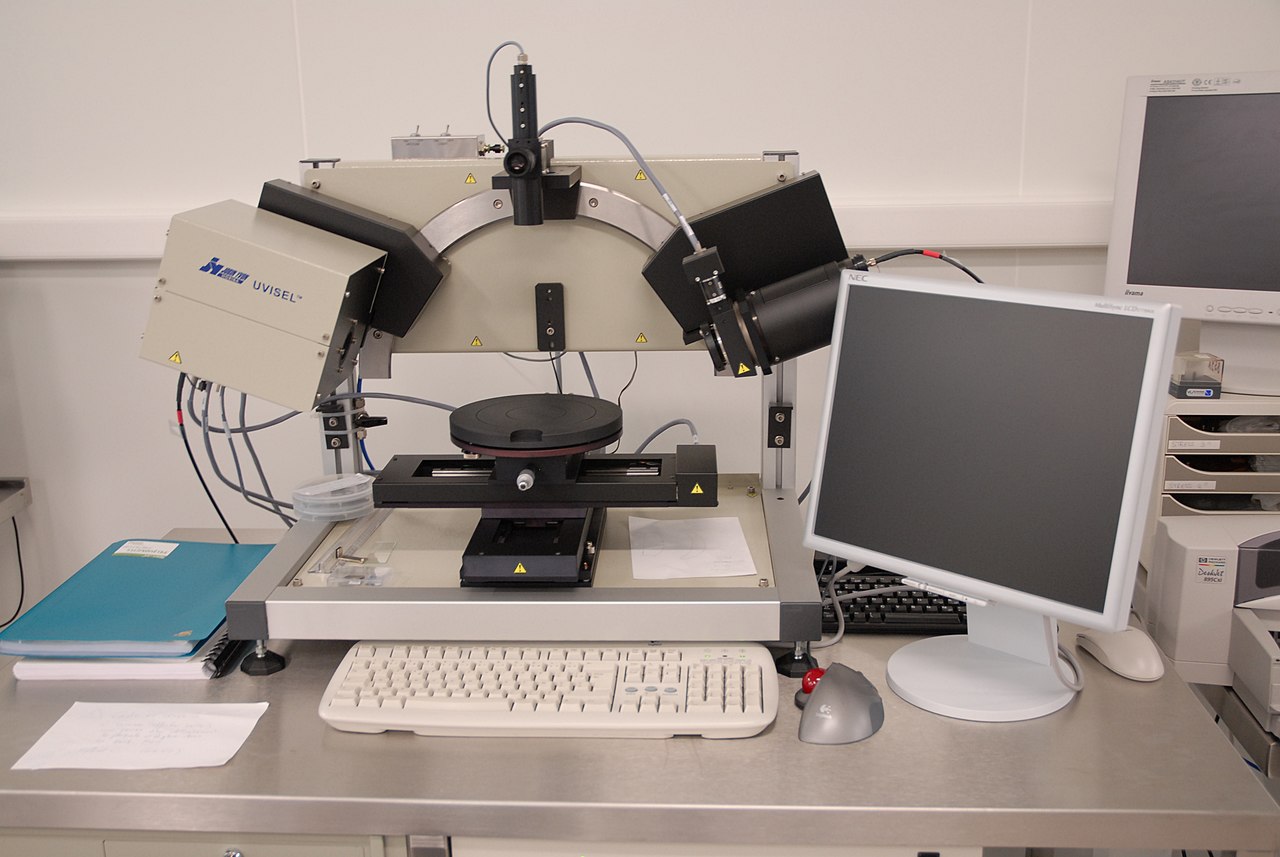
Ellipsometry is a non-destructive optical technique used to measure the thickness and optical properties of thin films, with applications in fields such as materials science, nanotechnology, and semiconductor manufacturing. Developed in the 1940s by scientists like Alexander Rothen, ellipsometry has evolved to become a crucial tool for characterizing material properties, with a Vibe score of 80 due to its significant impact on technological advancements. The technique works by analyzing the polarization state of light reflected from a sample, providing information on the film's thickness, refractive index, and absorption coefficient. With its high precision and versatility, ellipsometry has been employed in various research areas, including the study of graphene, solar cells, and biomaterials. As researchers continue to push the boundaries of this technique, ellipsometry is expected to play a vital role in the development of emerging technologies, such as quantum computing and nanoelectronics. With a controversy spectrum of 20, ellipsometry is a widely accepted technique, but its interpretation and application can be subject to debate, highlighting the need for continued research and refinement.
🔍 Introduction to Ellipsometry
Ellipsometry is a non-destructive optical technique used to investigate the dielectric properties of thin films. It measures the change in polarization of light upon reflection or transmission and compares it to a model, providing valuable information about the film's properties. This technique has been widely used in various fields, including materials science and nanotechnology. The history of ellipsometry dates back to the early 20th century, but it has undergone significant developments in recent years. Today, ellipsometry is an essential tool for characterizing the properties of thin films, which are used in a wide range of applications, from solar cells to semiconductor devices.
💡 Principles of Ellipsometry
The principles of ellipsometry are based on the measurement of the change in polarization of light upon reflection or transmission. This change is described by the Stokes parameters, which are used to calculate the ellipsometric parameters. These parameters provide information about the film's thickness, refractive index, and other optical properties. Ellipsometry can be used to study a wide range of materials, including metals, semiconductors, and dielectrics. The technique is particularly useful for characterizing the properties of nanostructured materials, which have unique optical properties. By using spectroscopic ellipsometry, researchers can study the optical properties of materials over a wide range of wavelengths.
📊 Measurement Techniques in Ellipsometry
There are several measurement techniques used in ellipsometry, including spectroscopic ellipsometry, imaging ellipsometry, and multi-angle ellipsometry. Each technique has its own advantages and limitations, and the choice of technique depends on the specific application and the properties of the material being studied. For example, spectroscopic ellipsometry is useful for studying the optical properties of materials over a wide range of wavelengths, while imaging ellipsometry is useful for studying the properties of materials with high spatial resolution. By using multi-angle ellipsometry, researchers can study the properties of materials at different angles of incidence, providing more detailed information about the material's properties.
🔬 Applications of Ellipsometry
Ellipsometry has a wide range of applications, including thin film deposition, surface characterization, and quality control. It is used in various industries, including semiconductor industry, solar industry, and biomedical industry. Ellipsometry is also used in research institutions to study the properties of nanostructured materials and meta-materials. By using ellipsometry, researchers can characterize the properties of thin films and nanostructured materials, which is essential for developing new technologies. For example, ellipsometry is used to study the properties of graphene and other 2D materials, which have unique optical and electrical properties.
📈 Data Analysis in Ellipsometry
Data analysis is a critical step in ellipsometry, as it involves the interpretation of the measured data to extract meaningful information about the material's properties. There are several data analysis techniques used in ellipsometry, including linear regression and non-linear regression. The choice of technique depends on the specific application and the properties of the material being studied. For example, linear regression is useful for analyzing data from spectroscopic ellipsometry, while non-linear regression is useful for analyzing data from imaging ellipsometry. By using machine learning algorithms, researchers can develop more accurate models for data analysis, which is essential for extracting meaningful information from the measured data.
🤔 Limitations and Challenges of Ellipsometry
Despite its many advantages, ellipsometry has some limitations and challenges. One of the main limitations is the need for a high degree of precision in the measurement of the polarization state of light. This requires the use of high-quality optical components and careful calibration of the instrument. Another challenge is the interpretation of the measured data, which can be complex and require specialized expertise. Additionally, ellipsometry is sensitive to the surface roughness and contamination of the sample, which can affect the accuracy of the measurements. To overcome these challenges, researchers use advanced data analysis techniques and machine learning algorithms to improve the accuracy and reliability of the measurements.
📚 History of Ellipsometry
The history of ellipsometry dates back to the early 20th century, when it was first used to study the properties of thin films. Since then, the technique has undergone significant developments, including the introduction of spectroscopic ellipsometry and imaging ellipsometry. Today, ellipsometry is a widely used technique in various fields, including materials science and nanotechnology. The development of ellipsometry has been driven by the need for a non-destructive technique for characterizing the properties of thin films and nanostructured materials. By studying the history of ellipsometry, researchers can gain a deeper understanding of the technique and its applications.
🔮 Future Developments in Ellipsometry
The future of ellipsometry is exciting, with ongoing developments in instrumentation and data analysis. One of the main areas of research is the development of high-speed ellipsometry, which can measure the properties of materials in real-time. Another area of research is the development of nano-ellipsometry, which can study the properties of materials at the nanoscale. By using machine learning algorithms and artificial intelligence, researchers can develop more accurate models for data analysis and improve the accuracy and reliability of the measurements. The future of ellipsometry holds much promise for advancing our understanding of the properties of thin films and nanostructured materials.
📊 Comparison with Other Techniques
Ellipsometry is often compared to other techniques, such as reflectometry and transmission spectroscopy. While these techniques can provide similar information, ellipsometry has several advantages, including its non-destructive nature and high sensitivity. Ellipsometry can also be used to study a wide range of materials, including metals, semiconductors, and dielectrics. By using combination techniques, researchers can study the properties of materials in more detail and gain a deeper understanding of their properties. For example, combination techniques can be used to study the properties of nanostructured materials and meta-materials.
📝 Conclusion
In conclusion, ellipsometry is a powerful technique for characterizing the properties of thin films and nanostructured materials. Its non-destructive nature, high sensitivity, and versatility make it an essential tool for researchers and industries. By understanding the principles, measurement techniques, and applications of ellipsometry, researchers can gain a deeper understanding of the properties of materials and develop new technologies. The future of ellipsometry holds much promise, with ongoing developments in instrumentation and data analysis. As researchers continue to develop new techniques and applications, ellipsometry will remain a vital tool for advancing our understanding of the properties of thin films and nanostructured materials.
Key Facts
- Year
- 1940
- Origin
- University of California, Berkeley
- Category
- Physics
- Type
- Scientific Technique
Frequently Asked Questions
What is ellipsometry?
Ellipsometry is a non-destructive optical technique used to investigate the dielectric properties of thin films. It measures the change in polarization of light upon reflection or transmission and compares it to a model, providing valuable information about the film's properties.
What are the applications of ellipsometry?
Ellipsometry has a wide range of applications, including thin film deposition, surface characterization, and quality control. It is used in various industries, including semiconductor industry, solar industry, and biomedical industry.
What are the limitations of ellipsometry?
Despite its many advantages, ellipsometry has some limitations and challenges. One of the main limitations is the need for a high degree of precision in the measurement of the polarization state of light. This requires the use of high-quality optical components and careful calibration of the instrument.
How does ellipsometry compare to other techniques?
Ellipsometry is often compared to other techniques, such as reflectometry and transmission spectroscopy. While these techniques can provide similar information, ellipsometry has several advantages, including its non-destructive nature and high sensitivity.
What is the future of ellipsometry?
The future of ellipsometry is exciting, with ongoing developments in instrumentation and data analysis. One of the main areas of research is the development of high-speed ellipsometry, which can measure the properties of materials in real-time.
What are the benefits of using ellipsometry?
The benefits of using ellipsometry include its non-destructive nature, high sensitivity, and versatility. It can be used to study a wide range of materials, including metals, semiconductors, and dielectrics. Ellipsometry is also a powerful tool for characterizing the properties of thin films and nanostructured materials.
How does ellipsometry work?
Ellipsometry works by measuring the change in polarization of light upon reflection or transmission and comparing it to a model. The technique uses the Stokes parameters to calculate the ellipsometric parameters, which provide information about the film's thickness, refractive index, and other optical properties.